
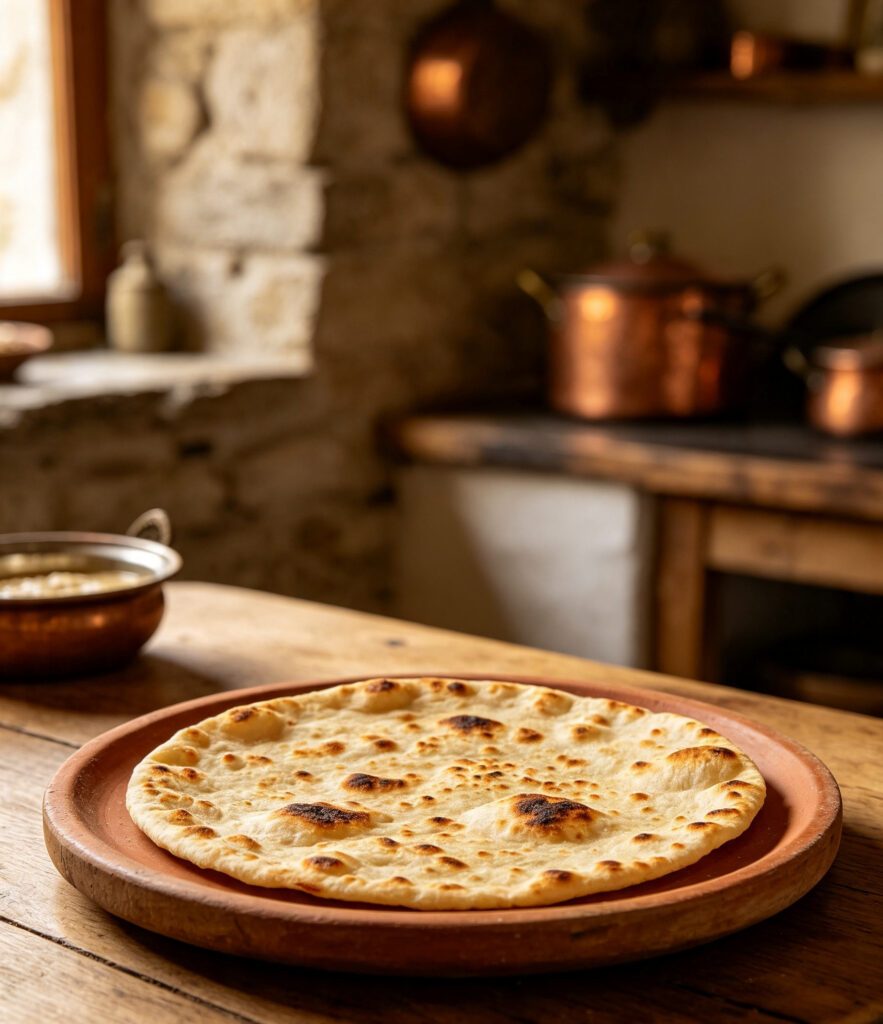
Yava Roti (Roasted Barley Flatbread)
The Quirky Foodster Team
Ingredients
- Barley flour — 250 g (2 cups)
- Warm water — 150-180 ml (0.6-0.75 cup)
- Rock salt — 1/4 tsp
- Ghee, melted, plus extra for serving — 1 tbsp
Method
- Combine the barley flour and salt in a mixing bowl.
- Gradually add the warm water, mixing and kneading until a smooth, firm dough forms that holds together without cracking.
- Knead in the melted ghee, then cover and rest the dough for 15-20 minutes.
- Divide the dough into 6-8 equal portions and roll each into a ball.
- On a lightly floured surface, roll each ball out into a thin, even round about 15 cm (6 in) across.
- Heat a dry griddle or heavy flat pan over medium-high heat.
- Cook each roti for 1-2 minutes on the first side, until small bubbles appear, then flip and cook for a further 1-2 minutes, pressing gently with a cloth or spatula to encourage even puffing, until lightly speckled brown on both sides.
- Serve warm, brushed with a little extra ghee if desired.
Introduction: A simple, unleavened flatbread made from barley flour and cooked on a hot griddle, yava roti reflects barley’s status as one of the earliest and most widely cultivated grains of the ancient Indian subcontinent.
Cultural Background: Yava, the Sanskrit word for barley, is one of the oldest attested grains in Indian agricultural and religious texts, valued in ritual contexts as well as everyday eating well before the Mauryan period and continuing through it. This simple flatbread, cooked directly on a hot griddle without leavening, represents the most fundamental way the region’s grains were transformed into an edible, portable form.
Tips: (cid:127) Barley flour dough can be slightly less elastic than wheat dough, so knead thoroughly and rest the dough fully before rolling to reduce cracking at the edges. (cid:127) Keep finished rotis wrapped in a clean cloth as you cook the remainder, to keep them soft.
Variations: (cid:127) A mix of barley and wheat flour can be used for a softer, more pliable roti, reflecting the mixed-grain agriculture common in the region. (cid:127) A pinch of ground cumin can be worked into the dough for a subtly spiced variation.
Storage: Store wrapped in a cloth or in an airtight container at room temperature for up to 1 day, or refrigerate for up to 3 days.
Reheating: Reheat briefly on a dry, hot griddle for 15-20 seconds per side, or wrap in a damp cloth and microwave briefly.
Nutrition: Per serving (approx., 1 roti): 130 kcal, 3 g protein, 24 g carbohydrate, 3 g fat, 4 g fibre, 60 mg sodium.
FAQs:
Q: Can I use only barley flour, or must I mix it with wheat?
A: Pure barley flour can be used, as described here, though it produces a slightly denser, less pliable bread than a wheat blend; both approaches are historically reasonable given the mixed grain agriculture of the period. (cid:127) Q: Why is barley significant in ancient Indian tradition? A: Barley is one of the earliest cultivated grains referenced in Indian religious and agricultural texts, playing a role in both everyday diet and certain ritual practices well before and during the Mauryan period.
- Barley flour — 250 g (2 cups)
- Warm water — 150-180 ml (0.6-0.75 cup)
- Rock salt — 1/4 tsp
- Ghee, melted, plus extra for serving — 1 tbsp
Please log in to leave a comment.