
Tingmo
The Quirky Foodster Team
Ingredients
- All-purpose flour (3 1/3 cups) — 400 g (14.1 oz)
- Warm water (1 cup) — 220 ml (1/4 cup)
- Active dry yeast — 1 tsp
- Sugar — 1 tbsp
- Vegetable oil — 1 tbsp
- Salt — 1/2 tsp
Method
- Dissolve the yeast and sugar in the warm water and let sit for 5 minutes until foamy.
- Combine the flour and salt in a bowl, then mix in the yeast mixture and oil to form a dough.
- Knead for 8–10 minutes until smooth and elastic. Cover and let rise for 1 hour, until doubled.
- Punch down the dough and roll into a rectangle, brushing lightly with oil.
- Roll the dough up into a log and slice into rounds.
- Rest the rounds for 15 minutes on parchment paper, then steam over boiling water for 15 minutes until
- Serve warm alongside stews or curries.
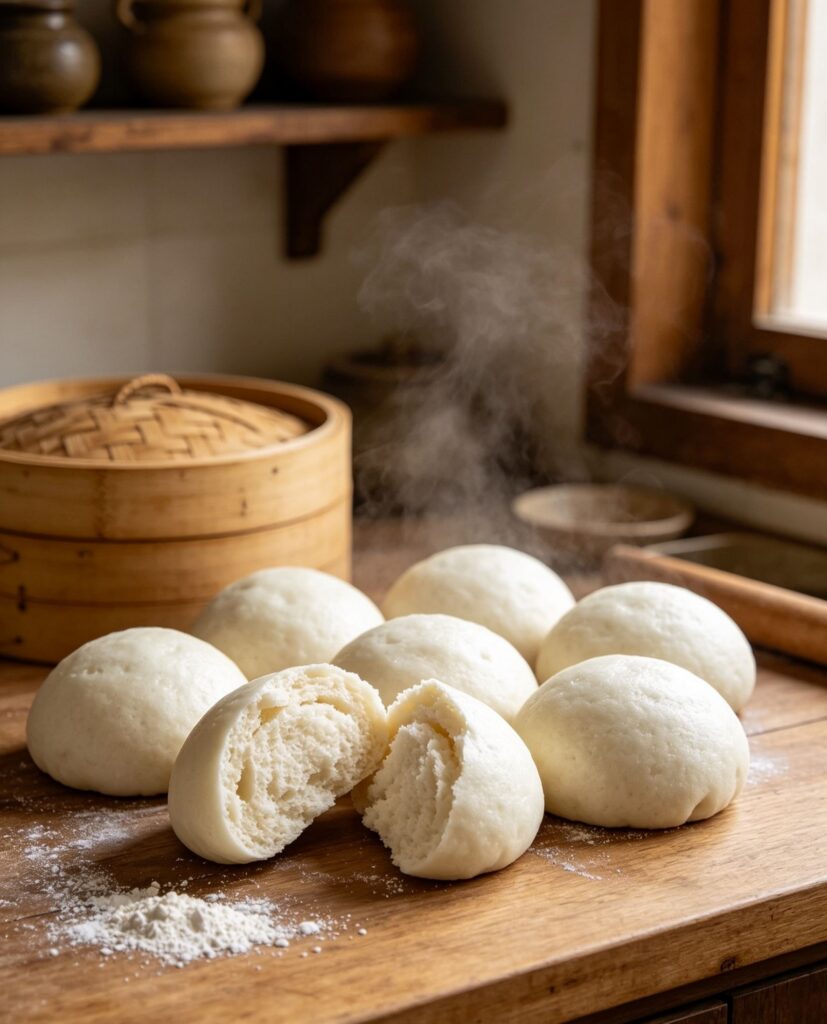
Introduction: Tingmo, a soft steamed bread, is shared across the Himalayan region through Bhutan’s close cultural and trade ties with Tibet.
Cultural Background: Tingmo, a soft steamed bread, is shared across the Himalayan region through Bhutan’s close cultural and trade ties with Tibet. Its pillowy texture makes it an ideal companion for soaking up rich, spicy sauces from dishes like Ema Datshi and Phaksha Paa, and it is commonly served alongside stews rather than eaten on its own.
Tips: Do not let the water run out while steaming; check partway through and top up if needed. Keep the steamer lid slightly ajar with a folded cloth underneath to stop condensation dripping onto the bread.
Variations: Roll thinner and coil into a spiral for a decorative flower-shaped Tingmo. Brush with a little sesame oil before rolling for extra flavour.
Vegetarian/Vegan: Naturally vegan.
Storage: Store cooled Tingmo in an airtight container or bag for up to 2 days at room temperature, or freeze for up to 1 month.
Reheating: Re-steam for 5 minutes until soft and warmed through.
FAQs:
Q: Why didn’t my Tingmo rise?
A: The yeast may be old or the water too hot; water should be warm, not hot, to activate the yeast.
Q: Can Tingmo be baked instead of steamed?
A: No, steaming is essential to its soft, moist texture; baking produces a different bread entirely.
- All-purpose flour (3 1/3 cups) — 400 g (14.1 oz)
- Warm water (1 cup) — 220 ml (1/4 cup)
- Active dry yeast — 1 tsp
- Sugar — 1 tbsp
- Vegetable oil — 1 tbsp
- Salt — 1/2 tsp
Please log in to leave a comment.