
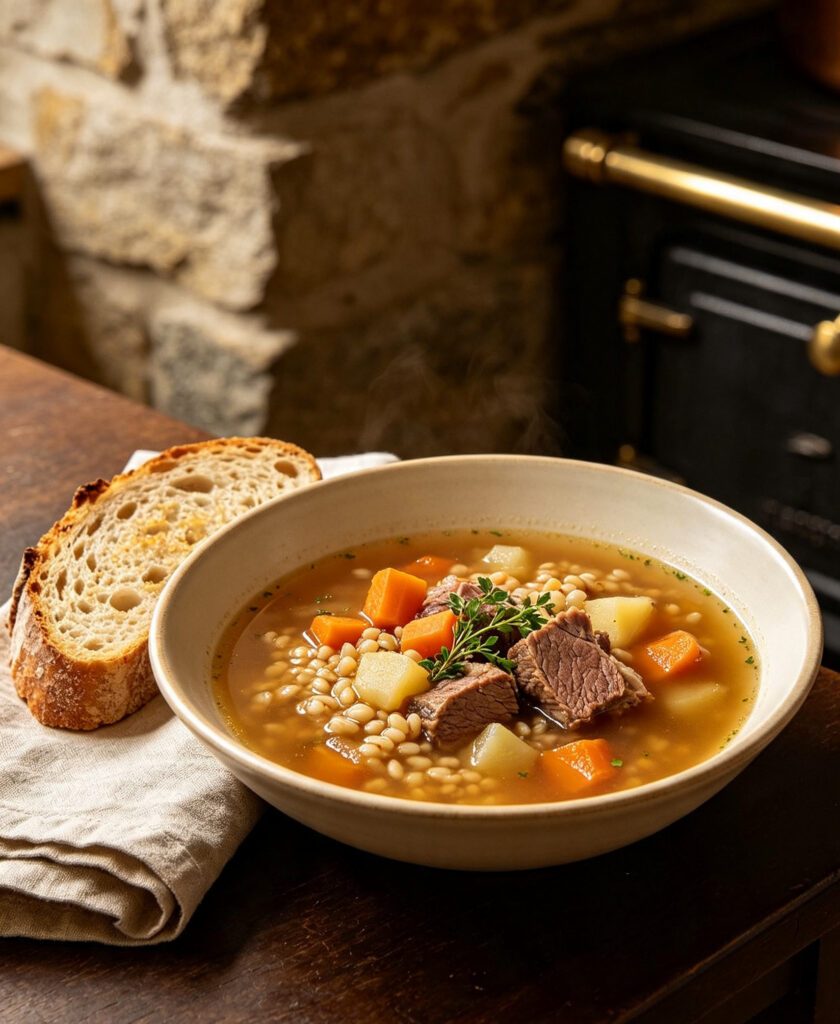
Scotch Broth (Scotch Broth)
The Quirky Foodster Team
Ingredients
- Lamb neck or shoulder, cubed — 500 g (1 lb 2 oz)
- Pearl barley — 100 g (1/2 cup)
- Onion, chopped — 1
- Carrots, diced — 2
- Turnip, diced — 1
- Leek, sliced — 1
- Water (1.9 litres / 64 fl oz) — 8 cups
- Salt and pepper — to taste
- Chopped parsley, to garnish
Method
- Place the lamb and water in a large pot and bring to a boil, skimming any foam.
- Add the barley and simmer for 45 minutes.
- Add the onion, carrot and turnip, and simmer for a further 30 minutes until the lamb and vegetables are tender.
- Add the leek and simmer for a final 10 minutes.
- Season with salt and pepper, and garnish with chopped parsley before serving hot.
Introduction: A hearty soup of barley, lamb and root vegetables, a substantial and warming Victorian lunch dish with deep Scottish roots.
Cultural Background: Scotch broth was embraced across Victorian Britain as a filling, economical soup, its combination of barley and lamb reflecting Scottish culinary tradition that had become well established in British households by the period.
Tips: Skim the broth periodically during the initial simmer for the cleanest flavour. Add the leek toward the end of cooking, as it needs less time than the heartier root vegetables.
Variations: Add a handful of split peas for extra heartiness, a common regional variation. Remove the lamb bones before serving and shred the meat back into the soup.
Storage: Refrigerate in an airtight container for up to 4 days.
Reheating: Reheat gently on the stovetop over medium heat until warmed through.
Nutrition: Per serving (approx.): 320 kcal, 20 g protein, 12 g fat, 34 g carbohydrate.
FAQs:
Q: Is Scotch broth exclusively Scottish?
A: While its roots are Scottish, the dish became widely adopted and beloved across Victorian Britain more broadly, appearing in many household cookbooks of the period.
Q: What cut of lamb works best?
A: Lamb neck or shoulder, being well suited to long, slow simmering, are traditional choices that become tender and flavourful in this hearty soup.
- Lamb neck or shoulder, cubed — 500 g (1 lb 2 oz)
- Pearl barley — 100 g (1/2 cup)
- Onion, chopped — 1
- Carrots, diced — 2
- Turnip, diced — 1
- Leek, sliced — 1
- Water (1.9 litres / 64 fl oz) — 8 cups
- Salt and pepper — to taste
- Chopped parsley, to garnish
Please log in to leave a comment.