
Breads
Roti Canai
The Quirky Foodster Team
Ingredients
- 400 g Plain flour (3¼ cups)
- 6 g Fine salt (1 tsp)
- 15 g Caster sugar (1 tbsp)
- 1 Large egg
- 200 ml Water, lukewarm (¾ cup plus 1 tbsp)
- 30 ml Ghee or melted butter, for the dough (2 tbsp)
- 150 ml Ghee or neutral oil, for laminating and frying (2/3 cup)
Method
- Whisk the flour, salt and sugar together in a large bowl.
- Add the egg, water and melted ghee, and mix to a soft, slightly sticky dough.
- Knead for 10 minutes until smooth and elastic. Divide into 8 equal balls.
- Coat each ball generously in ghee or oil, place on an oiled tray, cover, and rest for at least 2 hours at room temperature (or overnight in the fridge).
- On a well-oiled surface, stretch each ball by hand into a very thin, almost translucent sheet, working from the centre outward.
- Fold the edges of the sheet inward to form a square or rough rectangle, layering the dough on itself.
- Heat a flat griddle over medium heat with a little ghee. Fry the folded dough for 2–3 minutes per side until golden and crisp, pressing gently with a spatula to encourage even puffing.
- Once cooked, crush the roti gently between your palms to separate and fluff up the layers.
- Serve hot with curry or dhal for dipping.
Introduction: Roti canai, a flaky, pan-fried flatbread of Indian origin, arrived in Brunei via the historic spice trade and Indian communities who settled across Borneo, and it is now a breakfast and supper staple in nearly every Bruneian coffee shop.
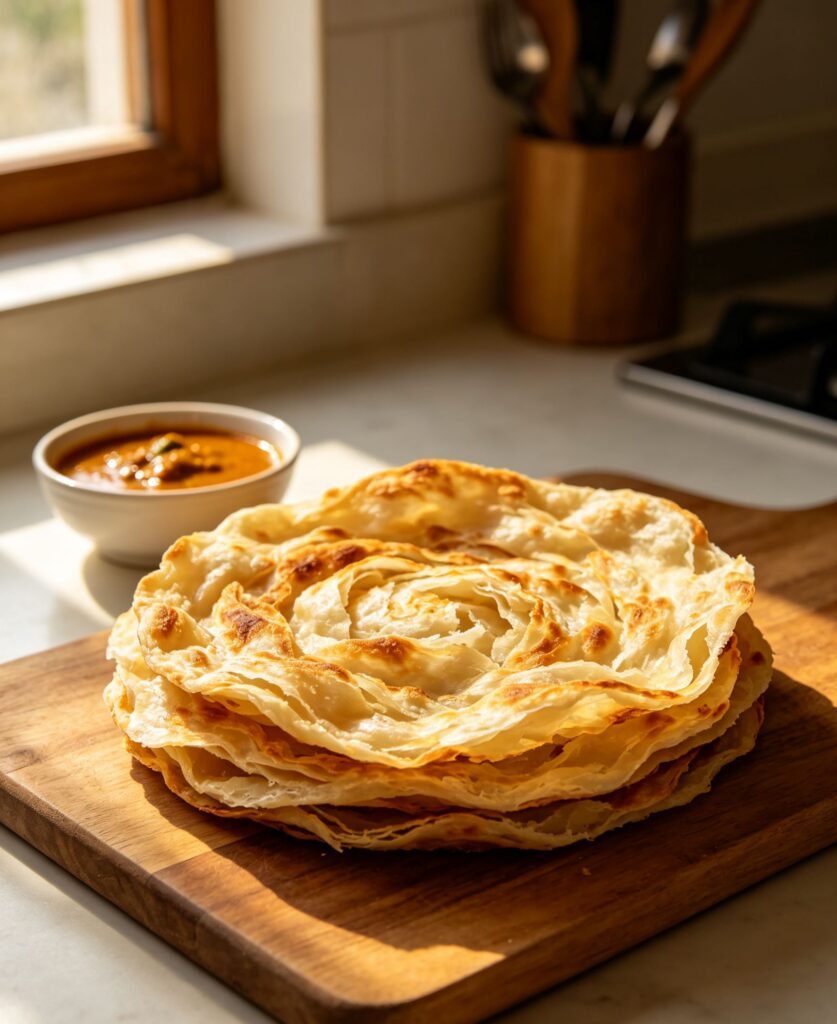
Cultural Background: Roti canai, a flaky, pan-fried flatbread of Indian origin, arrived in Brunei via the historic spice trade and Indian communities who settled across Borneo, and it is now a breakfast and supper staple in nearly every Bruneian coffee shop. The dough is stretched paper-thin by hand, folded repeatedly to create dozens of buttery layers, then pan-fried until crisp outside and soft within, usually served with a small bowl of curry for dipping.
Tips: The long resting time is essential — it relaxes the gluten so the dough can be stretched paper-thin without tearing. Use plenty of oil on both hands and the work surface when stretching to prevent sticking and tearing. Crushing the cooked roti between your palms right after frying helps separate the layers for the classic flaky texture.
Variations: Add a beaten egg on top of the dough before folding, for roti telur. Fill with sliced banana and a dusting of sugar for a sweet dessert-style roti. Serve alongside a fish or chicken curry for a full coffee-shop breakfast. Naturally vegetarian; use plant-based margarine instead of ghee for a vegan version.
Storage: Store cooked roti in an airtight container in the refrigerator for up to 2 days.
Reheating: Reheat in a dry pan over medium heat for 1–2 minutes per side to re-crisp; avoid microwaving, which makes it chewy rather than flaky.
Nutrition: Per roti: approx. 280 kcal, 6g protein, 32g carbohydrate, 14g fat.
FAQs:
Q: Can I make the dough ahead of time?
A: Yes — rested dough balls keep well covered in the refrigerator for up to 24 hours; bring to room temperature before stretching.
Q: Why does my roti tear when I stretch it?
A: The dough likely needs a longer rest; under-rested dough is too elastic and will resist stretching thin.
Q: What is roti canai traditionally served with?
A: It’s most commonly served with a simple dhal or a light chicken or fish curry for dipping.
Please log in to leave a comment.