
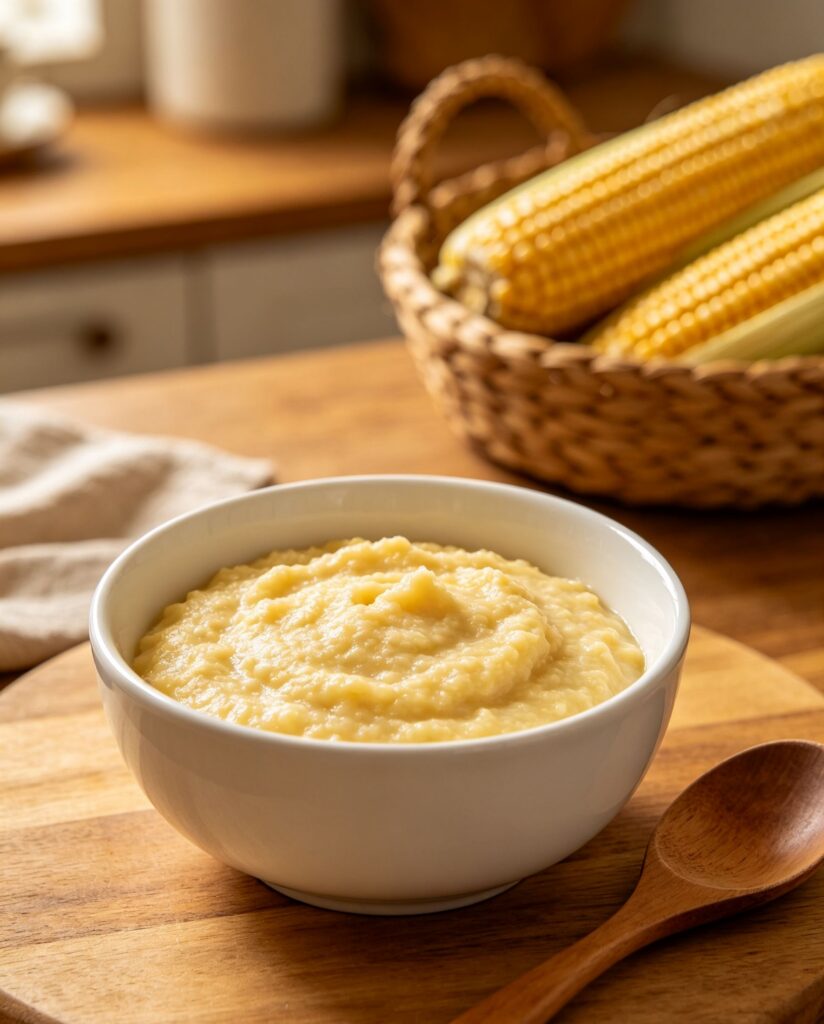
Phaletshe
The Quirky Foodster Team
Ingredients
- White maize meal — 400 g (2 2/3 cups)
- Water — 1 L (4 cups)
- Salt — 5 ml (1 tsp)
Method
- Bring the water to the boil in a heavy-based saucepan with the salt.
- Sprinkle in about a third of the maize meal, whisking to avoid lumps, and let it simmer for 5 minutes to form a loose porridge base.
- Gradually add the remaining maize meal, a little at a time, stirring vigorously with the wooden spoon between additions.
- Continue cooking over low heat, stirring often and turning the porridge over on itself, for 20-25 minutes until very thick, smooth and pulling away from the sides of the pot.
- Turn out onto a plate or into a serving bowl, shaping into a smooth dome with the back of the spoon.
- Serve hot alongside a main dish such as seswaa or serobe.
Introduction: Phaletshe is the firm, stiff maize porridge that forms the starchy backbone of most Setswana meals, similar to pap found elsewhere in Southern Africa.
Cultural Background: Phaletshe is the firm, stiff maize porridge that forms the starchy backbone of most Setswana meals, similar to pap found elsewhere in Southern Africa. Cooked until dense enough to be shaped and scooped by hand, it is the traditional accompaniment to seswaa, serobe and most other main dishes, and its preparation, judged by feel and consistency rather than exact measurement, is a skill passed down through generations of home cooks.
Tips: Add the maize meal gradually rather than all at once to avoid lumps and ensure even cooking. The porridge is ready when it becomes heavy to stir and holds its shape when mounded on a plate.
Variations: Use sorghum meal in place of maize meal for a version closer to traditional bogobe. Stir in a spoonful of butter at the end for a softer, richer finish. Naturally vegan as written.
Storage: Store in an airtight container in the refrigerator for up to 2 days.
Reheating: Reheat in a saucepan over low heat with a splash of water, stirring until soft and smooth again.
Nutrition: Approx. per serving: 260 kcal, 5 g protein, 56 g carbohydrates, 1 g fat, 3 g fibre.
FAQs:
Q: Why is my phaletshe lumpy?
A: Lumps form when maize meal is added too quickly; add it gradually while stirring continuously, especially in the early stages.
Q: Can I make a softer version for children?
A: Yes, simply use less maize meal relative to the water for a softer, more porridge-like consistency.
- White maize meal — 400 g (2 2/3 cups)
- Water — 1 L (4 cups)
- Salt — 5 ml (1 tsp)
Please log in to leave a comment.