
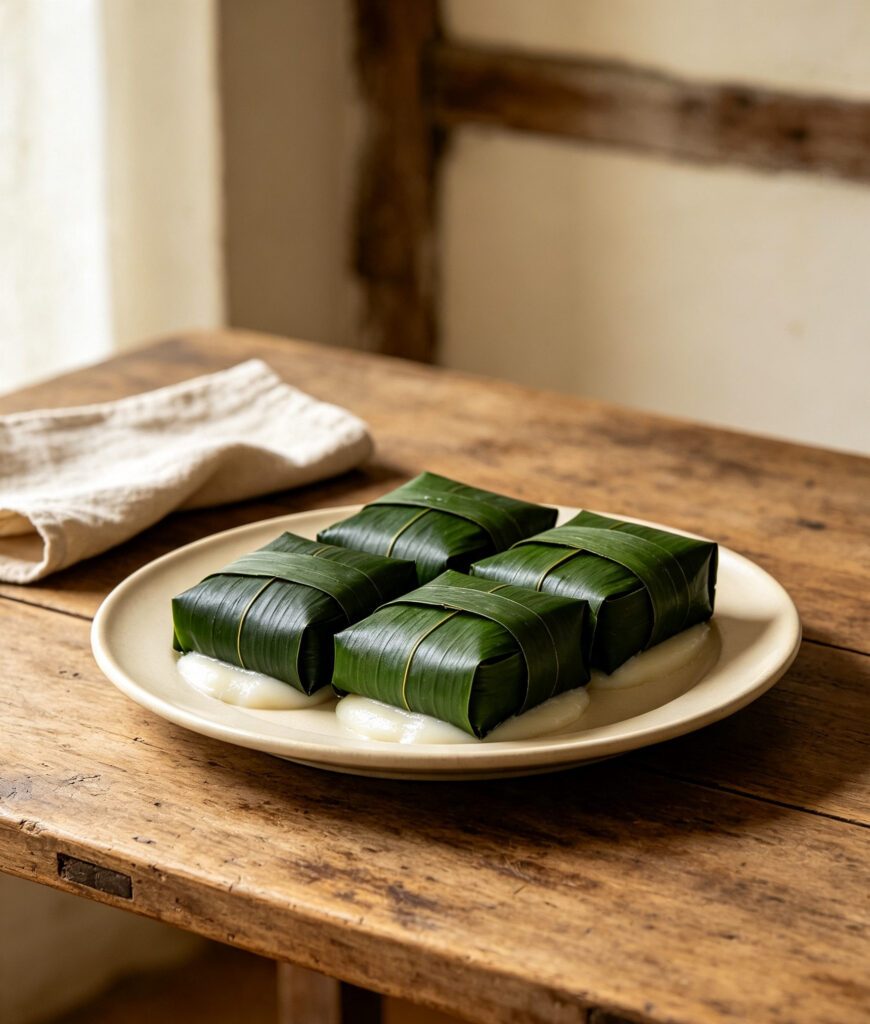
Palusami (Taro Leaves in Coconut Cream)
The Quirky Foodster Team
Ingredients
- Large taro leaves, stems trimmed, well washed — 25–30
- Onion, finely chopped — 1
- Coconut cream — 400 ml (1 3/4 cups)
- Salt — 1 tsp
- Black pepper — 1/4 tsp
- Canned corned beef or cooked fish, chopped (optional) — 200 g (7 oz)
- Banana leaves, for outer wrapping (optional)
Method
- Preheat the oven to 180°C (350°F).
- Layer 4–5 taro leaves, overlapping slightly, in the base of a baking dish to form a wide leaf-lined base.
- Scatter a portion of the chopped onion, and corned beef or fish if using, into the centre of the leaves.
- Fold the leaves up and over the filling to fully enclose it into a neat parcel, then place seam-side down in the dish.
- Repeat to make 5–6 parcels, arranging them snugly together, wrapping the whole dish in banana leaves if available for extra flavour.
- Pour the coconut cream evenly over the parcels, and season with salt and pepper.
- Cover the dish tightly with foil and bake for 55–60 minutes, until the taro leaves are completely tender and no longer taste sharp on the tongue.
- Serve hot, spooning the creamy sauce over each portion.
Introduction: Palusami is one of the most cherished dishes across Tokelau, taro leaves stuffed with coconut milk, onion
and sometimes fish or meat, wrapped in banana leaves and baked in the umu until wonderfully creamy
and tender.
Cultural Background: Palusami is one of the most cherished dishes across Tokelau, taro leaves stuffed with coconut milk, onion
and sometimes fish or meat, wrapped in banana leaves and baked in the umu until wonderfully creamy
and tender. The shared experience of preparing and unwrapping palusami together is treasured as much
as the eating itself, making it a fixture of feasts and family gatherings.
Tips: Taro leaves must be cooked thoroughly — undercooked leaves can cause an unpleasant itchy sensation, so always bake until fully tender. If fresh taro leaves aren't available, frozen taro leaves (sometimes labelled 'lu' or 'dalo leaves') from Pacific grocers work well.
Variations: Omit the corned beef or fish entirely for a simple vegetarian version with just onion and coconut cream. Add a small piece of pumpkin to the filling for natural sweetness. Omitting the corned beef or fish and using just onion and coconut cream gives a fully vegetarian version of
this dish, which is itself a common way it's prepared.
Vegetarian Palusami: Simply omit the corned beef or fish, filling the leaves with just the chopped onion.
Proceed exactly as directed, pouring over the coconut cream and baking until tender.
Storage: Refrigerate in an airtight container for up to 3 days.
Reheating: Reheat in a covered dish in a 160°C (325°F) oven for 15–20 minutes, or gently on the stovetop.
FAQs:
Q: Why is taro leaf cooking considered communal?
A: Preparing the umu and unwrapping the leaf parcels together is a cherished, shared part of Tokelauan feasts and family gatherings.
Q: Can I make it without meat or fish?
A: Yes, a simple onion and coconut cream filling is a common and authentic way to prepare palusami.
Q: Why must the taro leaves be cooked so long?
A: Raw or undercooked taro leaves contain compounds that can cause an itchy or irritated feeling in the mouth; thorough, long cooking breaks this down completely.
- Large taro leaves, stems trimmed, well washed — 25–30
- Onion, finely chopped — 1
- Coconut cream — 400 ml (1 3/4 cups)
- Salt — 1 tsp
- Black pepper — 1/4 tsp
- Canned corned beef or cooked fish, chopped (optional) — 200 g (7 oz)
- Banana leaves, for outer wrapping (optional)
Please log in to leave a comment.