
Holidays & Special Occasions
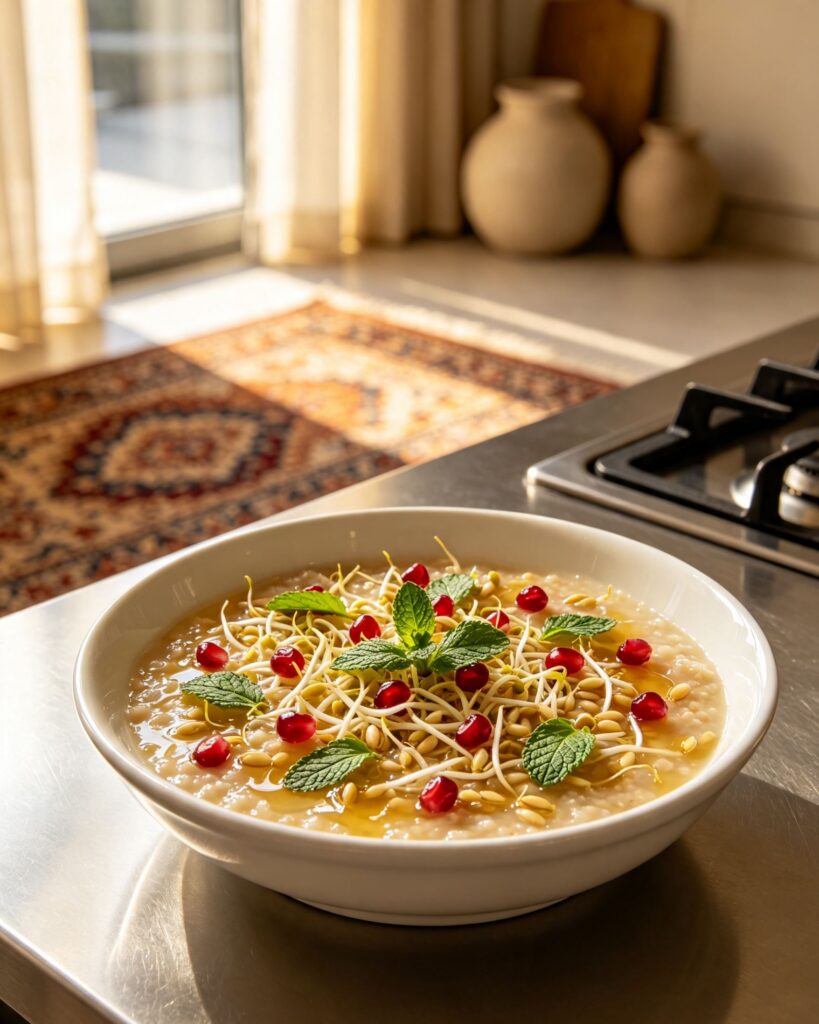
Nowruz Sprouted Wheat Pudding
The Quirky Foodster Team
Ingredients
- 500g (about 3 1/3 cups) Wheat berries
- water, for sprouting and cooking
- 150g (1 1/4 cups) Plain flour
- a few walnut halves (traditionally placed in the pot as a good-luck marker)
Method
- Soak the wheat berries in water for 24 hours, then drain and spread on a tray, covering with a damp cloth. Rinse twice a day for 3-4 days until sprouted with visible small shoots.
- Grind the sprouted wheat coarsely (a food processor works well) with a little water to a thick, wet paste.
- Strain the ground wheat through cheesecloth or a fine sieve set over a bowl, squeezing out the starchy liquid and reserving both the liquid and the pulp.
- In a large pot, combine the reserved liquid and pulp with the flour and enough additional water to form a thin batter.
- Cook over very low heat for 6-8 hours, stirring frequently to prevent sticking, until the mixture turns a deep caramel brown and thickens to a smooth, glossy paste. Add a few walnut halves partway through for tradition.
- Pour into a shallow dish, smooth the top, and let cool completely before serving in small portions.
Native Name: Samanu
Cultural Background: Samanu is one of the oldest continuously prepared dishes tied to Nowruz, the ancient Persian New Year
celebration rooted in Zoroastrian tradition, and it remains one of the seven symbolic 'haft-sin' items set on the
Nowruz table. Made purely from sprouted wheat cooked down slowly with no added sugar, its natural
sweetness was traditionally seen as a symbol of renewal, fertility and the return of spring.
Tips:
– This dish requires real patience — the long, slow cooking is what develops its natural sweetness and colour,
– and rushing the heat will scorch it.
– Stir from the bottom of the pot frequently throughout the long cooking time to prevent catching.
Variations:
– Some households add a pinch of ground cardamom near the end of cooking for extra fragrance.
– Traditionally the pot is often prepared and stirred communally among family or neighbours given the long
– cooking time involved.
Storage: Refrigerate covered for up to 1 week.
Reheating: Best served at room temperature or lightly warmed; stir well before serving.
Nutrition: Per serving: approx. 145 kcal, 4 g protein, 30 g carbohydrate, 1 g fat, 3 g fibre.
FAQs:
Q: Why does this dish have no added sugar?
A: Its sweetness comes entirely from the natural sugars released as the wheat sprouts and is slowly cooked down, which is central to its symbolism.
Q: Can the sprouting time be shortened?
A: Not easily — the sprouting is essential to developing the enzymes that create the pudding's characteristic sweetness and colour.
Please log in to leave a comment.