
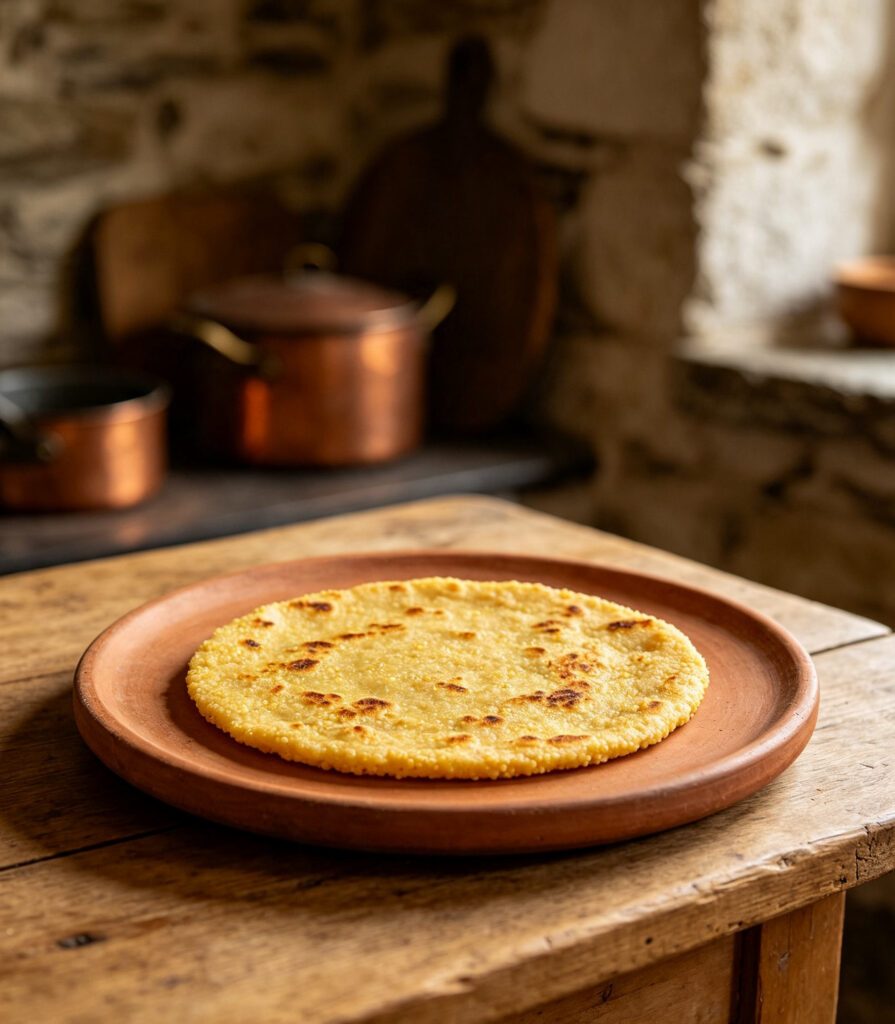
Millet Flatbread
The Quirky Foodster Team
Ingredients
- Millet flour — 300 g (2.5 cups)
- Water — 200 ml (0.8 cup)
- Salt — 1 pinch
Method
- Combine the millet flour and salt in the bowl.
- Gradually add the water, mixing to a firm, cohesive dough.
- Divide into small portions and flatten each into a thin round.
- Cook on a hot, dry griddle over medium heat for 4-5 minutes per side, until firm and lightly browned.
- Serve warm.
Introduction: A simple flatbread made from millet flour, cooked on a hot griddle, using one of the two dominant staple cereals of the Mali Empire’s agricultural economy.
Cultural Background: Millet is directly and repeatedly documented as a chief crop of the Mali Empire, both in Ibn Battuta’s firsthand account of foods traded for along his route and in the broader agricultural record of the region; simple griddle-baked flatbreads made without yeast represent the technologically straightforward bread form supported by the basic cooking equipment of the period.
Tips: – Keep the flatbreads thin for even cooking; thick cakes may remain doughy in the centre. – Millet dough is naturally more crumbly than wheat dough; handle gently when shaping and transferring to the griddle.
Variations: – Naturally vegan as written. – A little shea butter worked into the dough gives a richer, slightly more tender flatbread.
Storage: Keeps wrapped at room temperature for 1-2 days.
Reheating: Warm briefly on a dry griddle for 1-2 minutes per side.
Nutrition: Per serving (approx.): 175 kcal, 5 g protein, 36 g carbohydrate, 1.5 g fat, 4 g fibre.
FAQs:
Q: Is millet really the dominant Mali Empire grain?
A: It is directly and repeatedly documented as a chief crop of the Mali Empire, both in Ibn Battuta’s own firsthand account and in the broader agricultural record, alongside sorghum as the region’s two dominant staple cereals.
Q: Can sorghum flour be used instead?
A: Yes, sorghum is separately and equally well documented as a Mali Empire staple grain, and sorghum flour can be substituted for millet using the same basic method.
- Millet flour — 300 g (2.5 cups)
- Water — 200 ml (0.8 cup)
- Salt — 1 pinch
Please log in to leave a comment.