
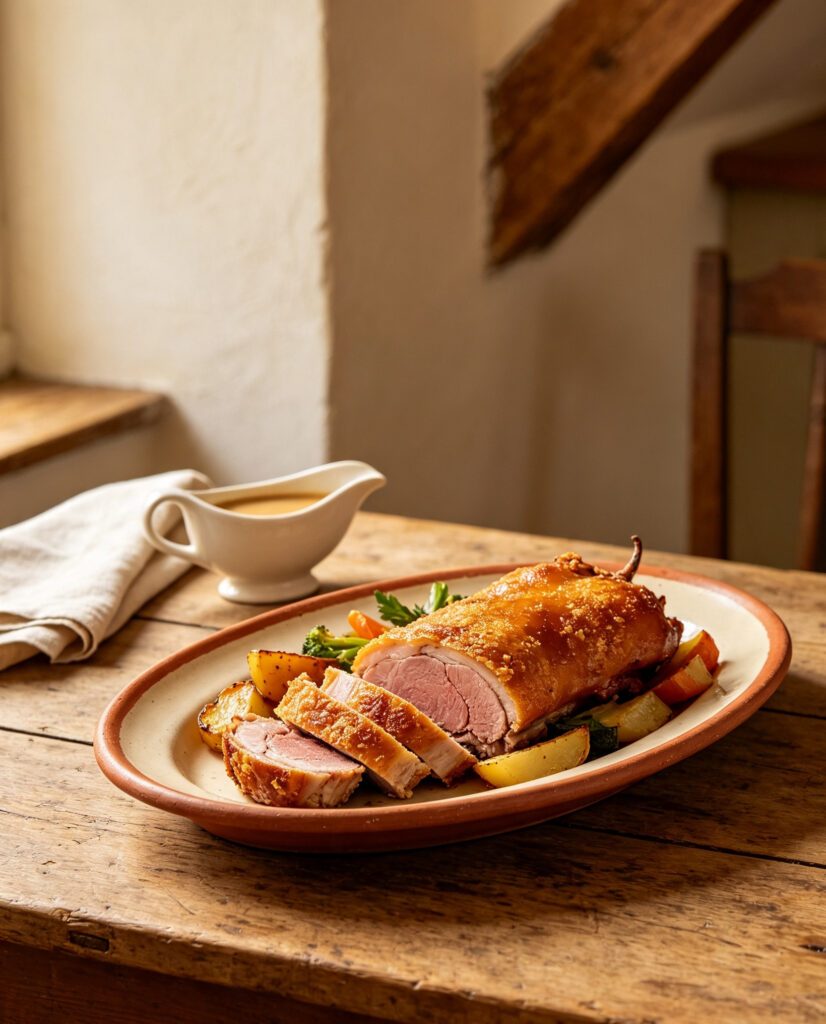
Leitão Assado Timorense (Christmas Roast Suckling Pig)
The Quirky Foodster Team
Ingredients
- Whole suckling pig (or a large pork leg/shoulder as a home-scale substitute) — 4–5 kg (9–11 lb)
- Garlic, minced — 8 cloves
- Fresh ginger, minced — 20 g (4 tsp)
- Fresh lime juice — 60 ml (¼ cup)
- Vegetable oil — 60 ml (¼ cup)
- Bay leaves, crushed — 4
- Salt, plus extra for the skin — 30 g (2 tbsp)
- Black pepper — 5 g (1 tsp)
- White vinegar, for the skin — 60 ml (¼ cup)
Method
- Pat the pig (or substitute cut) completely dry, especially the skin, and let it rest uncovered in the refrigerator for at least 4 hours or overnight to help the skin dry out for crackling.
- Combine garlic, ginger, lime juice, oil, crushed bay leaves, salt, and black pepper into a marinade paste.
- Rub the marinade generously over the meat and inside the cavity if using a whole pig, avoiding the outer skin surface where crackling is desired.
- Score the skin lightly in a diamond pattern, then rub with vinegar and a generous amount of salt to help draw out moisture for crisping.
- Preheat oven to 160°C (325°F). Roast the pig low and slow, allowing roughly 30–35 minutes per kilogram, basting the meat (not the skin) occasionally, until the internal temperature reaches 74°C (165°F) in the thickest part.
- For the final 20–30 minutes, increase oven temperature to 220°C (425°F) to crisp and blister the skin into deep golden crackling, watching closely to prevent burning.
- Rest the roast for 20–25 minutes before carving. Serve as the centrepiece of the Christmas table, alongside rice, batar da’an, and other festive sides.
Introduction: Leitão assado, roast suckling pig, is the centrepiece of Christmas celebrations in predominantly Catholic Timor-Leste, a legacy of Portuguese colonial and religious influence.
Cultural Background: Leitão assado, roast suckling pig, is the centrepiece of Christmas celebrations in predominantly Catholic Timor-Leste, a legacy of Portuguese colonial and religious influence. Slow-roasted until the skin turns deeply crackled and golden, it is the dish around which extended families gather each December.
Tips: Thoroughly drying the skin well in advance, and only oiling/seasoning the meat rather than the skin during the initial roast, are both essential steps for achieving proper crackling.
Variations: A pork shoulder or leg makes a practical home-scale substitute for a whole suckling pig, using the same seasoning and roasting technique with adjusted timing based on the cut’s size.
Storage: Refrigerate leftover meat in an airtight container for up to 3 days; freezes well for up to 2 months.
Reheating: Reheat gently in a 160°C (325°F) oven, covered loosely with foil, for 20–25 minutes until warmed through; crisp the skin briefly under a hot broiler if needed.
FAQs:
Q: Do I need a whole suckling pig for this recipe?
A: No, a pork leg or shoulder works well as a home-scale substitute using the same technique, though a whole pig is traditional for large Christmas gatherings.
Q: Why isn’t the skin crackling properly?
A: Excess moisture is the most common cause — ensure the skin is completely dry before roasting and avoid basting it with oil or marinade during cooking.
Q: Is leitão assado only served at Christmas?
A: It’s most strongly associated with Christmas, though it may also appear at other major family celebrations such as weddings.
- Whole suckling pig (or a large pork leg/shoulder as a home-scale substitute) — 4–5 kg (9–11 lb)
- Garlic, minced — 8 cloves
- Fresh ginger, minced — 20 g (4 tsp)
- Fresh lime juice — 60 ml (¼ cup)
- Vegetable oil — 60 ml (¼ cup)
- Bay leaves, crushed — 4
- Salt, plus extra for the skin — 30 g (2 tbsp)
- Black pepper — 5 g (1 tsp)
- White vinegar, for the skin — 60 ml (¼ cup)
Please log in to leave a comment.