
Korovai (Ceremonial Wedding Bread)
The Quirky Foodster Team
Ingredients
- All-purpose flour — 1 kg (8 cups)
- Whole milk, warmed — 400 ml (1 2/3 cups)
- Fresh yeast — 40 g (1.4 oz (or 4 tsp active dry yeast))
- Granulated sugar — 150 g (3/4 cup)
- Unsalted butter, softened — 150 g (2/3 cup)
- Eggs — 5
- Egg, for glazing — 1
- Fine salt — 2 tsp
Method
- Dissolve the yeast and a pinch of the sugar in the warm milk and leave for 10 minutes until foamy.
- Beat the eggs with the remaining sugar and salt, then combine with the yeast mixture.
- Gradually work in the flour, then knead in the softened butter a little at a time to form a smooth, elastic dough, about 12-15 minutes by hand.
- Set aside about one-quarter of the dough for decorations. Cover both portions and prove in a warm place for 1.5-2 hours, until doubled.
- Shape the main dough into a large, smooth round loaf and place on a greased, lined tray.
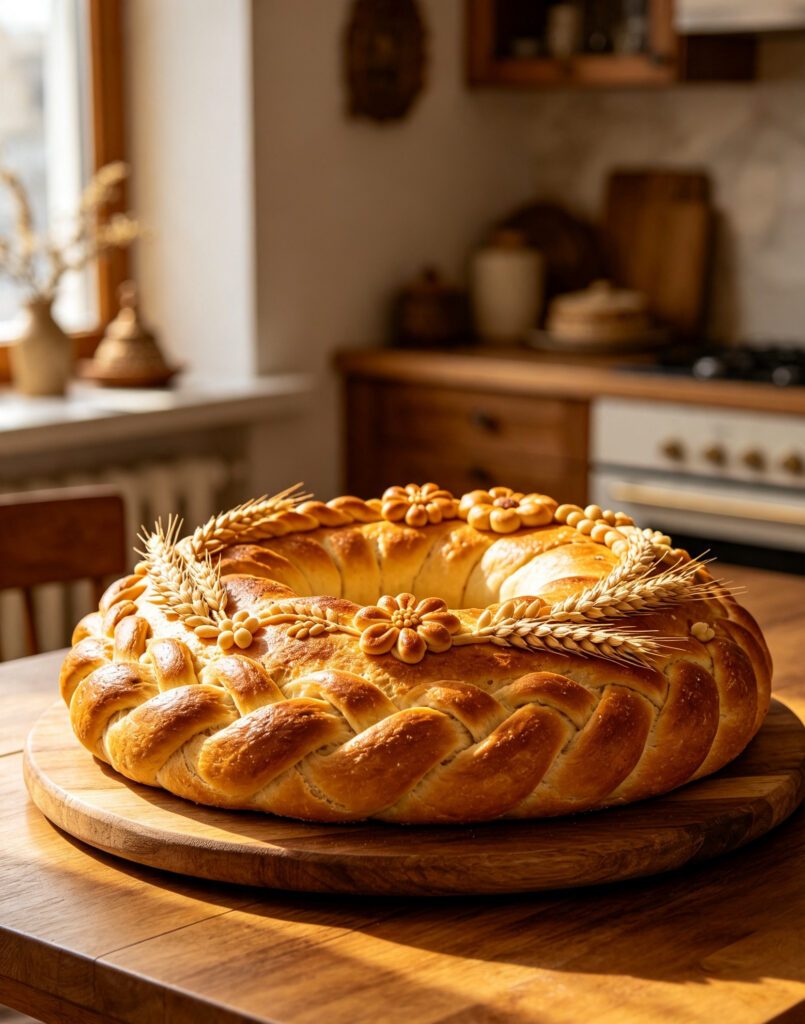
- Use the reserved dough to model traditional decorations such as birds, flowers, leaves and braided rings, and arrange them over the top of the loaf.
- Cover loosely and prove for a further 30-40 minutes, then brush all over with beaten egg.
- Bake at 170°C (340°F) for 50-60 minutes, covering the decorations loosely with foil partway through if they brown too quickly, until deep golden and cooked through. Cool completely on a wire rack before presenting.
Introduction: Korovai is an elaborately decorated round wedding bread, historically baked by a group of happily married women as part of a ritual believed to pass their good fortune on to the couple.
Cultural Background: Korovai is an elaborately decorated round wedding bread, historically baked by a group of happily married women as part of a ritual believed to pass their good fortune on to the couple. Adorned with dough shapes of birds, flowers and rings symbolising fertility and unity, it is presented to the newlyweds and shared with all the wedding guests.
Tips: Work with small amounts of the decorative dough at a time to keep it from drying out while shaping. Cover delicate decorations with foil partway through baking to stop them over-browning before the loaf's centre is fully baked.
Variations: Regional versions vary widely in their specific decorative motifs, from wheat sheaves to doves. A smaller version can be made for engagement parties or anniversaries using the same method at reduced scale. Vegetarian as written. No authentic vegan version; egg and dairy are essential to the enriched ceremonial dough.
Storage: Best served on the day it is made; leftover bread can be wrapped and kept at room temperature for up to 2 days.
Reheating: Best enjoyed at room temperature; not typically reheated given its ceremonial, decorative presentation.
FAQs:
Q: Who traditionally bakes the korovai?
A: Custom holds that it should be baked by happily married women as part of a blessing ritual for the couple, though modern celebrations vary.
Q: What do the decorations on korovai symbolise?
A: Elements like birds, rings and wheat sheaves traditionally symbolise fertility, unity and prosperity for the new couple.
- All-purpose flour — 1 kg (8 cups)
- Whole milk, warmed — 400 ml (1 2/3 cups)
- Fresh yeast — 40 g (1.4 oz (or 4 tsp active dry yeast))
- Granulated sugar — 150 g (3/4 cup)
- Unsalted butter, softened — 150 g (2/3 cup)
- Eggs — 5
- Egg, for glazing — 1
- Fine salt — 2 tsp
Please log in to leave a comment.