
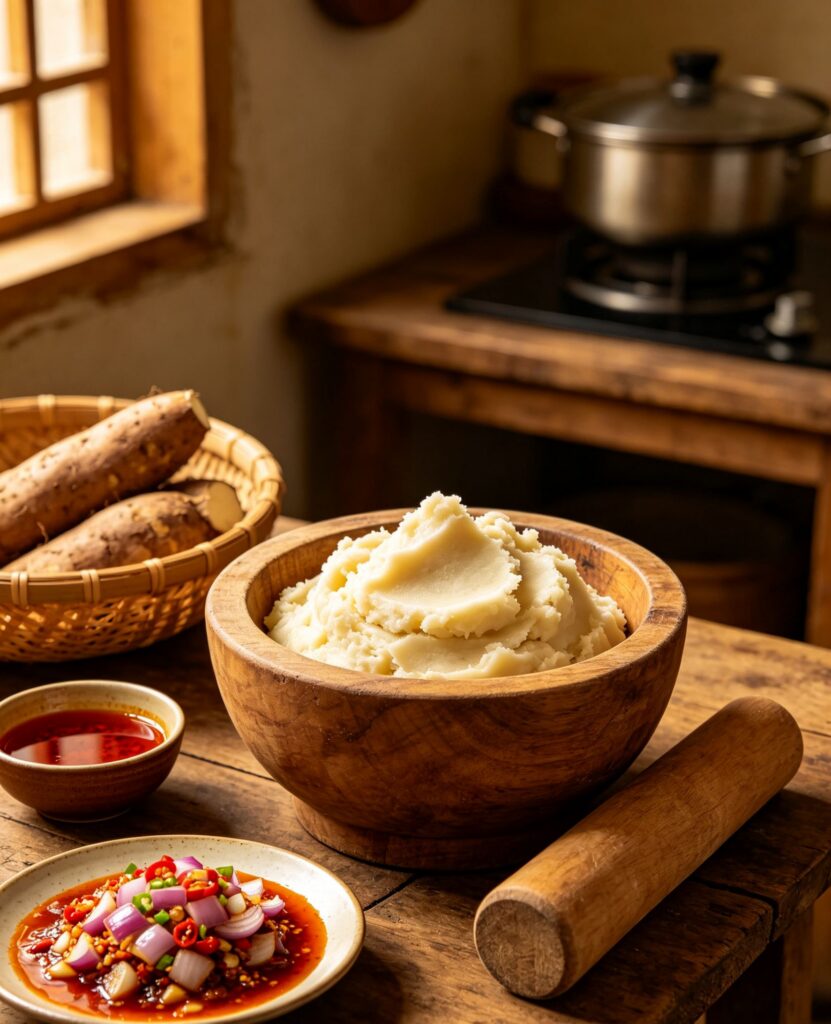
Igname Pilée (Pounded Yam)
The Quirky Foodster Team
Ingredients
- Fresh yam, peeled and cut into chunks — 1 kg (2.2 lb)
- Water, for boiling — 500 ml (2 cups)
- Salt — 1/2 tsp
Method
- Place the yam chunks in a pot, cover with water, add salt, and bring to a boil.
- Boil for 20-25 minutes until a knife slides through the yam easily.
- Drain well and transfer the hot yam to a mortar (or the bowl of a stand mixer).
- Pound (or mix on low-medium speed) continuously, adding a tablespoon of the reserved cooking water as needed, until the yam becomes a smooth, stretchy, lump-free dough.
- Shape into a smooth mound using wet hands and serve immediately while warm.
Introduction: Pounded yam is a foundational side across Benin, made by boiling and rhythmically pounding fresh yam into
a smooth, stretchy dough.
Cultural Background: Pounded yam is a foundational side across Benin, made by boiling and rhythmically pounding fresh yam into
a smooth, stretchy dough. In rural households it is still made the traditional way with a large mortar and
pestle, the pounding rhythm audible from neighbouring compounds.
Tips: Work quickly while the yam is still hot – it becomes far harder to smooth out as it cools. Wetting your hands
or the pestle prevents sticking.
Variations: Some households mix in a small amount of boiled cassava for a slightly different texture and flavour.
Vegetarian/Vegan: Already vegan as written.
Storage: Best eaten fresh; pounded yam firms up and becomes difficult to soften once refrigerated.
Reheating: Wrap in a damp cloth and steam gently for 5-10 minutes, or microwave covered with a damp paper towel in
short bursts, kneading between each.
Nutrition: Approx. 220 kcal, 3g protein, 0.3g fat, 51g carbohydrates per serving.
FAQs:
Q: Can I use a food processor instead of pounding by hand?
A: A stand mixer with a dough hook is the best substitute; a food processor tends to make the texture gluey rather than stretchy.
Q: What is this typically served with?
A: It's most often paired with soups and stews such as soupe kpétè or peanut sauce.
- Fresh yam, peeled and cut into chunks — 1 kg (2.2 lb)
- Water, for boiling — 500 ml (2 cups)
- Salt — 1/2 tsp
Please log in to leave a comment.