
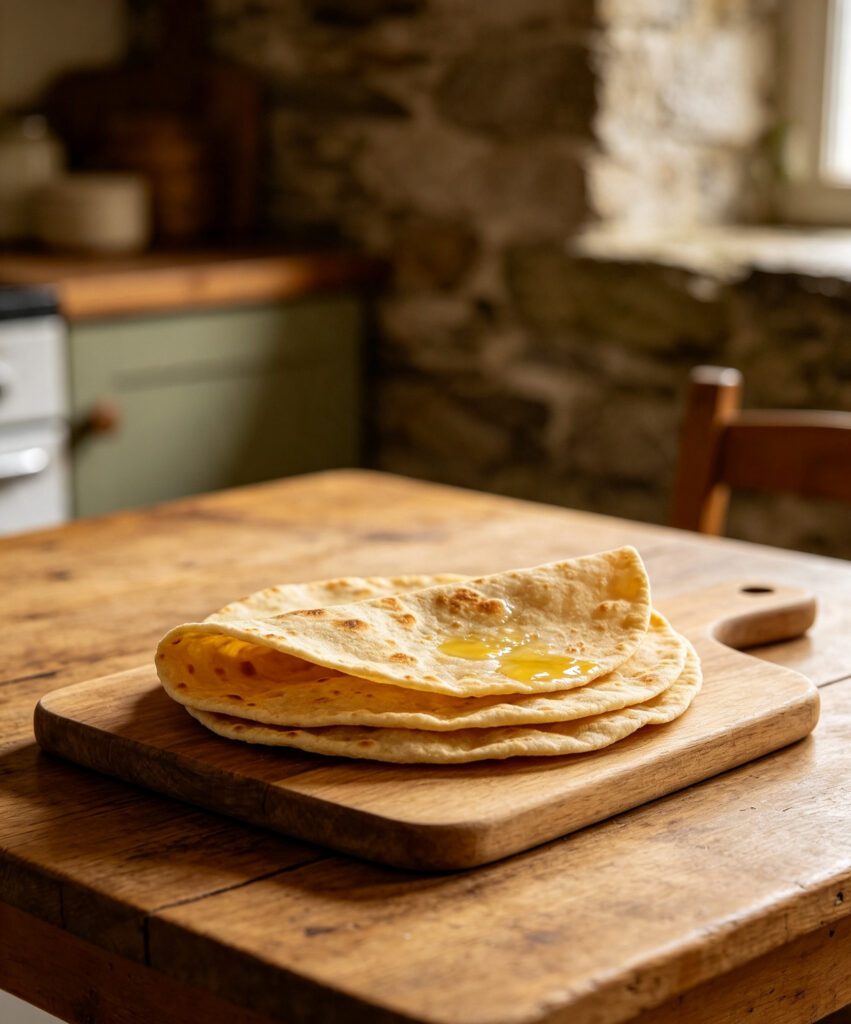
Godhuma Roti (Wheat Flatbread with Ghee)
The Quirky Foodster Team
Ingredients
- Whole wheat flour, plus extra for dusting — 250 g (2 cups)
- Warm water — 150-180 ml (0.6-0.75 cup)
- Rock salt — 1/4 tsp
- Ghee, melted, divided — 2 tbsp
Method
- Combine the wheat flour and salt in a mixing bowl.
- Gradually add the warm water, mixing and kneading for 8-10 minutes, until a smooth, soft, elastic dough forms.
- Cover and rest the dough for 20-30 minutes.
- Divide the dough into 8 equal portions and roll each into a ball.
- On a lightly floured surface, roll each ball into a thin, even round about 15-18 cm (6-7 in) across.
- Heat a dry griddle over medium-high heat and cook each roti for 30-45 seconds on the first side, until small bubbles form.
- Flip and cook the second side for a further 30-45 seconds, then, using tongs, briefly hold the roti directly over a low open flame for a few seconds per side if available, which causes it to puff up fully; alternatively, press gently with a cloth on the griddle to encourage puffing.
- Brush each cooked roti lightly with a little melted ghee and serve warm.
Introduction: A soft, pliable flatbread made from whole wheat flour and finished with a brushing of ghee, godhuma roti represents the everyday bread of households across the wheat-growing regions of the Mauryan Empire.
Cultural Background: Godhuma, the Sanskrit term for wheat, is recorded alongside barley and rice among the principal grains cultivated across the Mauryan Empire’s agricultural lands, with wheat becoming an increasingly significant crop in the northwestern regions of the empire. This simple, everyday flatbread, softened and enriched with a final brushing of ghee, remains essentially unchanged in method across millennia of the subcontinent’s home cooking.
Tips: (cid:127) Kneading the dough thoroughly for the full 8-10 minutes develops the gluten needed for a soft, pliable roti that puffs well. (cid:127) If you do not have an open flame available, pressing the roti gently with a folded cloth while it cooks on the griddle helps encourage some puffing.
Variations: (cid:127) A little milk can be used in place of some of the water for an even softer, more tender roti. (cid:127) Whole cumin or nigella seeds can be worked into the dough for a lightly spiced variation.
Storage: Store wrapped in a cloth or in an airtight container at room temperature for up to 1 day, or refrigerate for up to 3 days.
Reheating: Reheat briefly on a dry, hot griddle for 15-20 seconds per side, or wrap in a damp cloth and microwave briefly.
Nutrition: Per serving (approx., 1 roti): 140 kcal, 4 g protein, 22 g carbohydrate, 4 g fat, 3 g fibre, 60 mg sodium.
FAQs:
Q: Why does the roti puff up during cooking?
A: Steam builds up rapidly between the two surfaces of the thin dough when exposed to high heat, causing it to inflate; this happens most reliably over a direct open flame but can also occur, to a lesser extent, on a very hot griddle. (cid:127) Q: Can I make the dough ahead of time? A: Yes, the dough can be made a few hours ahead and kept covered at room temperature, or refrigerated overnight and brought back to room temperature before rolling and cooking.
- Whole wheat flour, plus extra for dusting — 250 g (2 cups)
- Warm water — 150-180 ml (0.6-0.75 cup)
- Rock salt — 1/4 tsp
- Ghee, melted, divided — 2 tbsp
Please log in to leave a comment.