
Breads
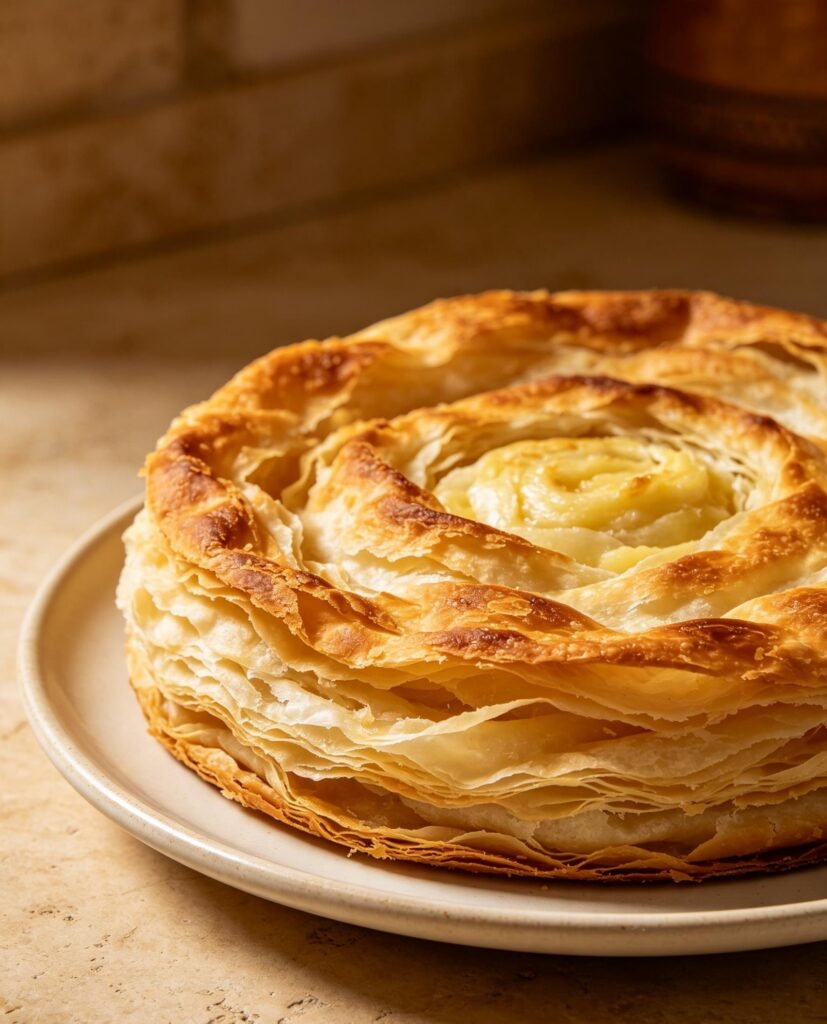
Feteer Meshaltet
The Quirky Foodster Team
Ingredients
- 500 g (4 cups) All-purpose flour
- 250 ml (1 cup) Warm water
- 1 tsp Salt
- 2 tbsp Vegetable oil, for the dough
- 200 g (1 cup) Ghee, melted, for layering
- as desired Honey or feta cheese, to serve
Method
- Mix the flour, salt, water and oil into a soft, smooth dough; knead for 10 minutes.
- Divide into 6 balls, coat each generously in oil, and rest covered for at least 1 hour.
- On an oiled surface, stretch each ball by hand into a very thin, almost see-through sheet.
- Brush the stretched sheet generously with melted ghee, then fold it repeatedly into a small square or coil to
- create many thin layers.
- Rest the folded dough for 15 minutes, then gently flatten each into a round about 20 cm (8 in) across.
- Preheat the oven to 220°C (425°F) and bake the rounds on a tray for 12–15 minutes until golden and puffed.
- Serve warm, torn open, with honey or crumbled feta cheese.
Introduction: Feteer meshaltet is Egypt's flaky, many-layered pastry bread, painstakingly stretched paper thin, brushed with ghee, and folded again and again — a technique often compared to a savoury or sweet Egyptian relative of puff pastry.
Cultural Background: Feteer meshaltet is Egypt's flaky, many-layered pastry bread, painstakingly stretched paper thin, brushed with ghee, and folded again and again — a technique often compared to a savoury or sweet Egyptian relative of puff pastry.
Tips: – Stretch the dough as thin as possible without tearing — this is what creates the many delicate layers. Generous ghee between the folds is essential for the flaky, buttery result.
Variations: – A sweet version is filled with honey and nuts before the final fold. A savoury version incorporates minced meat or cheese between the layers. Vegetarian as written; naturally dairy-free if served without cheese, though ghee is a dairy product.
Storage: Best eaten fresh the day it's made; can be kept 1 day at room temperature, wrapped.
Reheating: Reheat in a 180°C (350°F) oven for 5–7 minutes to restore flakiness.
Nutrition: Calories: 410 kcal | Protein: 7 g | Carbs: 42 g | Fat: 24 g | Fiber: 2 g
FAQs:
Q: Why is feteer so difficult to make?
A: The dough must be stretched extremely thin by hand and folded many times, a technique that takes practice to master.
Q: Is feteer sweet or savoury?
A: It can be either — served with honey and nuts for a sweet version, or filled with cheese or meat for a savoury one.
Please log in to leave a comment.