
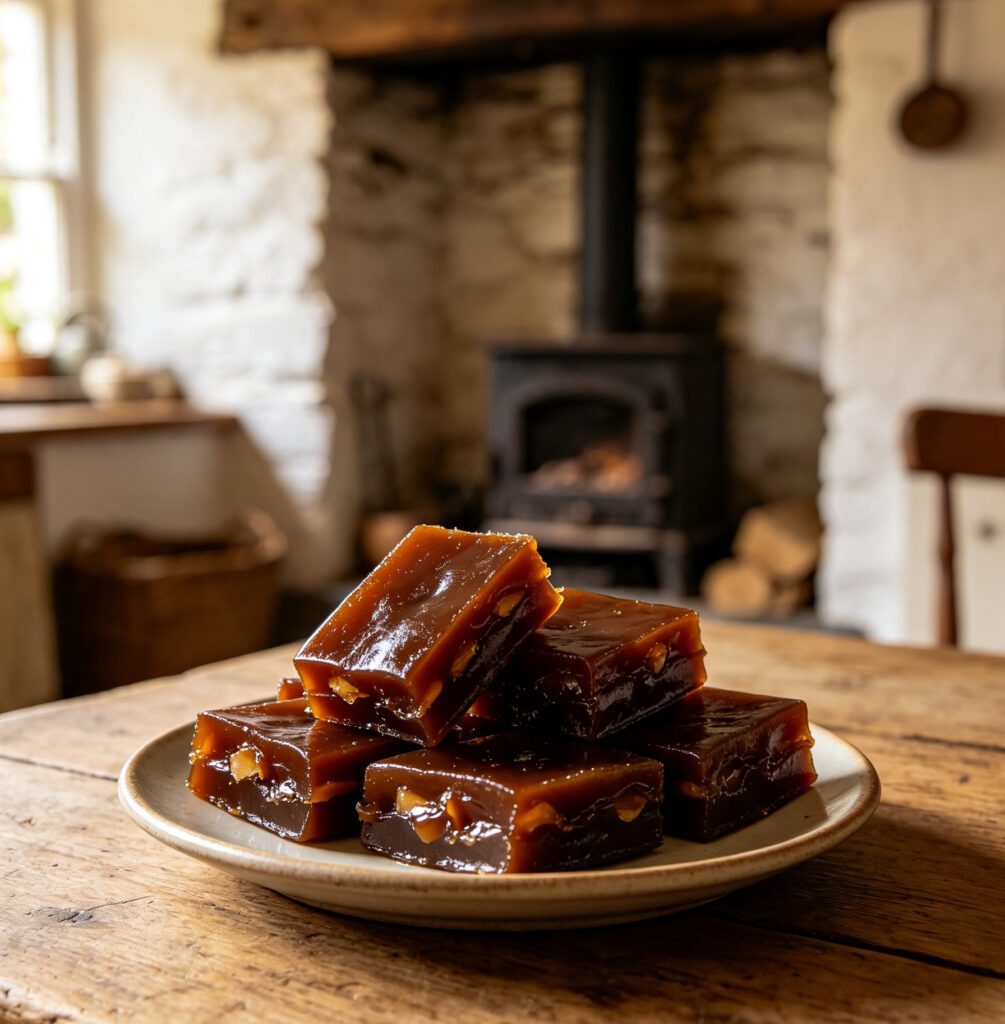
Dodol (Sticky Coconut Palm Sugar Sweet for Festivals)
The Quirky Foodster Team
Ingredients
- Glutinous rice flour — 250 g (2 cups)
- Rice flour — 50 g (1/3 cup plus 1 tbsp)
- Coconut milk — 800 ml (3 1/3 cups)
- Palm sugar (gula melaka), finely chopped — 400 g (2 cups)
- Sugar — 100 g (1/2 cup)
- Salt — a pinch
- Cooking oil, for greasing — as needed
Method
- In a bowl, whisk the glutinous rice flour and rice flour with about 300 ml of the coconut milk to form a smooth, lump-free batter.
- In the large wok, combine the remaining coconut milk, palm sugar, sugar and salt, and heat gently, stirring, until the sugar fully dissolves.
- Strain the flour batter into the wok, mixing well to combine evenly with the sweetened coconut milk.
- Cook over low heat, stirring continuously and scraping the bottom and sides frequently to prevent sticking and burning, for 2 1/2 to 3 hours.
- The mixture will gradually thicken, darken and become glossy; continue stirring patiently until it pulls away cleanly from the sides of the wok and turns a deep caramel brown.
- Pour the thickened dodol into a lightly greased tray, spreading it evenly, and allow to cool completely and set for several hours or overnight before slicing into pieces to serve.
Introduction: A dense, chewy, deeply caramelized sweet made from glutinous rice flour, coconut milk and palm sugar, stirred patiently over low heat for hours until thick and glossy — a festive treat prepared for major celebrations.
Cultural Background: Dodol requires many hours of continuous stirring over an open flame, traditionally a communal task undertaken by families and neighbours together ahead of festivals such as Hari Raya and weddings. Its labour-intensive preparation has long made it a symbol of celebration, patience and shared effort within Malay communities.
Tips: Constant stirring is essential throughout the entire cooking time — dodol burns very easily if left unattended, even briefly. Use the lowest heat setting your stove allows, as this is a slow, patient process rather than a quick one. The dodol is ready when it becomes very thick, glossy, and pulls cleanly away from the sides of the pan rather than sticking.
Variations: Add toasted sesame seeds or durian purée for regional flavour variations. Wrap individual portions in small squares of greased banana leaf or waxed paper for traditional festive presentation and easy sharing. Adjust the ratio of palm sugar to white sugar to vary the depth of caramel flavour and colour.
Storage: Store wrapped or in an airtight container at room temperature for up to 2 weeks, or refrigerate for up to a month.
Reheating: Dodol is eaten at room temperature and is not reheated; if it becomes very firm after long storage, warming briefly and gently in a low oven can soften it slightly.
Nutrition: Approx. per serving: 260 kcal, 2 g protein, 46 g carbohydrate, 8 g fat, 1 g fibre.
FAQs:
Q: Why does dodol take so long to cook?
A: The long, slow cooking time is necessary to fully cook the rice flour, evaporate excess liquid, and develop the dense, chewy texture and deep caramelized flavour that define dodol.
Q: Can I use a stand mixer to stir it for me?
A: Traditional dodol requires scraping the bottom and sides of the pan by hand to prevent burning, which a stand mixer cannot do effectively; hand-stirring is strongly recommended.
Q: Is dodol vegan?
A: Yes, as written it is entirely plant-based.
- Glutinous rice flour — 250 g (2 cups)
- Rice flour — 50 g (1/3 cup plus 1 tbsp)
- Coconut milk — 800 ml (3 1/3 cups)
- Palm sugar (gula melaka), finely chopped — 400 g (2 cups)
- Sugar — 100 g (1/2 cup)
- Salt — a pinch
- Cooking oil, for greasing — as needed
Please log in to leave a comment.