
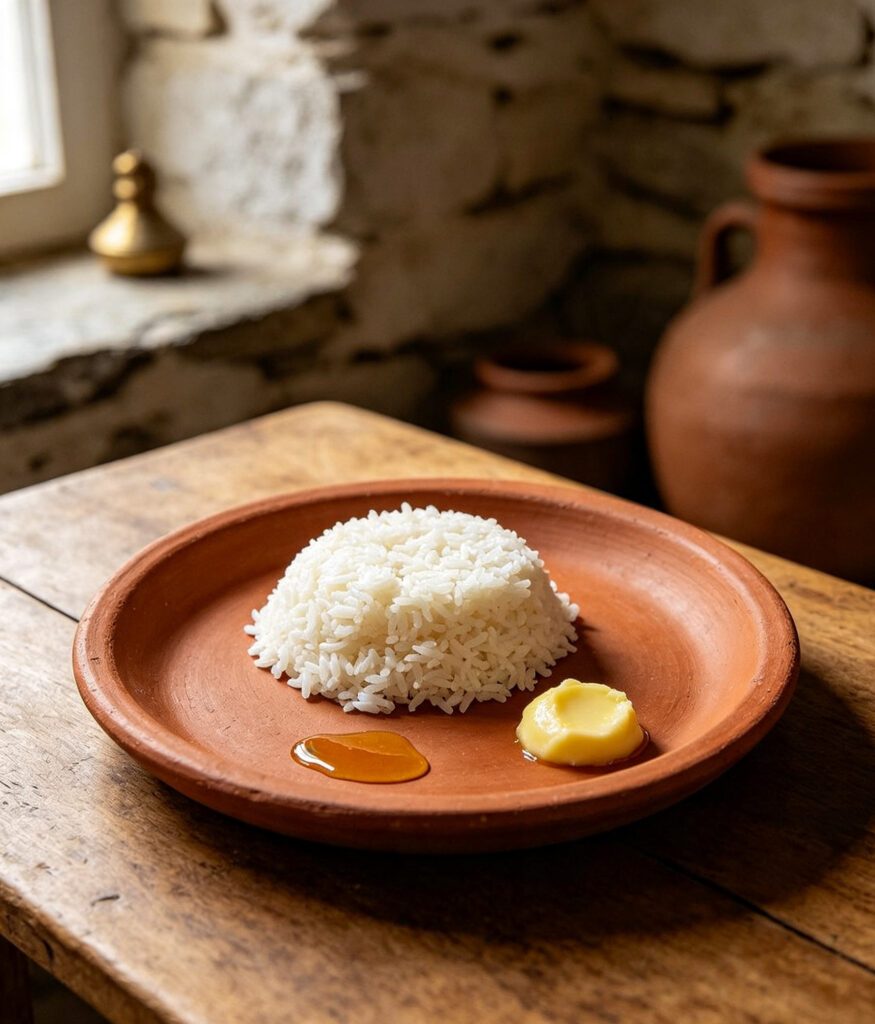
Danapatra Offering (Ceremonial Rice, Ghee and Honey Almsgiving Meal)
The Quirky Foodster Team
Ingredients
- Rice, rinsed — 200 g (1 cup)
- Water — 450 ml (1.75 cups)
- Ghee — 3 tbsp
- Honey — 2 tbsp
- Ground cardamom — 1/4 tsp
- Rock salt — 1 pinch
Method
- Combine the rinsed rice and water in a medium saucepan.
- Bring to the boil, then reduce to a low simmer, cover, and cook for 15-18 minutes, until the rice is tender and the water is fully absorbed.
- Remove from the heat and let the rice stand, covered, for 5 minutes.
- Fluff the rice gently with a fork, then stir in the ghee until melted and evenly distributed.
- Drizzle the honey over the rice and sprinkle with the ground cardamom and a small pinch of salt, folding through gently.
- Present the rice formally in a small bowl or on a leaf plate, as befits its ceremonial, offering-based origins.
- Serve warm, ideally offered generously to guests, elders or those in need, in keeping with the dish's historical association.
Introduction: A simple, formally presented meal of rice, ghee and honey, this ceremonial almsgiving dish reflects the widespread Mauryan-era practice of dana, or charitable giving, particularly associated with Ashoka’s promotion of Buddhist values across the empire.
Cultural Background: Ashoka’s edicts repeatedly emphasise the importance of dana, or generous giving, including the provision of food to Brahmins, ascetics and the needy, as a central expression of the moral and religious values he sought to spread across his empire. A dish of plain rice enriched simply with ghee and honey, presented with due formality, reflects the kind of humble but respectfully offered almsgiving meal recorded in the Buddhist textual tradition developing during this period.
Tips: (cid:127) Use good-quality, fragrant rice and fresh ghee, as this simple dish relies entirely on the quality of its few ingredients. (cid:127) Add the honey once the rice has cooled slightly from just off the boil, as very high heat can diminish some of honey’s delicate flavour.
Variations: (cid:127) A few strands of saffron can be added to the cooking water for a more visually striking, festive presentation. (cid:127) Chopped nuts such as almonds or cashews can be scattered over the top for a more elaborate version suited to a special occasion.
Storage: Store in an airtight container in the refrigerator for up to 2 days.
Reheating: Reheat gently in a covered pan with a splash of water over low heat, or in a microwave, until warmed through.
Nutrition: Per serving (approx.): 320 kcal, 4 g protein, 52 g carbohydrate, 11 g fat, 1 g fibre, 40 mg sodium.
FAQs:
Q: What is the significance of dana in Mauryan history?
A: Dana, or charitable giving, is repeatedly emphasised in Ashoka’s edicts as a core moral value he sought to promote across the empire, including the provision of food and other support to religious ascetics, Brahmins and the needy. (cid:127) Q: Is this dish meant to be elaborate or simple? A: It is intentionally simple, reflecting the humble but sincerely offered nature of almsgiving food described in the Buddhist textual tradition of this period, where the spirit of the offering mattered more than its complexity.
- Rice, rinsed — 200 g (1 cup)
- Water — 450 ml (1.75 cups)
- Ghee — 3 tbsp
- Honey — 2 tbsp
- Ground cardamom — 1/4 tsp
- Rock salt — 1 pinch
Please log in to leave a comment.