
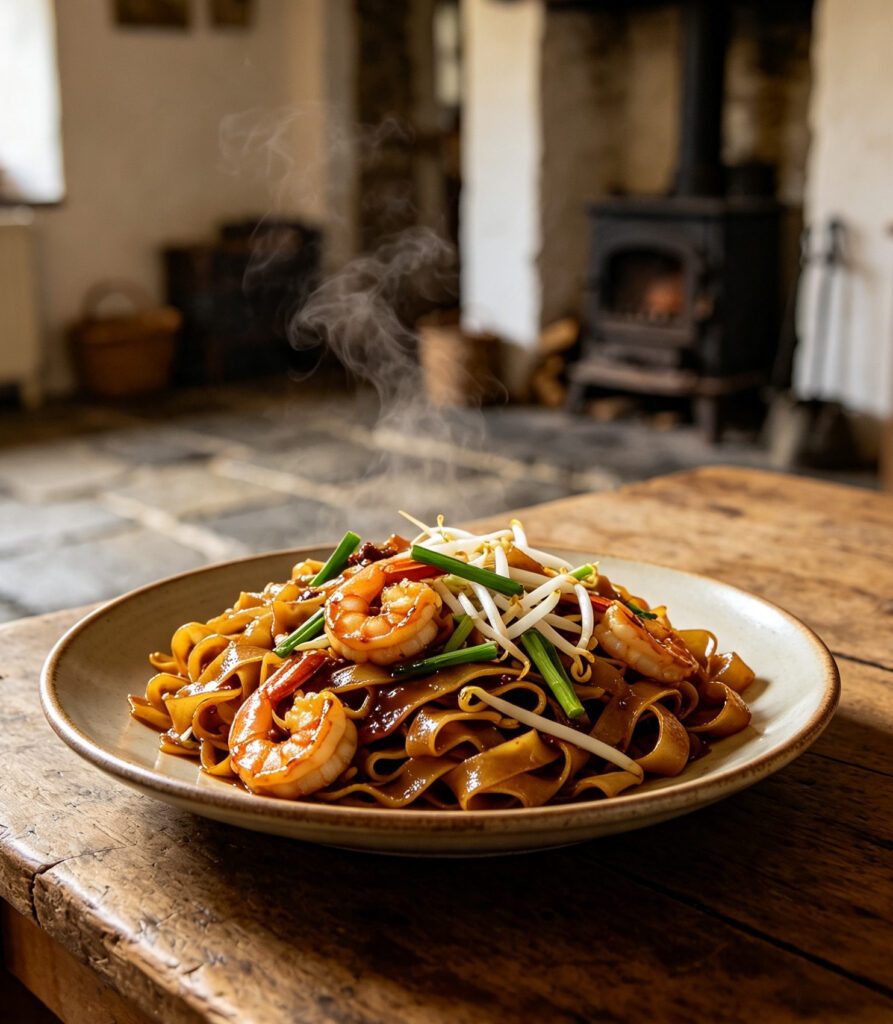
Char Kway Teow (Stir-Fried Flat Rice Noodles)
The Quirky Foodster Team
Ingredients
- Flat rice noodles (kway teow), fresh — 500 g (about 4 cups)
- Prawns, peeled and deveined — 200 g (7 oz)
- Chinese sausage (lap cheong), sliced — 100 g (3.5 oz)
- Large Eggs — 3
- Bean sprouts — 150 g (2 cups)
- Garlic chives (or spring onion), cut into 4 cm lengths — 60 g (1 cup)
- Garlic, minced — 3 cloves
- Dark soy sauce — 30 ml (2 tbsp)
- Light soy sauce — 15 ml (1 tbsp)
- Chili paste (sambal), or to taste — 15 g (1 tbsp)
- Cooking oil — 45 ml (3 tbsp)
- Fish sauce — 10 ml (2 tsp)
- Sugar — 5 g (1 tsp)
Method
- Have all ingredients prepped and within reach before starting, as this dish cooks very quickly over high heat.
- Heat half the oil in a wok over the highest possible heat until lightly smoking.
- Add the garlic and Chinese sausage, and stir-fry for 1 minute until fragrant.
- Add the prawns and cook for 1–2 minutes until just turning pink.
- Push everything to one side of the wok, add the remaining oil, crack in the eggs, and scramble briefly before mixing through the other ingredients.
- Add the noodles, dark and light soy sauce, chili paste, fish sauce and sugar, and toss vigorously to coat and lightly char the noodles, about 2–3 minutes.
- Add the bean sprouts and garlic chives, and stir-fry for a final 1 minute until just wilted but still crisp.
- Serve immediately, straight from the wok while piping hot.
Introduction: Smoky, wok-charred flat rice noodles stir-fried with prawns, egg, bean sprouts and Chinese sausage in a savoury dark soy sauce blend.
Cultural Background: Char kway teow developed among Chinese communities in Penang and continues to be closely associated with that city, traditionally cooked over intensely hot charcoal woks by hawkers to achieve its distinctive smoky flavour, known as ‘wok hei’. It remains one of the most ordered dishes at Malaysian hawker centres, prized for the balance of char, savouriness and a touch of sweetness.
Tips: The wok must be very hot before adding ingredients — this is essential for the characteristic smoky ‘wok hei’ flavour. Cook in one continuous, quick motion; char kway teow does not benefit from a slow, gentle approach. Fresh, not dried, flat rice noodles give the best texture; if only dried are available, soak and steam them briefly before use.
Variations: Add cockles (blood clams) for a more traditional Penang version, added with the prawns. Use tofu puffs in place of Chinese sausage for a lighter version. Adjust the chili paste up or down depending on your preferred spice level.
Storage: Best eaten immediately; if needed, store leftovers in an airtight container in the refrigerator for up to 1 day, though texture softens on storing.
Reheating: Reheat in a hot wok or frying pan over high heat for 2–3 minutes, tossing constantly; microwaving will make the noodles soft and is not recommended.
Nutrition: Approx. per serving: 480 kcal, 22 g protein, 52 g carbohydrate, 20 g fat, 2 g fibre.
FAQs:
Q: What is ‘wok hei’?
A: It refers to the distinctive smoky aroma and flavour that develops when ingredients are stir-fried very quickly over extremely high heat, characteristic of well-made char kway teow.
Q: Can I make this without a wok?
A: A large, heavy frying pan can be used, though it is harder to reach the same very high heat; work in smaller batches if needed.
Q: Is there a vegetarian version?
A: Yes, omit the prawns, sausage and fish sauce, using extra tofu, mushrooms and soy sauce for a satisfying vegetarian stir-fry.
- Flat rice noodles (kway teow), fresh — 500 g (about 4 cups)
- Prawns, peeled and deveined — 200 g (7 oz)
- Chinese sausage (lap cheong), sliced — 100 g (3.5 oz)
- Large Eggs — 3
- Bean sprouts — 150 g (2 cups)
- Garlic chives (or spring onion), cut into 4 cm lengths — 60 g (1 cup)
- Garlic, minced — 3 cloves
- Dark soy sauce — 30 ml (2 tbsp)
- Light soy sauce — 15 ml (1 tbsp)
- Chili paste (sambal), or to taste — 15 g (1 tbsp)
- Cooking oil — 45 ml (3 tbsp)
- Fish sauce — 10 ml (2 tsp)
- Sugar — 5 g (1 tsp)
Please log in to leave a comment.