
Ceremonial Chicha and Offering Bread
The Quirky Foodster Team
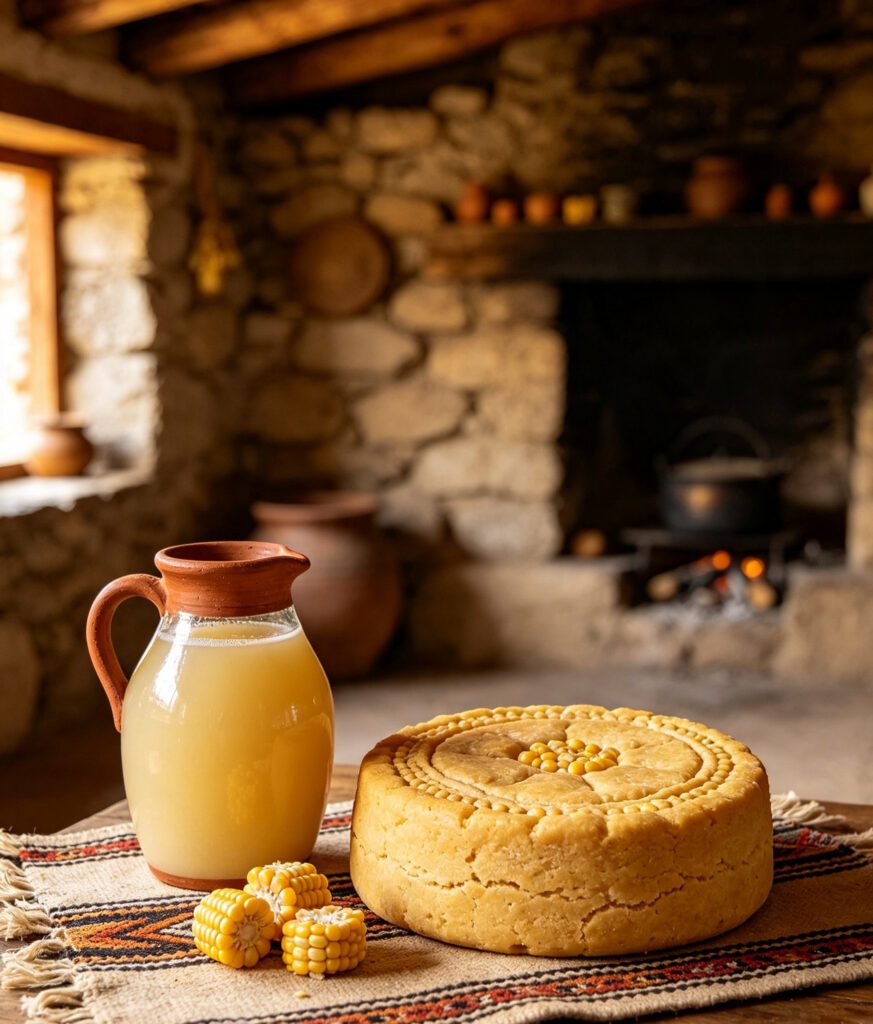
Ingredients
- Batch Chicha de Jora (see Drinks) — 1
- Batch Sanku (see Breads) — 1
Method
- Prepare the chicha de jora and sanku separately in advance, following their individual recipes.
- Pour a portion of the chicha into a ceremonial vessel.
- Place a piece of sanku on a small offering plate or cloth beside it.
- Present the pair together, as was traditional practice at religious ceremonies and offerings at huacas
- (sacred sites).
- The remainder may be shared and eaten by those present, as was also traditional after the ceremonial portion was set aside.
Introduction: A paired offering of chicha and plain maize bread, presented together as was customary at religious ceremonies and huaca (sacred site) offerings throughout the empire.
Cultural Background: Chroniclers describe the pairing of chicha (aqha) and maize bread (sanku) as a common form of ritual offering (haywarikuy) at huacas and state ceremonies, poured or placed as a gift to deities and ancestors; this dish presents the two prepared components together in the paired offering format documented in colonial-era accounts, using the plain (non-blood) versions of each as prepared elsewhere in this collection.
Tips: – Prepare both components a day ahead, since chicha requires several days of fermentation. – This is a presentation format combining two already-documented individual dishes, rather than a distinct new recipe in its own right.
Variations: – A simpler, non-fermented chicha (see the variation note in the Drinks recipe) can be substituted for a milder, non-alcoholic offering pairing.
Storage: Store each component according to its own recipe instructions.
Reheating: Not applicable; both components are served at room temperature.
Nutrition: Combined nutrition follows the individual totals for Chicha de Jora and Sanku, listed in their respective recipes.
FAQs:
Q: Is this a single recipe or a combination?
A: It is a documented pairing of two separately prepared dishes (chicha and sanku), presented together in the traditional offering format described by colonial chroniclers.
Q: Can this be prepared for a modern gathering rather than a religious ceremony?
A: Yes, the pairing works well as a symbolic centrepiece for a themed meal, separate from its original ceremonial religious context.
- Batch Chicha de Jora (see Drinks) — 1
- Batch Sanku (see Breads) — 1
Please log in to leave a comment.