
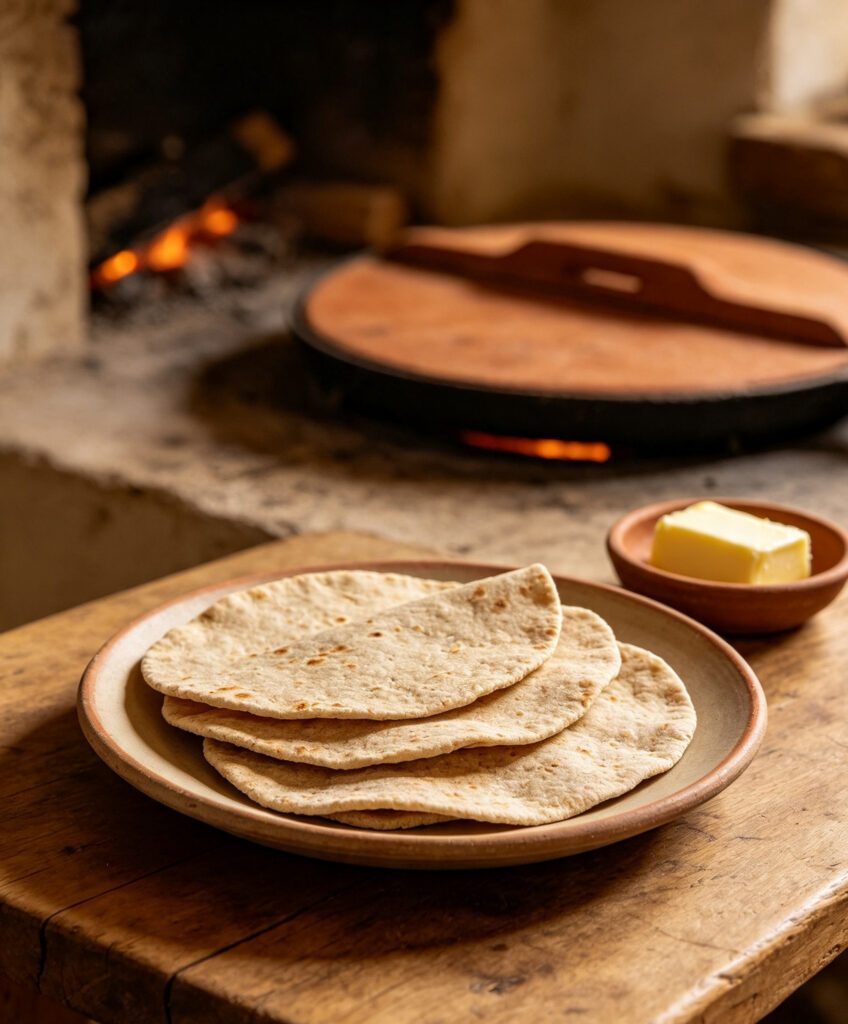
Barley Flatbread
The Quirky Foodster Team
Ingredients
- Barley flour — 300 g (2.5 cups)
- Water — 200 ml (0.8 cup)
- Salt — 1 pinch
Method
- Combine the barley flour and salt in the bowl.
- Gradually add the water, mixing to a firm, cohesive dough.
- Divide into small portions and flatten each into a thin round.
- Cook on a hot, dry griddle over medium heat for 4-5 minutes per side, until firm and lightly browned.
- Serve warm.
Introduction: A thin, flat barley bread cooked quickly on a hot griddle, a lighter alternative to the denser emmer loaf and well suited to Iron Age Gaul’s principal cereal crop.
Cultural Background: Barley is the single most consistently attested cereal across Iron Age Gallic archaeobotanical remains, and thin, unleavened flatbreads are the simplest bread form achievable with a hot griddle or flat stone, the basic baking equipment documented at continental Celtic settlement sites.
Tips: – Keep the flatbreads thin for even cooking; thick cakes may remain doughy in the centre. – Barley dough is naturally more crumbly than wheat dough; handle gently when shaping and transferring to the griddle.
Variations: – Naturally vegan as written. – A little rendered fat or butter worked into the dough gives a richer, slightly more tender flatbread.
Storage: Keeps wrapped at room temperature for 1-2 days.
Reheating: Warm briefly on a dry griddle for 1-2 minutes per side.
Nutrition: Per serving (approx.): 175 kcal, 4 g protein, 36 g carbohydrate, 1 g fat, 5 g fibre.
FAQs:
Q: Why was barley the dominant Gallic grain?
A: It is the single most consistently recovered cereal across Iron Age Gallic archaeobotanical assemblages, suggesting it was particularly well suited to the growing conditions and farming practices of the region.
Q: Can wheat flour be used instead?
A: Emmer wheat was also cultivated in Iron Age Gaul (see the Emmer Bread recipe), but barley is the more strongly attested staple grain for this kind of quick, everyday flatbread.
- Barley flour — 300 g (2.5 cups)
- Water — 200 ml (0.8 cup)
- Salt — 1 pinch
Please log in to leave a comment.