
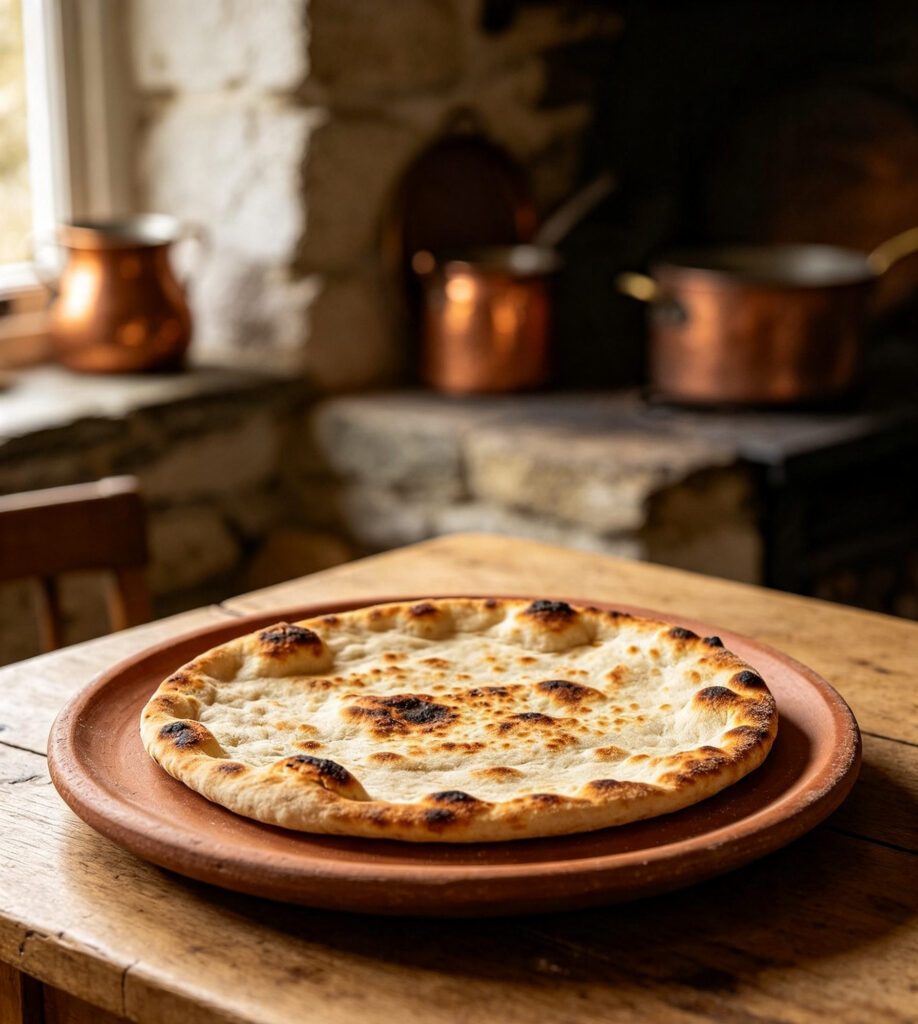
Barley Flatbread (Tannur-Baked)
The Quirky Foodster Team
Ingredients
- Barley flour — 300 g (2.5 cups)
- Water — 200 ml (0.8 cup)
- Salt — 1 pinch
Method
- Combine the barley flour and salt in the bowl.
- Gradually add the water, mixing to a firm, workable dough.
- Divide into small portions and flatten each into a thin round.
- If using a tannur, press the flattened dough against the hot interior wall of the oven and bake for 2-3 minutes, until set and lightly browned, then peel away carefully.
- If using a conventional oven as a modern substitute, bake on a preheated baking stone at the highest available oven temperature for 4-6 minutes, until lightly browned.
- Serve warm.
Introduction: A simple flatbread made from barley flour and baked against the hot interior wall of a tannur-style clay oven, the everyday bread technology of ancient Mesopotamia.
Cultural Background: Barley bread was the fundamental everyday bread of ancient Sumer and Akkad, and domed clay ovens closely resembling the tannur (or tinuru in Akkadian) used across the modern Middle East are well attested archaeologically at Mesopotamian sites, providing strong physical evidence for this baking method continuing in an unbroken tradition from antiquity to the present day.
Tips: – Barley flour makes a denser, less elastic dough than wheat flour; work it just enough to bring it together. – A tannur-style oven cooks bread very quickly due to its intense, direct heat; watch closely to avoid burning.
Variations: – Naturally vegan as written. – Emmer wheat flour can be substituted for barley, or the two combined, reflecting Mesopotamia’s use of both grains.
Storage: Keeps wrapped at room temperature for 1-2 days.
Reheating: Warm briefly in a hot oven or on a dry griddle for 1-2 minutes per side.
Nutrition: Per serving (approx.): 180 kcal, 4 g protein, 38 g carbohydrate, 1 g fat, 5 g fibre.
FAQs:
Q: Is the tannur oven really this old?
A: Domed clay ovens closely resembling the modern tannur are well attested archaeologically at Mesopotamian sites, representing a baking technology with a genuinely unbroken tradition stretching from antiquity into the present-day Middle East.
Q: Why barley rather than wheat for everyday bread?
A: Barley was the dominant staple grain of ancient Mesopotamia, well suited to the region’s soil and irrigation conditions, and formed the basis of the most common everyday bread, though emmer wheat was also cultivated.
- Barley flour — 300 g (2.5 cups)
- Water — 200 ml (0.8 cup)
- Salt — 1 pinch
Please log in to leave a comment.