
Breads
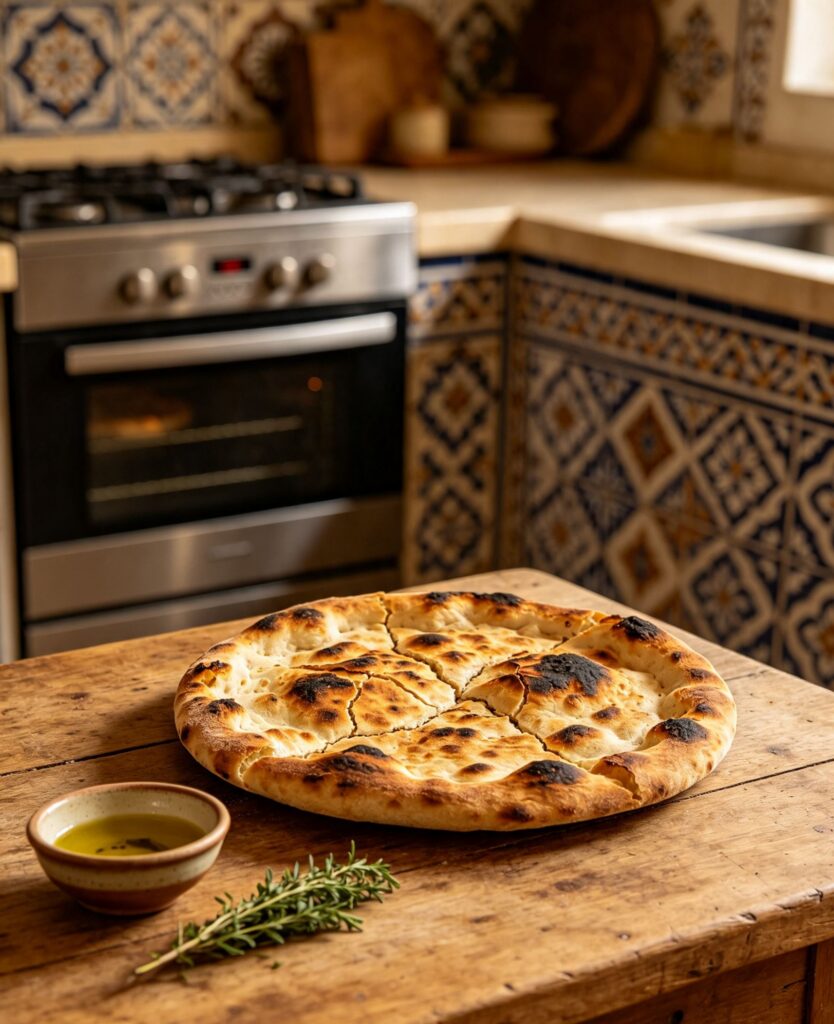
Ancient Stone-Baked Flatbread
The Quirky Foodster Team
Ingredients
- 500g (4 cups) Plain wheat flour, plus extra for dusting
- 1 tsp active dry yeast
- 1 tsp sugar
- 350ml (1 1/2 cups) Warm water
- 1 tsp salt
- 2 tbsp olive oil
Method
- Dissolve the yeast and sugar in the warm water and let stand for 10 minutes until foamy.
- Combine the flour and salt in a large bowl, then stir in the yeast mixture and olive oil to form a dough.
- Knead for 8-10 minutes until smooth and elastic, then place in an oiled bowl, cover, and let rise for 1 hour until doubled.
- Preheat the oven with a baking stone or heavy tray inside to 250°C (480°F).
- Divide the dough into 6 pieces, roll each into a thin oval about 5 mm (1/4 in) thick, and dimple the surface with your fingertips.
- Bake in batches directly on the hot stone or tray for 3-4 minutes per side until puffed and lightly charred in spots.
Native Name: Nan-e Sang
Cultural Background: Bread baked directly on heated stones or pebbles is one of the oldest baking methods recorded on the Iranian
Plateau, later refined into ovens lined with stones, giving flatbreads their characteristically dimpled surface.
Bread of this kind was the daily foundation of the Persian table, used to scoop up stews, dips and pottages.
Tips:
– Get your baking surface as hot as your oven allows — this is what gives the bread its characteristic blistered
– crust.
– Work quickly once the dough is rolled out, as thin dough dries and toughens fast.
Variations:
– Sprinkle sesame or nigella seeds onto the dough before baking.
– Brush lightly with olive oil and a pinch of salt straight out of the oven.
Storage: Store wrapped at room temperature for up to 2 days.
Reheating: Warm briefly in a dry pan or low oven to refresh before serving.
Nutrition: Per flatbread: approx. 300 kcal, 8 g protein, 55 g carbohydrate, 5 g fat, 2 g fibre.
FAQs:
Q: Can I make this without a baking stone?
A: Yes, a heavy preheated baking tray or even a very hot heavy frying pan can approximate the effect.
Q: Why does my bread come out dense?
A: This is usually caused by not letting the dough rise fully, or an oven that isn't hot enough before baking.
Please log in to leave a comment.