
Breads
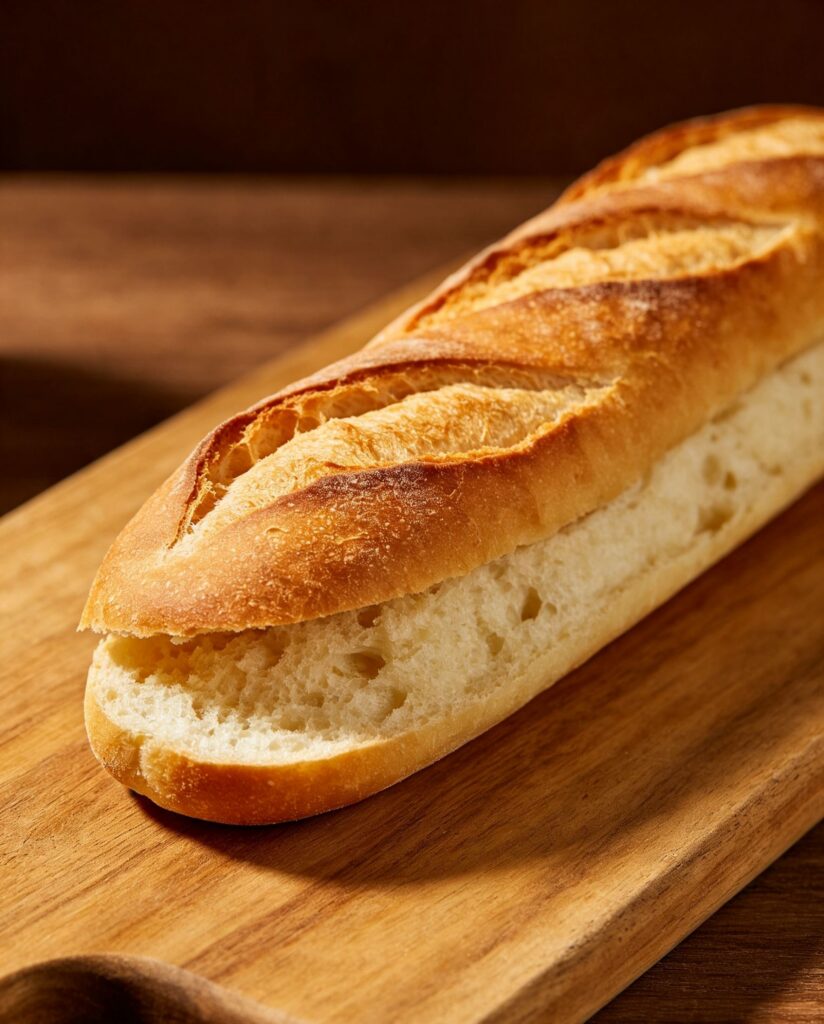
Pan Cubano
The Quirky Foodster Team
Ingredients
- 500 g (4 cups) Bread flour
- 320 ml (1 1/3 cups) Warm water
- 7 g (2 1/4 tsp) Active dry yeast
- 15 g (1 tbsp) Granulated sugar
- 10 g (2 tsp) Fine sea salt
- 20 g (1.5 tbsp) Lard or vegetable shortening, softened
Method
- In a small bowl, dissolve the yeast and sugar in the warm water and let stand for 10 minutes until foamy.
- In a large mixing bowl, combine the flour and salt, then add the yeast mixture and shortening.
- Mix and knead for 10 minutes until a smooth, elastic dough forms.
- Place the dough in a lightly oiled bowl, cover, and let rise in a warm place for about 1 hour, or until doubled in size.
- Punch down the dough and shape into a long, tapered loaf on a baking sheet lined with parchment.
- Cover and let rise for a further 30-40 minutes.
- Preheat the oven to 220°C (425°F) and place a shallow pan of water on the lower rack to create steam.
- Score a shallow lengthwise slash along the top of the loaf using a sharp razor.
- Bake for 20-25 minutes, misting the loaf with water once or twice during the first 10 minutes, until deep golden and hollow-sounding when tapped.
- Cool on a wire rack for at least 20 minutes before slicing.
Introduction: Pan Cubano is the light, crackling-crusted white bread that anchors Cuban breakfasts and sandwiches alike,
distinguished from a French baguette by the addition of a small amount of lard or vegetable shortening in the
dough, which gives it a softer, closer crumb.
Cultural Background: Pan Cubano is the light, crackling-crusted white bread that anchors Cuban breakfasts and sandwiches alike,
distinguished from a French baguette by the addition of a small amount of lard or vegetable shortening in the
dough, which gives it a softer, closer crumb. Traditionally shaped long and split with a palm frond or piece of stiff
palm leaf laid along the top before baking to create its signature split crust.
Tips: The steam from the water pan is essential for achieving the thin, crisp crust characteristic of Pan Cubano. Do not over-knead the dough past the point of smooth elasticity, as it should remain light rather than dense.
Variations: A shorter, rounder shape called Pan de Agua uses the same dough without the traditional palm-leaf scoring. A version with a touch of extra sugar creates a slightly sweeter breakfast-style loaf. Substitute vegetable shortening for lard, which is already common practice, to make this fully vegan.
Storage: Store at room temperature wrapped in a paper bag for up to 1 day; bread stales quickly due to its low fat content.
Reheating: Refresh in a 180°C (350°F) oven for 5 minutes to restore crispness before serving.
Nutrition: Per serving (1 slice): 140 kcal, 4g protein, 27g carbohydrates, 1.5g fat, 1g fibre, 260mg sodium.
FAQs
Q: Why did my loaf come out dense?
A: This is often due to under-proofing; ensure the dough has properly doubled in size at each rising stage.
Q: Can I substitute the lard entirely?
A: Vegetable shortening is a reliable substitute and is commonly used in modern Cuban households.
Please log in to leave a comment.