
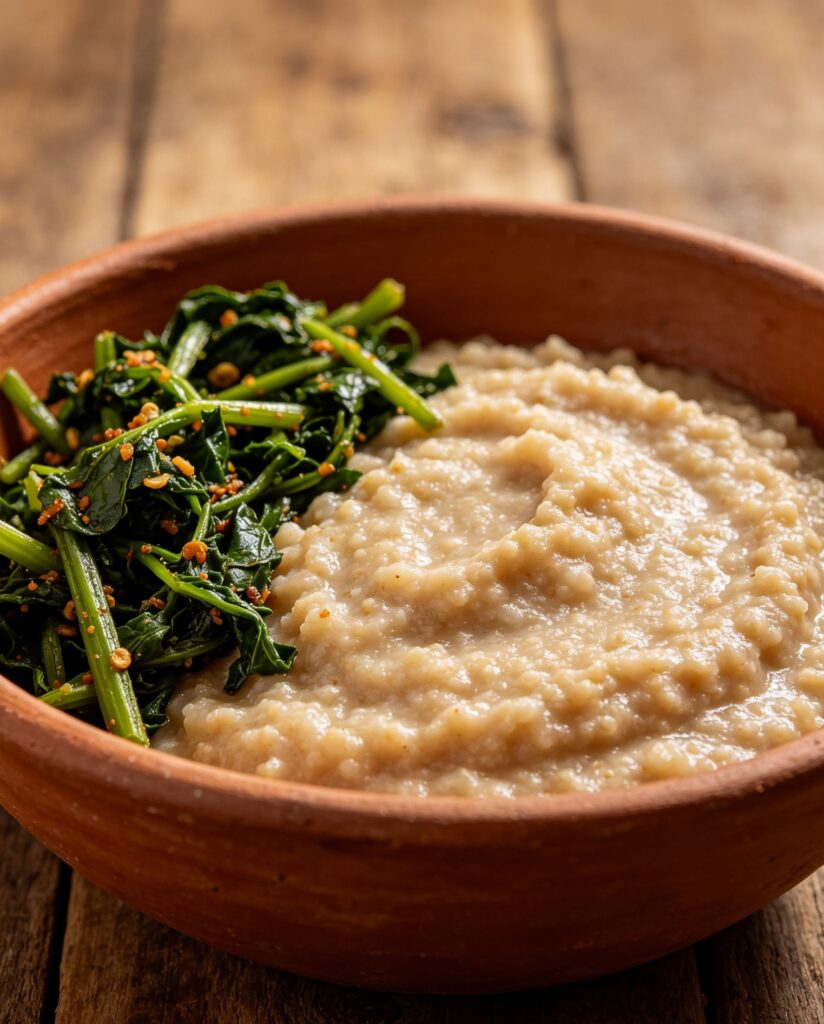
Bogobe le Morogo
The Quirky Foodster Team
Ingredients
- Sorghum meal — 300 g (1 3/4 cups)
- Water, for the porridge — 1 L (4 cups)
- Salt, for the porridge — 1 pinch
- Morogo (amaranth or spinach leaves), washed and roughly chopped — 500 g (1 lb)
- Medium onion, chopped — 1
- Medium tomatoes, chopped — 2
- Vegetable oil — 30 ml (2 tbsp)
- Salt, for the greens — 1 pinch
- Water, for the greens — 125 ml (1/2 cup)
Method
- Bring the water for the porridge to the boil with a pinch of salt.
- Mix the sorghum meal with a little cold water to form a smooth paste, whisk into the boiling water, and stir well.
- Reduce heat to low and cook for 25-30 minutes, stirring often, until very thick and firm enough to hold its shape on a spoon.
- Meanwhile, heat the oil in a second saucepan and saute the onion until soft and translucent.
- Add the tomatoes and cook for 5 minutes until softened.
- Add the chopped morogo, salt and the 125 ml water. Cover and simmer for 15-20 minutes, stirring occasionally, until the greens are tender.
- Serve the firm porridge alongside or topped with the cooked morogo.
Introduction: Bogobe le morogo pairs firm sorghum porridge with morogo, a general Setswana term for wild leafy greens gathered from fields and gardens, such as amaranth or blackjack leaves.
Cultural Background: Bogobe le morogo pairs firm sorghum porridge with morogo, a general Setswana term for wild leafy greens gathered from fields and gardens, such as amaranth or blackjack leaves. This simple, plant-based combination has fed rural families in Botswana for generations and remains a common, affordable lunch, particularly during the rainy season when greens grow wild and plentiful.
Tips: The porridge should be firm, not runny; this style is meant to be scooped and shaped by hand to dip into the greens. If morogo is unavailable, English spinach or Swiss chard makes a good substitute, though the flavour will be milder.
Variations: Add a small piece of dried fish or a spoonful of ground peanuts to the morogo for extra richness. Use maize meal instead of sorghum for a milder-tasting porridge. Naturally vegan; keep dried fish out of the morogo to preserve this.
Storage: Store porridge and morogo separately in airtight containers in the refrigerator for up to 2 days.
Reheating: Reheat both components in separate saucepans over low heat with a splash of water, stirring often.
Nutrition: Approx. per serving: 290 kcal, 9 g protein, 48 g carbohydrates, 8 g fat, 6 g fibre.
FAQs:
Q: What greens count as morogo?
A: Morogo refers broadly to wild or garden leafy greens such as amaranth, blackjack, pumpkin leaves or spider plant leaves, whichever is locally available and in season.
Q: Is this dish naturally vegan?
A: Yes, this dish is naturally plant-based provided no dried fish is added.
- Sorghum meal — 300 g (1 3/4 cups)
- Water, for the porridge — 1 L (4 cups)
- Salt, for the porridge — 1 pinch
- Morogo (amaranth or spinach leaves), washed and roughly chopped — 500 g (1 lb)
- Medium onion, chopped — 1
- Medium tomatoes, chopped — 2
- Vegetable oil — 30 ml (2 tbsp)
- Salt, for the greens — 1 pinch
- Water, for the greens — 125 ml (1/2 cup)
Please log in to leave a comment.