
Martinigansl (St. Martin’s Roast Goose)
The Quirky Foodster Team
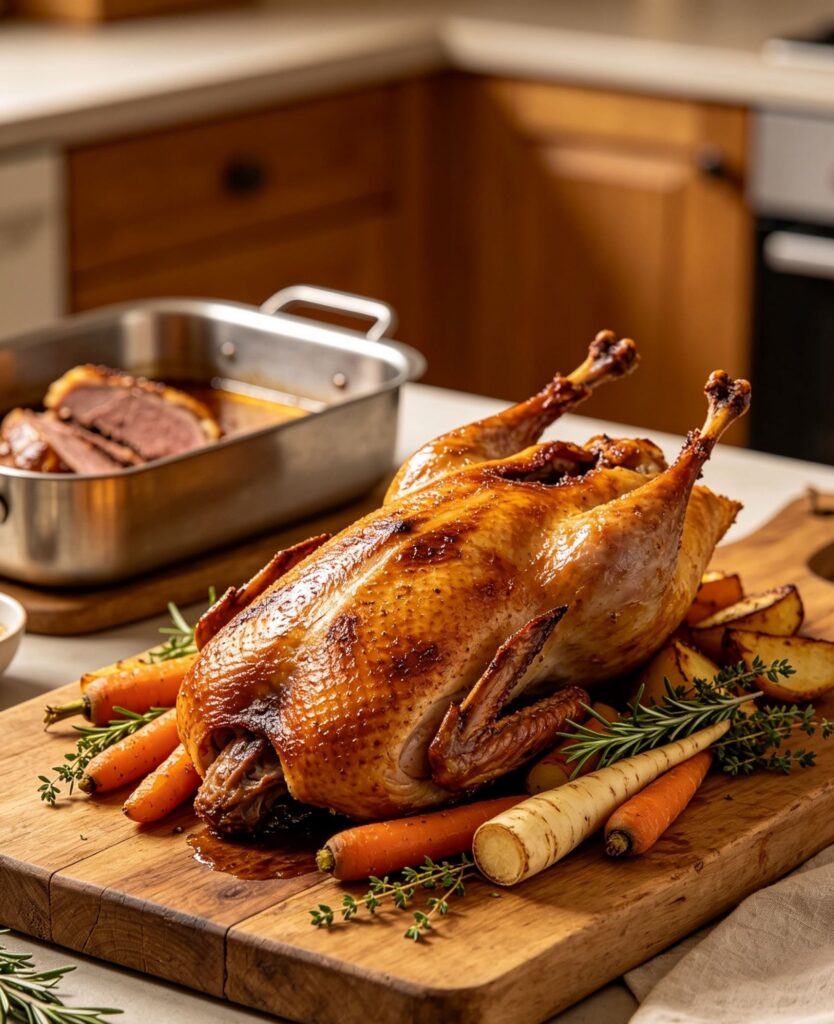
Ingredients
- Whole goose (about 4-4.5 kg / 9-10 lb) — 1
- Salt, plus extra for seasoning — 2 tsp
- Ground black pepper — 1 tsp
- Caraway seeds — 1 tsp
- Apples, quartered and cored — 2
- Onion, quartered — 1
- Fresh marjoram or 1 tsp dried marjoram — 4 sprigs
- Water or stock, for the roasting tin — 250 ml (1 cup)
- Flour, for the gravy (optional) — 1 tbsp
Method
- Preheat the oven to 160°C (320°F).
- Pat the goose dry inside and out. Season the cavity generously with salt, pepper and caraway seeds.
- Stuff the cavity with the quartered apples, onion and marjoram, then truss the legs closed with kitchen twine.
- Prick the skin all over (especially around the thighs and breast) to help the fat render during roasting.
- Place the goose breast-side up in a roasting tin, season the skin with salt, and pour the water into the base of the tin.
- Roast for about 2 to 2.5 hours (roughly 30 minutes per kg), basting occasionally with the rendered fat and pan juices, and draining excess fat from the tin periodically.
- For crisp skin, increase the oven temperature to 220°C (425°F) for the final 20-25 minutes of roasting.
- Check the goose is cooked through with a meat thermometer reading at least 74°C (165°F) in the thickest part of the thigh.
- Rest the goose for 15-20 minutes before carving. If desired, use the pan drippings to make a gravy, thickened with a little flour if needed.
Introduction: Martinigansl, roast goose served on and around St.
Cultural Background: Martinigansl, roast goose served on and around St. Martin’s Day (11 November), is one of Austria’s most anticipated autumn feasts. Rooted in the legend of St. Martin, who reportedly hid among geese to avoid being made bishop only for the birds to give him away, the tradition of eating goose on this day has endured for centuries across Austrian towns and villages.
Tips: Pricking the skin thoroughly and draining rendered fat during roasting is essential for crisp, non-greasy skin. Save the rendered goose fat — it is a prized ingredient in Austrian cooking, excellent for roasting potatoes.
Variations: Serve with Rotkraut (braised red cabbage) and Semmelknödel (bread dumplings), the traditional accompaniments. Add chestnuts to the cavity stuffing for a richer, more festive variation.
Vegetarian/Vegan: This dish’s identity is centred on roast goose; a vegetarian version is not traditionally authentic, though the traditional side dishes (Rotkraut and Semmelknödel) are naturally vegetarian.
Storage: Store cooked goose covered in the refrigerator for up to 3 days; rendered fat can be stored refrigerated for months.
Reheating: Reheat sliced goose covered in a 160°C (320°F) oven with a little stock or gravy to keep it moist, for about 15-20 minutes.
Nutrition: Approx. per serving: 520 kcal, 38g protein, 6g carbohydrate, 38g fat
FAQs:
Q: Why is goose eaten on St. Martin’s Day?
A: The tradition stems from a legend about St. Martin hiding among geese, and it has become an enduring Austrian autumn custom on and around 11 November.
Q: What should Martinigansl be served with?
A: Braised red cabbage (Rotkraut) and bread dumplings (Semmelknödel) are the classic traditional accompaniments.
- Whole goose (about 4-4.5 kg / 9-10 lb) — 1
- Salt, plus extra for seasoning — 2 tsp
- Ground black pepper — 1 tsp
- Caraway seeds — 1 tsp
- Apples, quartered and cored — 2
- Onion, quartered — 1
- Fresh marjoram or 1 tsp dried marjoram — 4 sprigs
- Water or stock, for the roasting tin — 250 ml (1 cup)
- Flour, for the gravy (optional) — 1 tbsp
Please log in to leave a comment.