
Breads
Crumpets (Crumpets)
sjfegan
Ingredients
- 250g (2 cups) Flour
- 1.5 tsp active dry yeast
- 1 tsp sugar
- 360ml (1.5 cups) Warm milk
- 1/2 tsp salt
- 1/4 tsp baking soda, dissolved in a little water
- Butter, for cooking and serving
Method
- Dissolve the yeast and sugar in the warm milk and let sit for 10 minutes until foamy.
- Combine the flour and salt in a bowl, then add the yeast mixture, whisking to form a smooth, thick batter.
- Cover and let rise in a warm place for 1 hour until bubbly.
- Stir in the dissolved baking soda.
- Heat a lightly greased griddle over medium heat and place the greased rings on it.
- Pour batter into each ring to about 1 cm (1/2 in) deep.
- Cook for 8–10 minutes until the surface is covered in small holes and mostly set, then remove the rings and flip to briefly cook the other side for 1–2 minutes.
- Serve warm, toasted if desired, with plenty of butter.
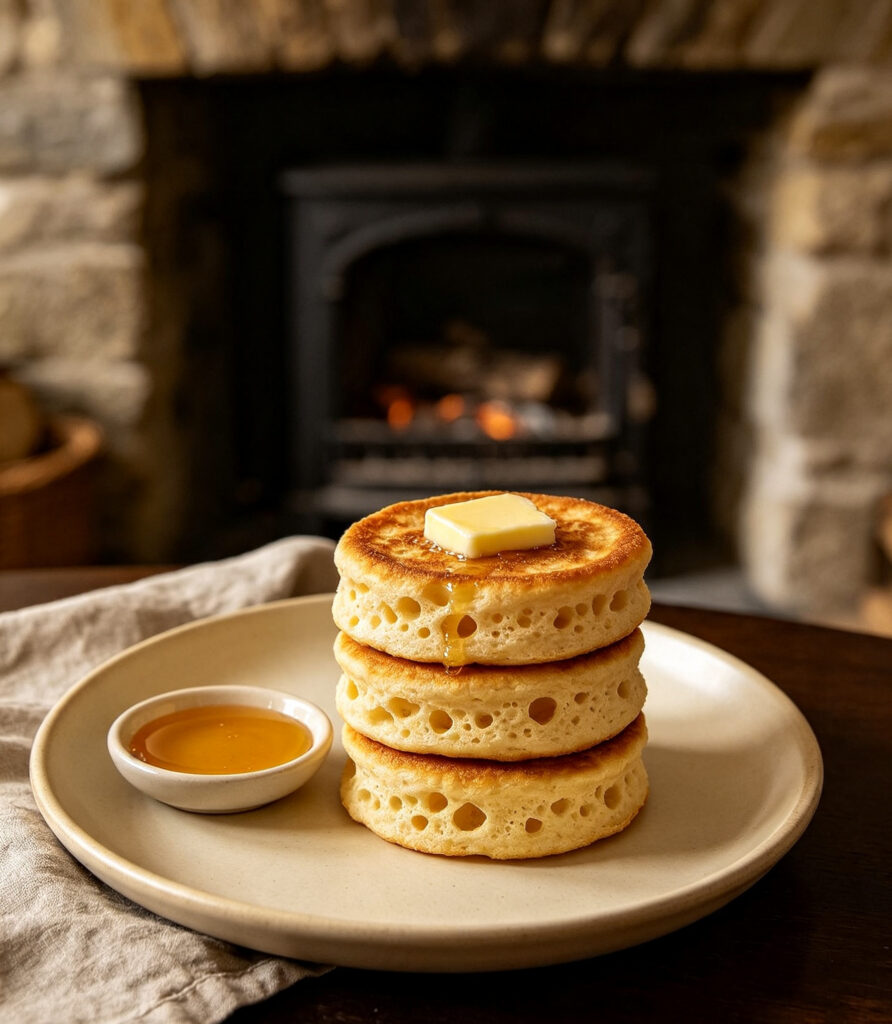
Introduction: Small, spongy griddle cakes riddled with characteristic holes, a beloved Victorian teatime treat served hot with butter.
Cultural Background: Crumpets became firmly established as a British teatime staple during the Victorian era, their distinctive holey texture, achieved through a yeasted batter cooked in rings, perfect for soaking up melted butter.
Tips: Let the batter rise and bubble fully, as this is essential for developing the characteristic holes. Cook over moderate, steady heat so the crumpets cook through without burning the base before the top sets.
Variations: Serve with jam alongside the butter for a sweeter teatime treat. Toast day-old crumpets before serving for extra texture.
Storage: Store cooled crumpets in an airtight container at room temperature for up to 2 days.
Reheating: Toast briefly before serving to restore texture and warmth.
Nutrition: Per serving (approx., 1 crumpet): 160 kcal, 5 g protein, 3 g fat, 28 g carbohydrate.
FAQs:
Q: What creates the characteristic holes in crumpets?
A: The combination of yeast fermentation and baking soda creates bubbles that rise to the surface and burst during cooking, leaving behind the distinctive holey texture.
Q: Are crumpets the same as English muffins?
A: They’re related but distinct — crumpets are cooked only from one side up in a ring, giving a flat top full of holes, while English muffins are turned and have a different texture.
Please log in to leave a comment.