
Manchet Bread (Fine White Bread)
The Quirky Foodster Team
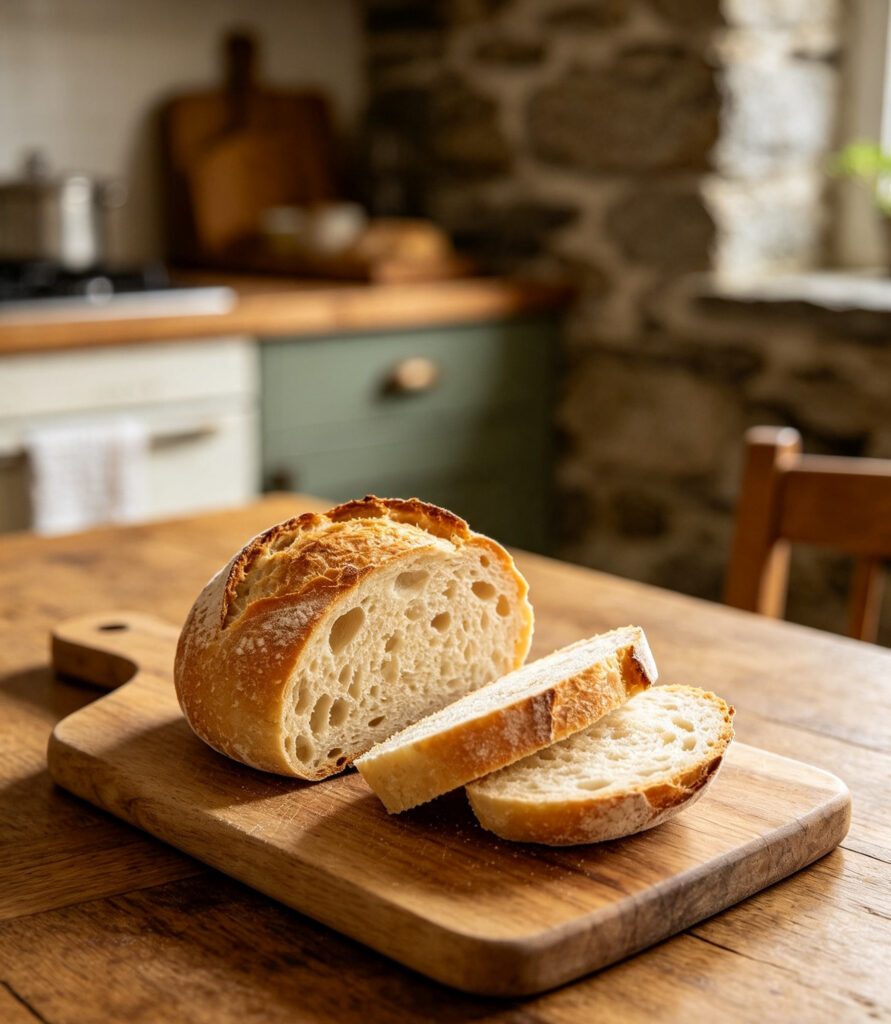
Ingredients
- Strong white bread flour — 500 g (4 cups)
- Fine salt — 10 g (2 tsp)
- Fast-action dried yeast — 7 g (2 tsp)
- Sugar — 1 tbsp
- Warm water — 300 ml (1.25 cups)
- Unsalted butter, melted — 30 g (2 tbsp)
Method
- In a large bowl, mix the flour, salt, yeast and sugar together.
- Add the warm water and melted butter, and mix until a rough dough forms.
- Turn out onto a floured surface and knead for 10 minutes, until smooth and elastic.
- Place the dough in a lightly oiled bowl, cover with a tea towel, and leave to rise in a warm place for 1 hour, or until doubled in size.
- Knock back the dough, shape into two round loaves, and place on a floured baking tray.
- Cover and leave to prove for a further 30-40 minutes, until visibly puffy.
- Preheat the oven to 220°C (425°F). Score a deep cross into the top of each loaf.
- Bake for 25-30 minutes, until golden brown and the loaves sound hollow when tapped on the base.
- Cool on a wire rack before slicing.
Introduction: The finest white bread of the Tudor table, manchet was made from the most highly refined wheat flour and reserved chiefly for the wealthy.
Cultural Background: Manchet bread represented the top tier of the Tudor bread hierarchy, made from the whitest, most finely bolted (sieved) flour available and served to nobility and royalty, including at the table of Henry VIII, whose household accounts record substantial quantities baked daily. Its fine crumb and pale colour stood in sharp contrast to the coarser breads eaten by common people.
Tips: (cid:127) Scoring a deep cross into the top of each loaf was a traditional method that helped the bread rise evenly and made it easier to break into quarters at the table. (cid:127) Ensure the water is warm, not hot, as overly hot water can kill the yeast and prevent the dough from rising.
Variations: (cid:127) A little milk can be used in place of some of the water for an even softer, richer crumb. (cid:127) Shape into small individual rolls rather than large loaves for an authentic single-serving presentation.
Storage: Store in a bread bin or paper bag at room temperature for up to 3 days.
Reheating: Refresh in an oven preheated to 180°C (350°F) for 5 minutes to restore crustiness, or toast slices as needed.
Nutrition: Per serving (approx., 1 slice): 140 kcal, 4 g protein, 26 g carbohydrate, 2 g fat, 1 g fibre, 240 mg sodium.
FAQs:
Q: Why is manchet bread so white?
A: It was traditionally made from the finest bolted (sieved) wheat flour, with the bran and germ removed, giving it a much paler colour than everyday breads of the period. (cid:127) Q: Can I make this bread by hand without a stand mixer? A: Yes, this recipe is designed for hand kneading and requires no special equipment beyond a mixing bowl and a floured work surface.
- Strong white bread flour — 500 g (4 cups)
- Fine salt — 10 g (2 tsp)
- Fast-action dried yeast — 7 g (2 tsp)
- Sugar — 1 tbsp
- Warm water — 300 ml (1.25 cups)
- Unsalted butter, melted — 30 g (2 tbsp)
Please log in to leave a comment.