
Cowpea and Millet Pottage
The Quirky Foodster Team
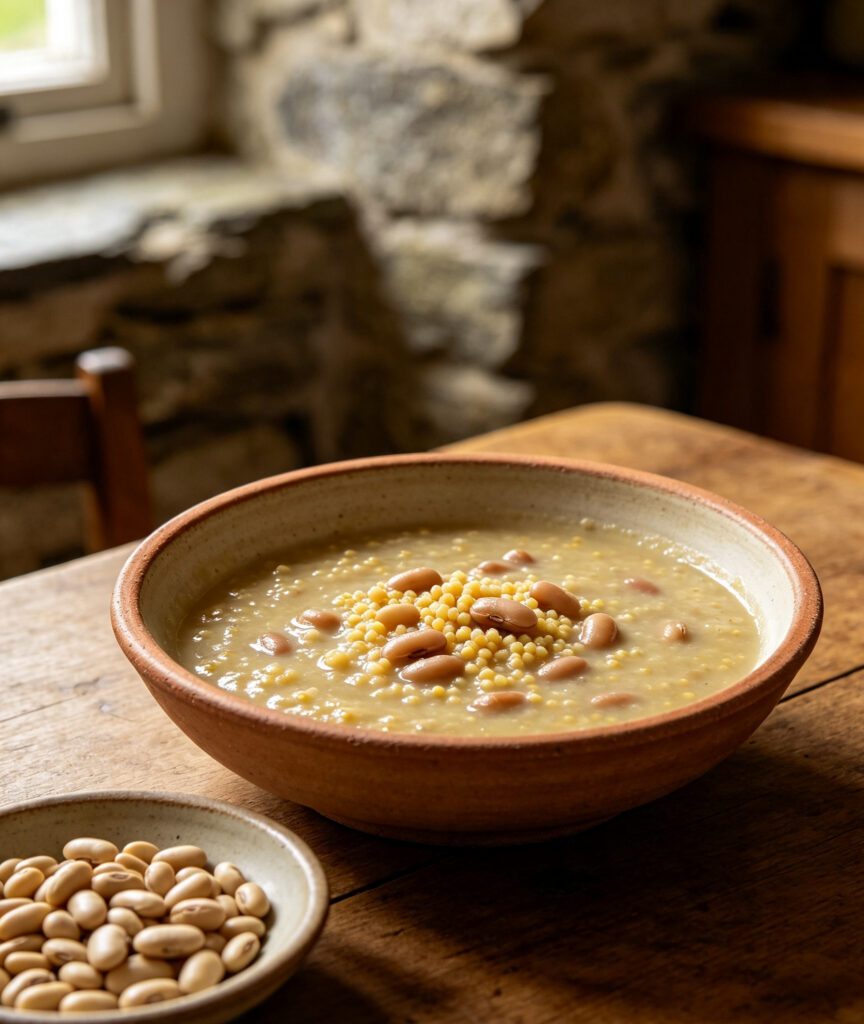
Ingredients
- Dried cowpeas, soaked overnight — 200 g (1 cup)
- Millet — 150 g (0.75 cup)
- Water — 1 L (4 cups)
- Onion, chopped — 1
- Salt — 1 pinch
Method
- Drain the soaked cowpeas and place in the pot with the millet and water.
- Bring to a simmer and cook for 35-40 minutes, stirring occasionally, until both the cowpeas and millet are tender and the pottage has thickened.
- Add the chopped onion partway through, in the final 15 minutes of cooking.
- Season with salt and serve hot.
Introduction: A thick pottage of cowpeas and millet, drawing directly on Ibn Battuta’s account of pounded beans offered alongside millet and other local foods along his route.
Cultural Background: Ibn Battuta directly records being offered ‘pounded green beans’ alongside millet, milk, rice and other foods by local women during his journey along the Niger River; this most plausibly refers to cowpeas (Vigna unguiculata), a legume genuinely native to Africa and well documented as a staple crop across the wider Sahel, making the pairing of beans and millet in this dish a reasonably well-grounded reconstruction.
Tips: – Soaking the cowpeas overnight shortens cooking time considerably. – Stir occasionally toward the end of cooking, as the thickened pottage can catch on the bottom of the pot.
Variations: – Naturally vegan as written. – A little shea butter can be stirred in at the end, reflecting a well-documented regional cooking fat (see Sides section).
Storage: Refrigerate covered for up to 4 days.
Reheating: Reheat in a pot over low heat with a splash of water, stirring, for 6-8 minutes until hot throughout.
Nutrition: Per serving (approx.): 240 kcal, 13 g protein, 42 g carbohydrate, 2 g fat, 8 g fibre.
FAQs:
Q: Does Ibn Battuta really mention beans specifically?
A: Yes, he directly lists ‘pounded green beans’ among the foods offered to him by local women along the Niger, alongside millet, milk, rice and other items, most plausibly referring to cowpeas, a legume genuinely native to Africa and well documented as a Sahelian staple.
Q: Is this exact pairing of cowpeas and millet directly named?
A: The two ingredients are separately and directly attested in Ibn Battuta’s account and in the broader crop record for the region; their specific combination into one pottage is a reasonable reconstruction rather than a single named period recipe.
- Dried cowpeas, soaked overnight — 200 g (1 cup)
- Millet — 150 g (0.75 cup)
- Water — 1 L (4 cups)
- Onion, chopped — 1
- Salt — 1 pinch
Please log in to leave a comment.