
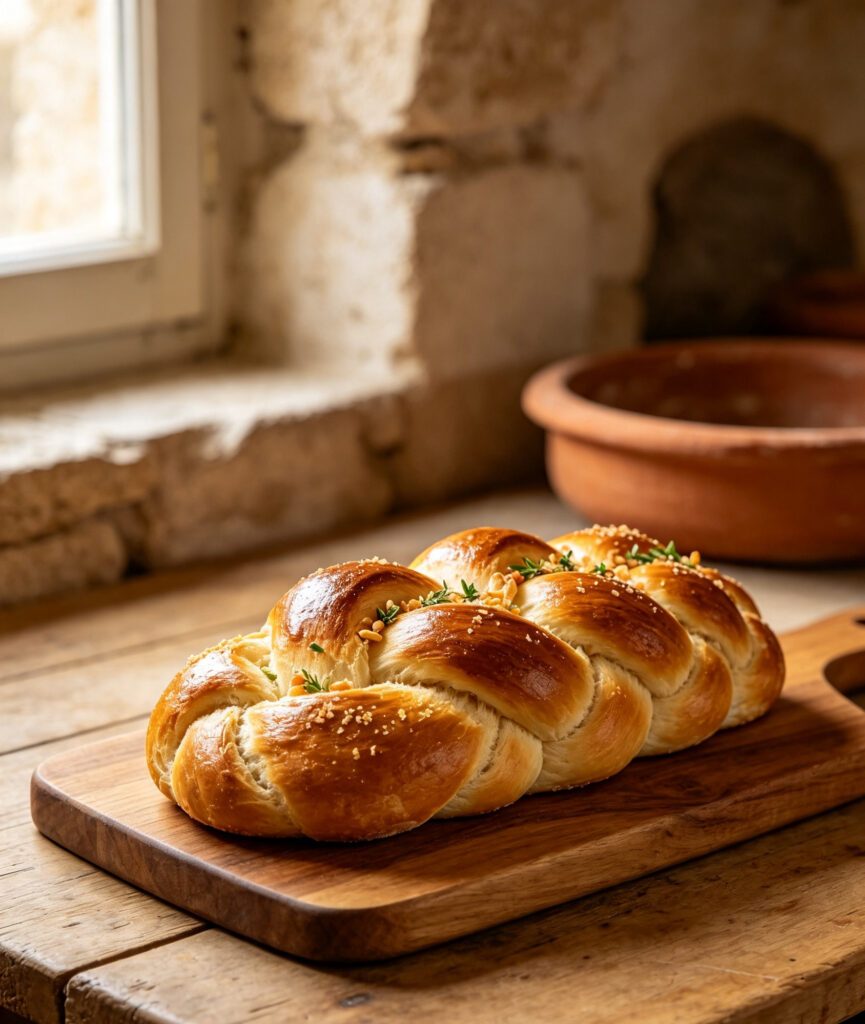
Easter Bread (Tsoureki Byzantino)
The Quirky Foodster Team
Ingredients
- Bread flour (625 g / 1 lb 6 oz) — 5 cups
- Active dry yeast — 2.5 tsp
- Sugar — 200 g (1 cup)
- Warm milk — 240 ml (1 cup)
- Egg yolks — 4
- Butter, softened — 115 g (1/2 cup)
- Ground mahlab or cardamom — 1 tsp
- Egg, beaten, for glazing — 1
- Sesame seeds, for topping
Method
- Dissolve the yeast and a little sugar in the warm milk and let sit for 10 minutes until foamy.
- Combine the flour, remaining sugar and spice in a large bowl, then add the yeast mixture, egg yolks and softened butter, kneading for 12–15 minutes until smooth and elastic.
- Cover and let rise in a warm place for 2 hours, or until doubled.
- Divide into three portions, roll each into a rope, and braid together.
- Place on a baking tray and let rise for a further 45 minutes.
- Preheat the oven to 170°C (340°F).
- Brush with beaten egg and sprinkle with sesame seeds.
- Bake for 35–40 minutes until deeply golden.
Introduction: A rich, braided sweet bread flavoured with warm spices, prepared to celebrate Easter, one of the most significant observances of the Byzantine Christian calendar.
Cultural Background: As the centre of Eastern Orthodox Christianity, Byzantine Constantinople placed great significance on Easter celebrations, and rich, braided breads like this one marked the joyful end of the Lenten fast, a tradition that continues into the modern Greek Orthodox tsoureki.
Tips: Knead the dough thoroughly for the full time specified, as this develops the characteristic soft, stretchy crumb. Let the bread cool before slicing, as this helps the rich crumb structure set properly.
Variations: Traditionally, a red-dyed egg is sometimes tucked into the braid for Easter, symbolising renewal. Adjust the spice to preference, as both mahlab and cardamom are traditional options.
Storage: Store wrapped at room temperature for up to 4 days.
Reheating: Not typically reheated; served at room temperature or lightly toasted.
Nutrition: Per serving (approx., 1 slice): 320 kcal, 8 g protein, 10 g fat, 48 g carbohydrate.
FAQs:
Q: Why was Easter so significant in Byzantine Constantinople?
A: As the heart of Eastern Orthodox Christianity, Constantinople placed deep religious significance on Easter, marking the most important celebration of the Christian liturgical calendar.
Q: Is this bread a direct ancestor of modern tsoureki?
A: Yes, this rich, braided sweet bread tradition continues largely unbroken into the tsoureki still baked for Greek Orthodox Easter celebrations today.
- Bread flour (625 g / 1 lb 6 oz) — 5 cups
- Active dry yeast — 2.5 tsp
- Sugar — 200 g (1 cup)
- Warm milk — 240 ml (1 cup)
- Egg yolks — 4
- Butter, softened — 115 g (1/2 cup)
- Ground mahlab or cardamom — 1 tsp
- Egg, beaten, for glazing — 1
- Sesame seeds, for topping
Please log in to leave a comment.