
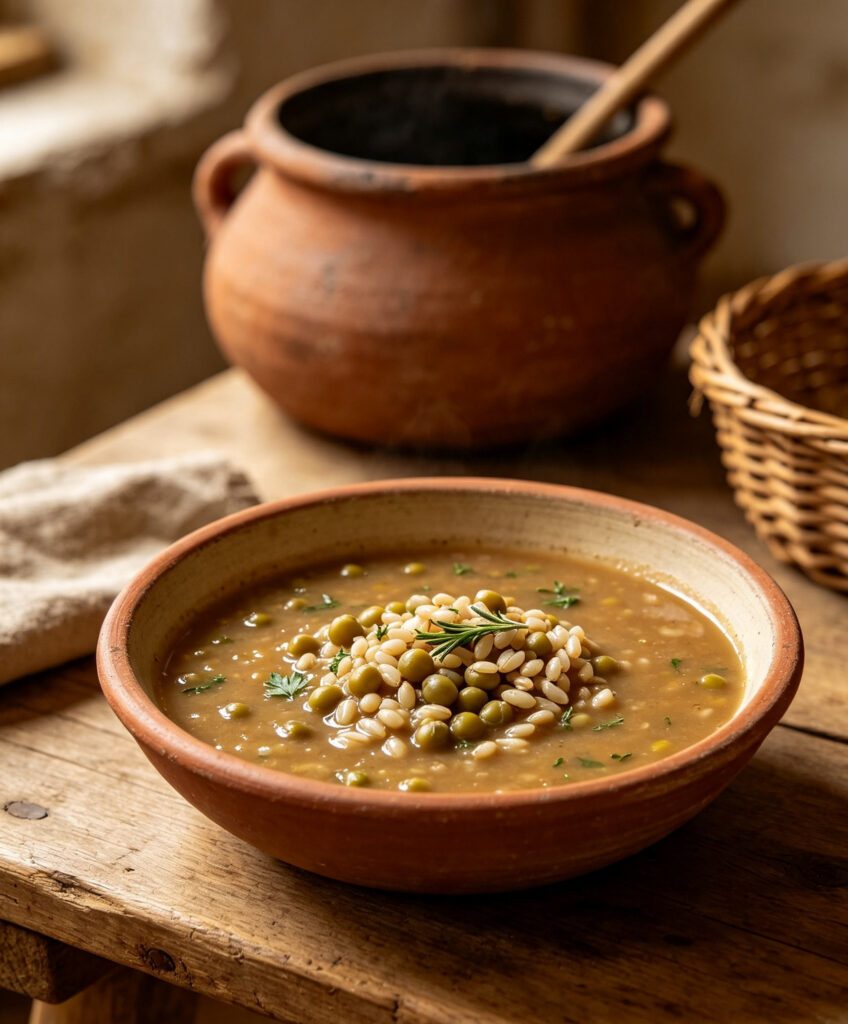
Pea and Barley Pottage
The Quirky Foodster Team
Ingredients
- Dried peas, soaked overnight — 200 g (1 cup)
- Barley — 150 g (0.75 cup)
- Water — 1 L (4 cups)
- Onion, chopped — 1
- Salt — 1 pinch
Method
- Drain the soaked peas and place in the pot with the barley and water.
- Bring to a simmer and cook for 45-50 minutes, stirring occasionally, until both the peas and barley are tender and the pottage has thickened.
- Add the chopped onion partway through, in the final 15 minutes of cooking.
- Season with salt and serve hot.
Introduction: A thick midday pottage of dried peas simmered with barley, a filling one-pot meal drawing on two staple crops well attested across Iron Age Gallic farming sites.
Cultural Background: Both peas and barley are recovered from Iron Age Gallic and central European archaeobotanical assemblages as established field crops, and thick grain-and-legume pottages are the simplest and most broadly supported cooking format given the basic hearth and pot equipment documented archaeologically at continental Celtic settlement sites; the specific combined recipe here is a reasonable reconstruction rather than a directly attested period dish, since no written continental Celtic recipe survives.
Tips: – Soaking the peas overnight shortens cooking time and gives a smoother final texture. – Stir occasionally toward the end of cooking, as the thickened pottage can catch on the bottom of the pot.
Variations: – Naturally vegan as written. – A little smoked or salted meat can be simmered in for a heartier version.
Storage: Refrigerate covered for up to 4 days.
Reheating: Reheat in a pot over low heat with a splash of water, stirring, for 6-8 minutes until hot throughout.
Nutrition: Per serving (approx.): 230 kcal, 12 g protein, 42 g carbohydrate, 1.5 g fat, 9 g fibre.
FAQs:
Q: Were peas a significant Gallic crop?
A: Yes, they are recovered from Iron Age Gallic and central European archaeobotanical sites as an established field crop alongside barley and emmer wheat.
Q: Is this an exact named period recipe?
A: No; it is a plausible reconstruction from two well-attested staple crops, since no continental Celtic written recipes survive at all.
- Dried peas, soaked overnight — 200 g (1 cup)
- Barley — 150 g (0.75 cup)
- Water — 1 L (4 cups)
- Onion, chopped — 1
- Salt — 1 pinch
Please log in to leave a comment.