
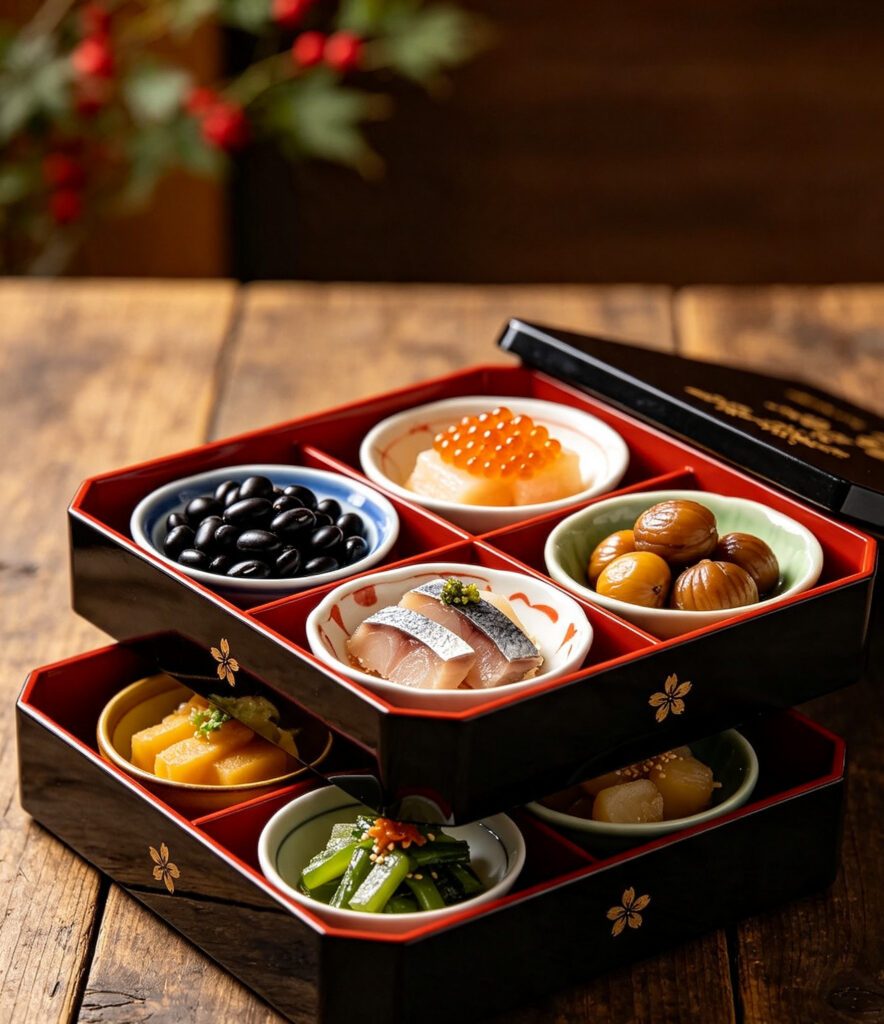
New Year Layered Box Meal
The Quirky Foodster Team
Ingredients
- Kuromame (black soybeans) — 200 g (7.1 oz)
- Sugar — 100 g (3.5 oz)
- Soy sauce — 1 tsp
- Carrots, cut into decorative shapes — 2
- Renkon (lotus root), sliced — 150 g (5.3 oz)
- Dashi broth — 150 ml (2/3 cup)
- Soy sauce — 3 tbsp
- Mirin — 2 tbsp
- Sugar — 2 tbsp
- Dried sardines or a small amount of herring roe (kazunoko), to represent additional symbolic dishes — 4
Method
- Simmer the black soybeans gently in water with sugar and soy sauce for about 40 minutes, until tender and glossy.
- In a separate pot, simmer the carrots and lotus root in the dashi, soy sauce, mirin, and sugar for 15-20 minutes, until tender.
- Prepare any additional symbolic elements, such as dried sardines or roe, according to preference.
- Arrange each finished dish carefully in a compartment of a layered box or divided serving dish, taking care with presentation.
- Serve at room temperature as part of the New Year celebration.
Introduction: An assortment of symbolic, carefully prepared dishes arranged in layered boxes, the centrepiece of the Japanese New Year celebration.
Cultural Background: Osechi ryori developed over many centuries into an elaborate tradition of symbolic New Year foods, each dish carrying meanings of longevity, prosperity, fertility, or happiness, prepared in advance so households could rest from cooking during the first days of the new year.
Tips: Careful, attractive arrangement is considered as important as the cooking itself for this presentation-focused meal.
Variations: Regional and household traditions vary considerably in which specific dishes are included.
Nutrition: Approx. 280 kcal per serving (across the assortment).
FAQs:
Q: Why is osechi prepared in advance?
A: Traditionally, the dishes are prepared before New Year’s Day so that households, particularly those managing the kitchen, could rest from cooking during the early days of the new year.
Q: What do the individual dishes symbolise?
A: Different ingredients carry different symbolic meanings — for example, black soybeans (kuromame) are associated with health and hard work, while lotus root’s many holes are said to represent an unobstructed future.
- Kuromame (black soybeans) — 200 g (7.1 oz)
- Sugar — 100 g (3.5 oz)
- Soy sauce — 1 tsp
- Carrots, cut into decorative shapes — 2
- Renkon (lotus root), sliced — 150 g (5.3 oz)
- Dashi broth — 150 ml (2/3 cup)
- Soy sauce — 3 tbsp
- Mirin — 2 tbsp
- Sugar — 2 tbsp
- Dried sardines or a small amount of herring roe (kazunoko), to represent additional symbolic dishes — 4
Please log in to leave a comment.