
Tzoalli (Amaranth Seed Cakes for the Panquetzaliztli Festival)
The Quirky Foodster Team
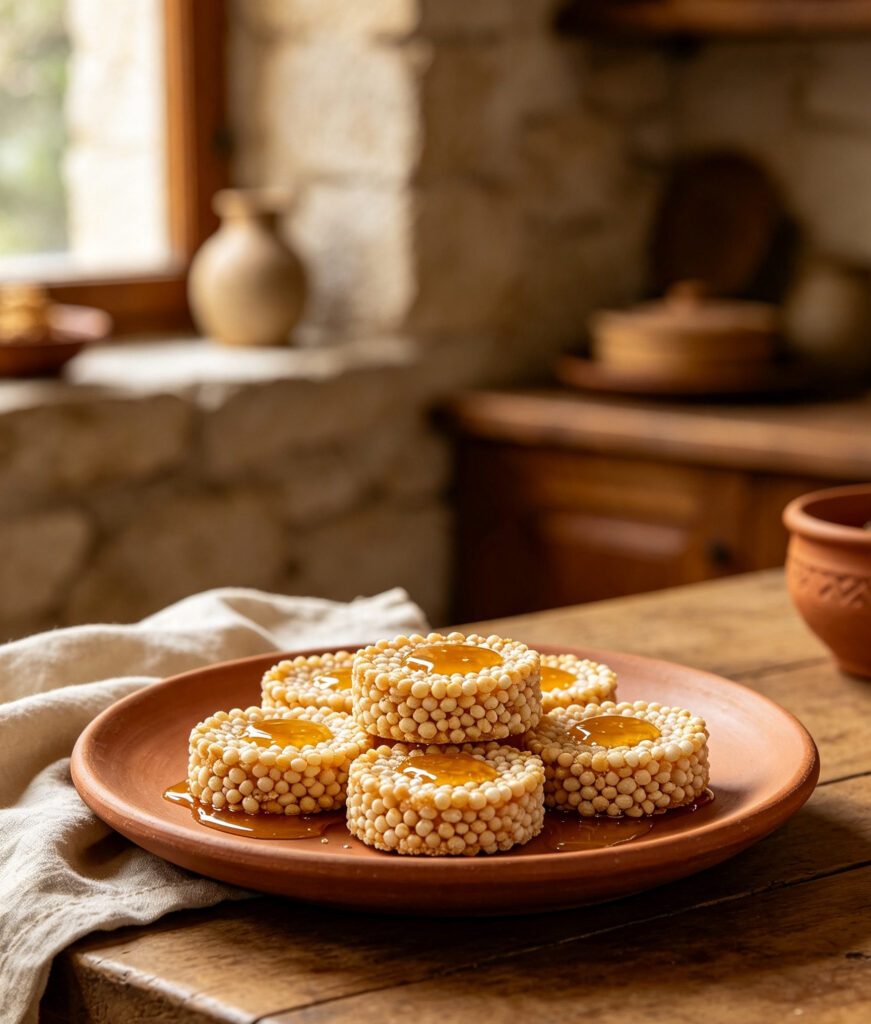
Ingredients
- Ground toasted amaranth seed flour (or finely ground popped amaranth) — 250 g (2 cups)
- Honey — 200 g (2/3 cup)
- Fine salt — 1/4 tsp
- Toasted, finely chopped pumpkin seeds, for decoration (optional) — 1 tbsp
Method
- Gently warm the honey in a small saucepan over low heat until runny, taking care not to let it boil.
- Place the ground amaranth flour and salt in a mixing bowl and pour over the warm honey, stirring vigorously until a stiff, well-combined dough forms.
- Once cool enough to handle, knead briefly by hand until smooth and pliable.
- Press the dough out on the lined baking tray to an even thickness of about 1.5 cm (2/3 in).
- Use small cutters to shape the dough into simple cake shapes, or shape by hand into small rounds.
- Decorate the tops with a few toasted pumpkin seeds if desired.
- Leave to firm up at room temperature for at least 2 hours before serving.
Introduction: A stiff dough of ground amaranth seed and honey, shaped and eaten as part of one of the Mexica calendar’s most significant religious festivals, tzoalli carried deep ceremonial meaning far beyond its role as a sweet food.
Cultural Background: During the festival of Panquetzaliztli, held in honour of the patron deity Huitzilopochtli, tzoalli dough was shaped into a large ceremonial image of the god, which was later ritually broken apart and shared among participants in a rite of communal consumption. This recipe presents a home-cook-friendly, non-ceremonial version of the dough itself, shaped simply into small cakes rather than a religious icon, in respectful recognition of the practice’s sacred original context.
Tips: Work the dough while it is still warm and pliable, as it becomes considerably harder to shape once fully cooled. This is presented here as a home-style sweet inspired by the tzoalli tradition, distinct from the elaborate ceremonial figures made for the Panquetzaliztli festival itself.
Variations: A few drops of natural red food colouring derived from beetroot can be worked into a portion of the dough for a festive, multi-coloured presentation. Small pieces of dried fruit can be pressed into the surface for extra decoration and flavour.
Storage: Store in an airtight container at room temperature for up to 2 weeks.
Reheating: No reheating required; served at room temperature.
Nutrition: Per serving (approx., 1 small cake): 140 kcal, 3 g protein, 26 g carbohydrate, 2 g fat, 1 g fibre, 60 mg sodium.
FAQs:
Q: What is the historical significance of tzoalli?
A: It was used to form a large ceremonial image of the deity Huitzilopochtli during the Panquetzaliztli festival, which was later ritually broken and shared, a practice of deep religious significance to the Mexica.
Q: Is this recipe the same as the ceremonial version?
A: No, this is a simplified, everyday-style sweet inspired by the same dough used in the ceremony, shaped into simple cakes rather than a religious icon, out of respect for the practice’s original sacred context.
- Ground toasted amaranth seed flour (or finely ground popped amaranth) — 250 g (2 cups)
- Honey — 200 g (2/3 cup)
- Fine salt — 1/4 tsp
- Toasted, finely chopped pumpkin seeds, for decoration (optional) — 1 tbsp
Please log in to leave a comment.