
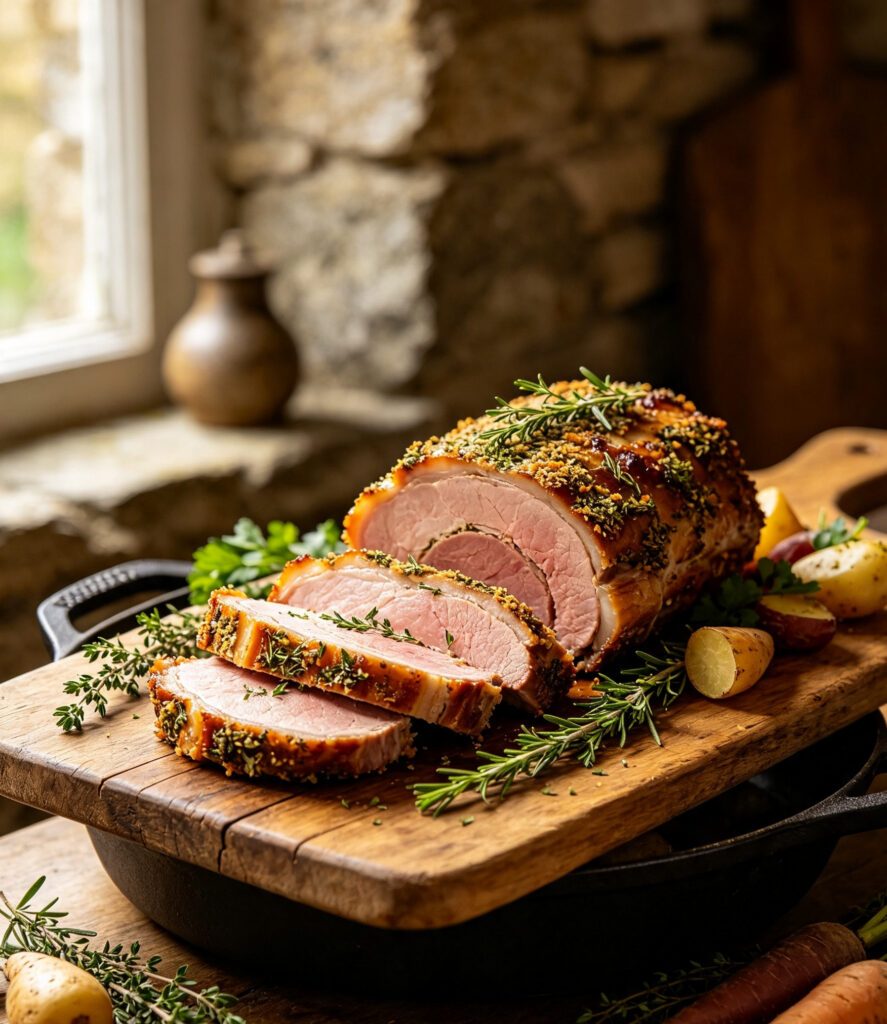
Roast Pork with Wild Herbs
The Quirky Foodster Team
Ingredients
- Pork joint — 1.5 kg (3.3 lb)
- Mixed wild herbs (wild thyme, wild garlic if in season, or similar), chopped — 1 handful
- Salt — 1 pinch
Method
- Rub the pork joint all over with salt and the chopped wild herbs.
- If using an open fire, mount on a spit and roast, turning regularly, for approximately 2-2.5 hours, until fully cooked through, basting occasionally with its own juices.
- If using a conventional oven as a modern substitute, roast at 180C (350F) for approximately 25 minutes per 500g (1.1 lb), until fully cooked through.
- Rest for 15 minutes before carving and serving.
Introduction: A joint of pork roasted over an open fire and rubbed with wild herbs, pork being one of the most highly regarded meats in early Irish society.
Cultural Background: Pork held particularly high status in early Ireland, reflected in the frequent appearance of pigs and pork in early Irish law tracts and literature, including its prominent role in feasting narratives such as the recurring ‘champion’s portion’ contests over the best cut of pork described in early Irish sagas; pig bones are also common at early Irish settlement sites.
Tips: Turn regularly over an open fire to ensure even cooking and prevent burning on one side. Resting the meat before carving allows the juices to redistribute for a more tender result.
Variations: Wild boar, where legally available, offers a closer approximation to some pig populations of the period. A simpler salt-only rub suits those wanting a plainer roast.
Storage: Refrigerate cooked meat covered for up to 3 days.
Reheating: Reheat in a covered dish in a moderate oven (160C/325F) for 15-20 minutes until hot throughout.
Nutrition: Per serving (approx.): 310 kcal, 32 g protein, 0.5 g carbohydrate, 20 g fat.
FAQs:
Q: Why was pork so highly regarded in early Ireland?
A: Early Irish sagas and law tracts repeatedly emphasise pork’s prestige, including feasting narratives centred on contests for the best cut of pork, known as the ‘champion’s portion,’ reflecting its high status among meats.
Q: Can this be made without an open fire?
A: Yes, a conventional oven gives a comparable result, though it will lack the smoky flavour of open-fire roasting.
- Pork joint — 1.5 kg (3.3 lb)
- Mixed wild herbs (wild thyme, wild garlic if in season, or similar), chopped — 1 handful
- Salt — 1 pinch
Please log in to leave a comment.