
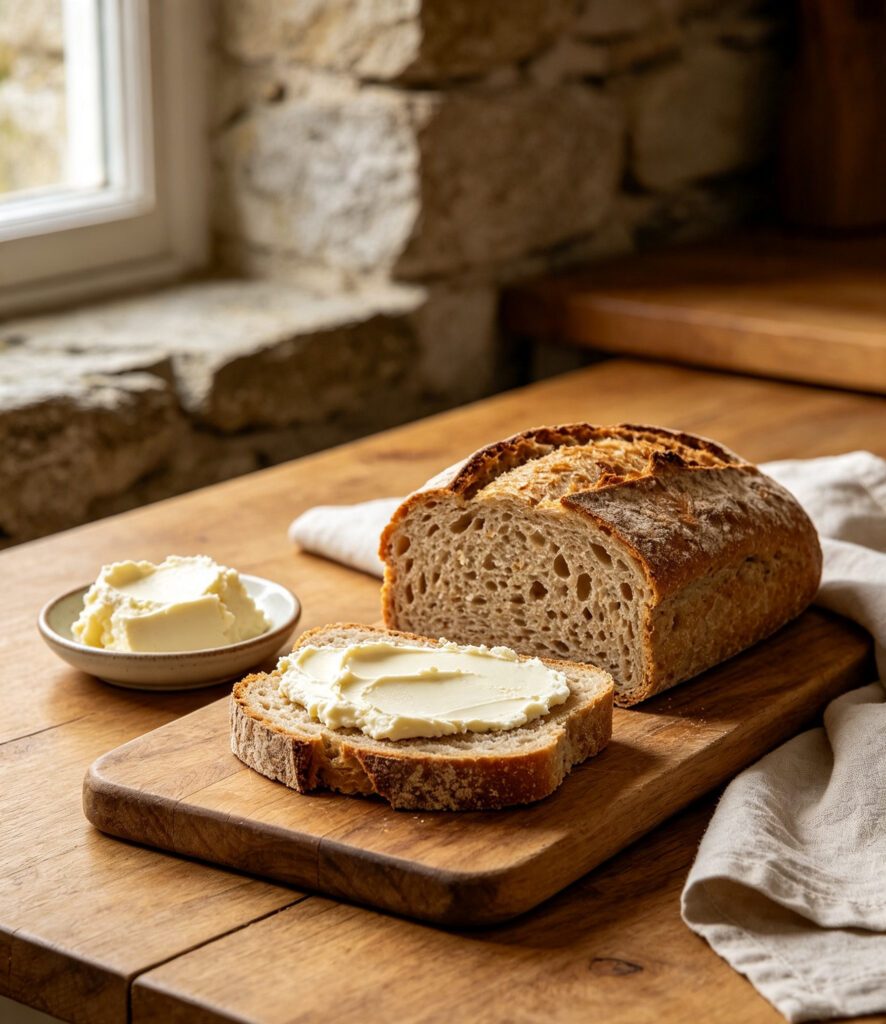
Buttered Barley Bread with Soft Cheese
The Quirky Foodster Team
Ingredients
- Barley bannock or oatcake (see Breads section) — 1
- Butter — 2 tbsp
- Soft fresh cheese (mulchan-style, or substitute a mild fresh curd cheese) — 100 g (3.5 oz)
Method
- Slice or break the barley bannock into portions.
- Spread generously with butter while the bread is still warm, so it melts slightly into the crumb.
- Serve alongside a portion of the soft cheese for spreading or eating alongside.
Introduction: A simple lunch of griddle-baked barley bread spread generously with butter and served alongside a soft fresh cheese.
Cultural Background: Butter held major economic and dietary significance in early Ireland, confirmed both by textual sources and by the substantial number of archaeological ‘bog butter’ finds – wooden kegs of butter buried in peat bogs, likely for storage or preservation; soft fresh cheeses (mulchan and related terms) are also referenced in early Irish glossaries and legal tracts alongside butter as staple dairy foods.
Tips: Butter spreads best on bread that is still warm from the griddle. A softer, younger cheese suits this dish better than an aged, firm one.
Variations: Naturally vegetarian; not vegan, due to butter and cheese. A little honey can be added alongside for a sweeter version of the same simple meal.
Storage: Store bread and cheese separately; bread keeps 1-2 days wrapped at room temperature, cheese keeps refrigerated for up to 4 days.
Reheating: Warm the bread briefly on a dry griddle for 1-2 minutes if desired; the cheese is served cold or at room temperature.
Nutrition: Per serving (approx.): 320 kcal, 10 g protein, 30 g carbohydrate, 18 g fat.
FAQs:
Q: What is bog butter?
A: Wooden vessels of butter deliberately buried in Irish peat bogs, likely for long-term storage or preservation, and a significant source of archaeological evidence for the importance of butter in early Ireland.
Q: What is mulchan?
A: A term used in early Irish sources for a type of soft cheese, distinct from harder aged cheeses also referenced in the same texts.
- Barley bannock or oatcake (see Breads section) — 1
- Butter — 2 tbsp
- Soft fresh cheese (mulchan-style, or substitute a mild fresh curd cheese) — 100 g (3.5 oz)
Please log in to leave a comment.