
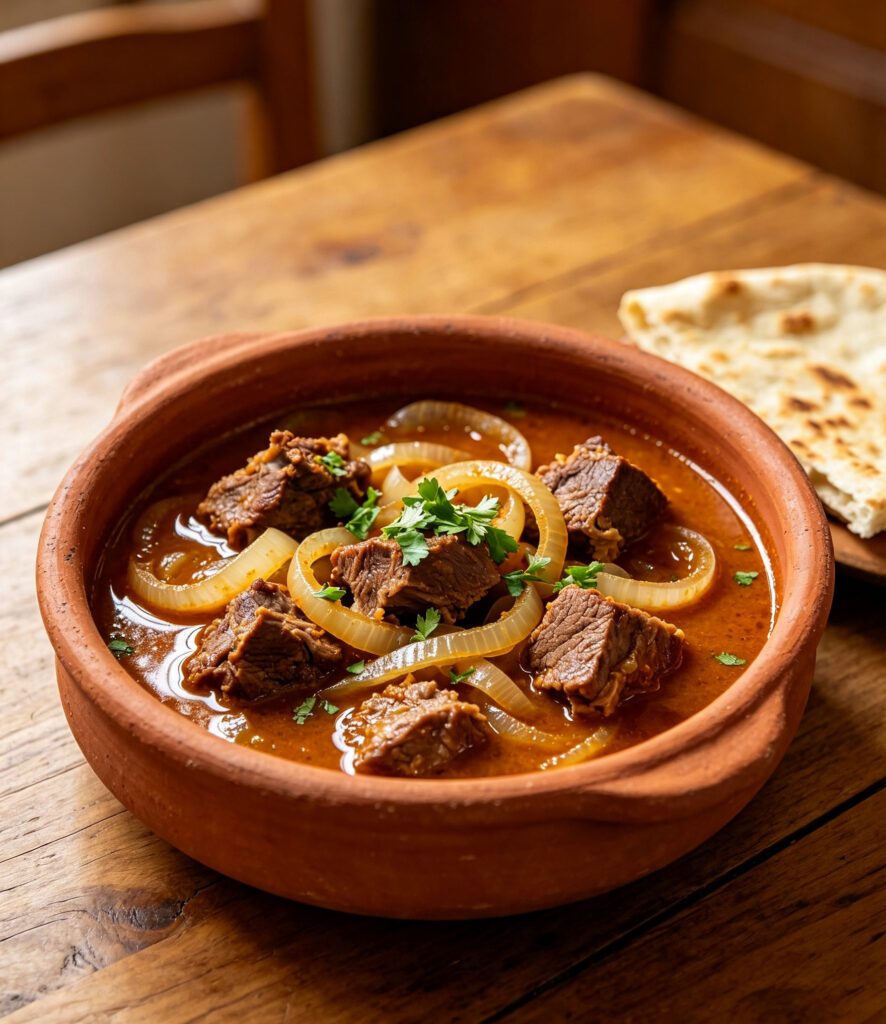
Mullah Ta’ashia (Sudanese Meat and Onion Stew)
The Quirky Foodster Team
Ingredients
- Beef, cubed — 800 g (1.75 lb)
- Large onions, thinly sliced — 4
- Vegetable oil — 80 ml (1/3 cup)
- Garlic cloves, minced — 4
- Tomato paste — 2 tbsp
- Ground coriander — 1 tsp
- Ground cumin — 1 tsp
- Cinnamon stick — 1
- Water or beef stock — 750 ml (3 cups)
- Salt — 1.5 tsp
- Black pepper — 1/2 tsp
Method
- Heat oil in a large pot over medium heat. Add onions and fry slowly for 20-25 minutes, stirring often, until deeply golden and soft.
- Add garlic and cook 1 minute until fragrant.
- Add beef and brown on all sides, about 8 minutes.
- Stir in tomato paste, coriander, cumin, and cinnamon stick; cook 2 minutes.
- Pour in water or stock, add salt and pepper. Bring to a boil, then reduce heat, cover, and simmer 1 hour 10 minutes until the meat is tender and the sauce has thickened.
- Remove cinnamon stick before serving.
Introduction: Mullah ta'ashia is a deeply savoury onion-based stew built on the technique of slowly frying down onions until they collapse into a rich base.
Cultural Background: Mullah ta'ashia is a deeply savoury onion-based stew built on the technique of slowly frying down onions until they collapse into a rich base. It is a staple of Sudanese home cooking, traditionally eaten with kisra or asida, and reflects the central role that mullah (stew) dishes play in daily meals.
Tips: Do not rush the onion-frying step — it builds the stew's characteristic depth of flavour.
Variations: Lamb or goat can be used in place of beef for a more traditional rural preparation. Replace beef with chickpeas and mushrooms, using vegetable stock, for an authentic-feeling vegetarian mullah.
Storage: Refrigerate up to 4 days; freezes well for up to 3 months.
Reheating: Reheat gently on the stovetop over low heat, adding a splash of water if needed.
Nutrition: Approx. 410 kcal, 34 g protein, 26 g fat, 9 g carbohydrate per serving.
FAQs:
Q: Why are the onions cooked so long?
A: Long, slow frying caramelises the onions, which forms the backbone of the stew's flavour.
- Beef, cubed — 800 g (1.75 lb)
- Large onions, thinly sliced — 4
- Vegetable oil — 80 ml (1/3 cup)
- Garlic cloves, minced — 4
- Tomato paste — 2 tbsp
- Ground coriander — 1 tsp
- Ground cumin — 1 tsp
- Cinnamon stick — 1
- Water or beef stock — 750 ml (3 cups)
- Salt — 1.5 tsp
- Black pepper — 1/2 tsp
Please log in to leave a comment.