
Egg Hoppers
The Quirky Foodster Team
Ingredients
- Rice flour (2 cups) — 250 g (8.8 oz)
- Instant yeast (1/4 teaspoon) — 1 g
- Sugar (1 tablespoon) — 12 g (0.4 oz)
- Coconut milk (1 cup) — 240 ml (1 cup)
- Warm water, approximately (1 cup) — 240 ml (1 cup)
- Salt (1/2 teaspoon) — 3 g
- Eggs, 1 per hopper — 8
- Oil, for greasing the pan
Method
- Dissolve the yeast and sugar in the warm water and let it sit for 10 minutes until foamy.
- Whisk the rice flour, coconut milk, yeast mixture and salt together into a smooth, thin, pourable batter, similar to a crepe batter.
- Cover and leave to ferment at room temperature for at least 6 hours, or overnight, until slightly bubbly and aerated.
- Heat the hopper pan over medium heat and lightly grease it with oil. Ladle in a portion of batter, then immediately lift and swirl the pan so the batter coats the sides thinly, leaving a slightly thicker pool in the centre.
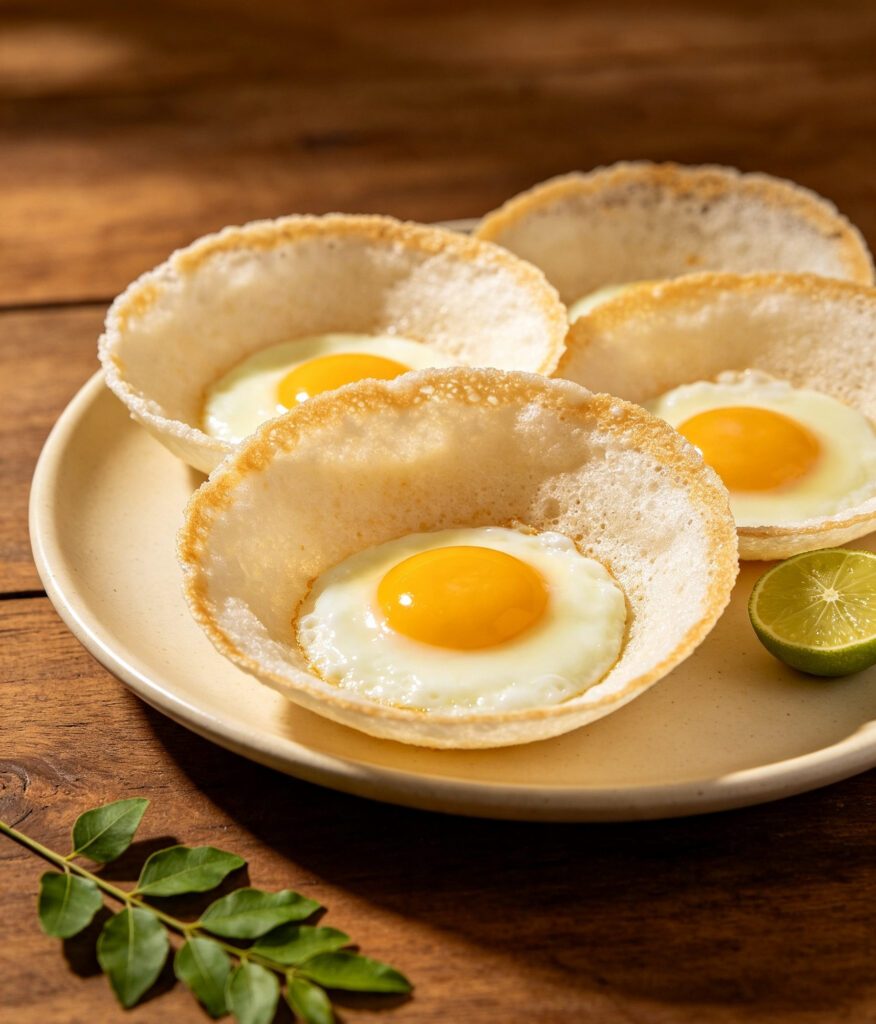
- Crack an egg into the centre of the hopper. Cover with a lid and cook for 2-3 minutes, until the edges are crisp, golden and lacy, and the egg is set to your liking.
- Carefully loosen the edges with a spatula and lift the hopper out. Repeat with the remaining batter, re-greasing the pan lightly between each one.
- Serve hot with pol sambol or a curry.
Introduction: Hoppers are bowl-shaped pancakes made from a fermented rice flour and coconut milk batter, cooked in a small, curved wok-like pan (appachchatti) that gives them their signature thin, lacy, crisp edges and soft, spongy centre.
Cultural Background: Hoppers are bowl-shaped pancakes made from a fermented rice flour and coconut milk batter, cooked in a small, curved wok-like pan (appachchatti) that gives them their signature thin, lacy, crisp edges and soft, spongy centre. Egg hoppers, with a whole egg cracked into the centre while cooking, are one of Sri Lanka's most iconic breakfast and dinner dishes, sold at roadside stalls and hopper-specialist restaurants across the island, best eaten with the edges torn off and dipped into curry or sambol.
Tips: Fermentation is what gives hoppers their characteristic slightly sour flavour and airy texture – don't skip it, even though it takes time. Swirl the pan quickly and confidently right after pouring the batter in, or the sides won't coat thinly enough to crisp up properly. A well-seasoned hopper pan is important; a new pan may need a few practice hoppers before they release cleanly.
Variations: Plain hoppers (without egg) are eaten the same way, often with a sprinkle of sugar for a sweet breakfast option. Milk hoppers add condensed milk to the centre instead of egg for a sweet dessert version. Vegetarian as written; for a vegan version, simply make plain hoppers without the egg.
Storage: Best eaten immediately; plain (eggless) hoppers can be stored in an airtight container for up to 1 day.
Reheating: Reheat plain hoppers briefly in a dry pan or microwave for 20 seconds; egg hoppers are best made fresh, as reheating overcooks the egg.
Nutrition: Approx. 220 kcal, 9 g protein, 9 g fat, 26 g carbohydrates, 1 g fibre per hopper
FAQs:
Q: Why didn't my hopper batter ferment or bubble?
A: This is usually because the yeast was inactive (check it's not expired, and that the water wasn't too hot when dissolving it) or the room was too cold; a warm spot speeds fermentation.
Q: Can I make hoppers without a special pan?
A: A small, deep non-stick wok can work in a pinch, though the classic thin, lacy edges are hardest to achieve without a proper curved hopper pan.
Q: How do I know when the egg is cooked to my liking?
A: Cover with the lid for a runnier yolk (about 2 minutes) or a little longer, up to 3-4 minutes, for a fully set yolk.
- Rice flour (2 cups) — 250 g (8.8 oz)
- Instant yeast (1/4 teaspoon) — 1 g
- Sugar (1 tablespoon) — 12 g (0.4 oz)
- Coconut milk (1 cup) — 240 ml (1 cup)
- Warm water, approximately (1 cup) — 240 ml (1 cup)
- Salt (1/2 teaspoon) — 3 g
- Eggs, 1 per hopper — 8
- Oil, for greasing the pan
Please log in to leave a comment.