
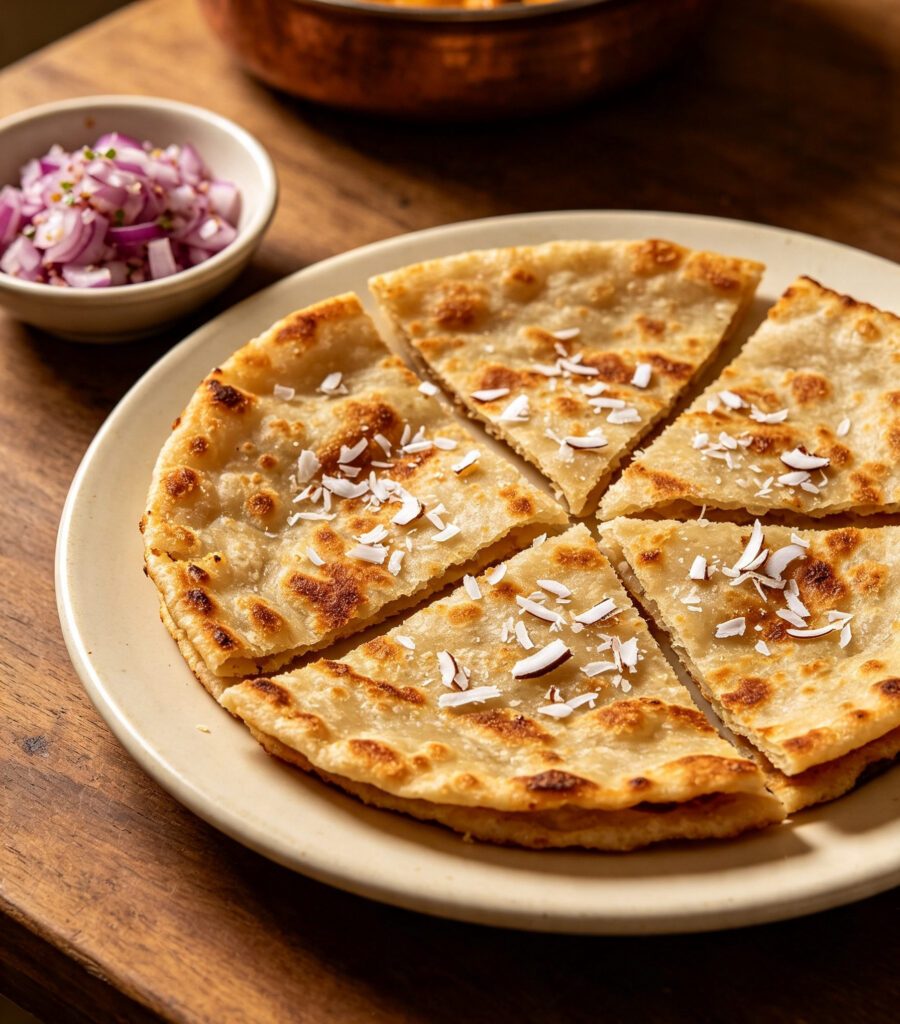
Pol Roti (Coconut Flatbread)
The Quirky Foodster Team
Ingredients
- Wheat flour (2 cups) — 250 g (8.8 oz)
- Freshly grated coconut (1 cup) — 100 g (3.5 oz)
- Small red onion, finely chopped, optional (50 g) — 1
- Green chilli, finely chopped, optional — 1
- Salt (1/2 teaspoon) — 3 g
- Warm water, approximately (3/4 cup) — 180 ml (3/4 cup)
- Oil, for cooking
Method
- In a bowl, combine the flour, grated coconut, onion and green chilli (if using), and salt.
- Gradually add warm water, mixing and kneading until you get a soft, slightly sticky but manageable dough.
- Knead for 3-4 minutes until smooth.
- Divide the dough into 8 equal portions and shape each into a ball.
- Flatten each ball by hand (or with a rolling pin) into a round about 12-15 cm (5-6 inches) across and roughly 1 cm (1/3 inch) thick - pol roti is traditionally thicker and more rustic than a typical flatbread.
- Heat a flat griddle or heavy pan over medium heat with a little oil. Cook each roti for 2-3 minutes per side, pressing gently, until lightly charred in spots and cooked through.
- Serve warm, ideally with lunu miris or a curry.
Introduction: Pol roti is one of Sri Lanka's most everyday breads, a simple flatbread of wheat flour worked with generous amounts of fresh grated coconut, cooked on a flat griddle until lightly charred in spots.
Cultural Background: Pol roti is one of Sri Lanka's most everyday breads, a simple flatbread of wheat flour worked with generous amounts of fresh grated coconut, cooked on a flat griddle until lightly charred in spots. Quick to make with no yeast or long proving required, it is a staple breakfast or dinner bread eaten with lunu miris (chilli-onion relish) or a curry, and its coconut content means it stays soft and slightly sweet even as it cools, unlike a plain flour roti.
Tips: Shaping by hand rather than with a rolling pin is traditional and gives pol roti its characteristic rustic, slightly uneven texture. Cook over medium, not high, heat – pol roti is thicker than most flatbreads and needs time for the centre to cook through without the outside burning. Fresh grated coconut gives the best texture and sweetness; desiccated coconut can be used if soaked briefly in warm water first.
Variations: A sweet version adds a spoon of treacle or sugar to the dough for a lightly sweetened roti eaten as a snack. Some cooks add a pinch of turmeric for colour. Naturally vegan as written.
Storage: Store in an airtight container or wrapped in a cloth at room temperature for up to 1 day, or refrigerate for up to 3 days.
Reheating: Reheat on a dry griddle or pan for 30-60 seconds per side, or wrap in a damp paper towel and microwave for 20-30 seconds.
Nutrition: Approx. 200 kcal, 5 g protein, 6 g fat, 32 g carbohydrates, 3 g fibre per roti
FAQs:
Q: Can I make pol roti gluten-free?
A: A gluten-free flour blend can be substituted, though the dough will be more delicate to handle and may need more careful shaping by hand rather than rolling.
Q: What is pol roti traditionally served with?
A: Most commonly lunu miris (a spicy onion and chilli relish) for breakfast, or alongside any curry for dinner.
Q: Why is pol roti thicker than other flatbreads?
A: Its thickness is traditional and helps it hold together well given the coconut content, which makes the dough more delicate than plain wheat dough.
- Wheat flour (2 cups) — 250 g (8.8 oz)
- Freshly grated coconut (1 cup) — 100 g (3.5 oz)
- Small red onion, finely chopped, optional (50 g) — 1
- Green chilli, finely chopped, optional — 1
- Salt (1/2 teaspoon) — 3 g
- Warm water, approximately (3/4 cup) — 180 ml (3/4 cup)
- Oil, for cooking
Please log in to leave a comment.