
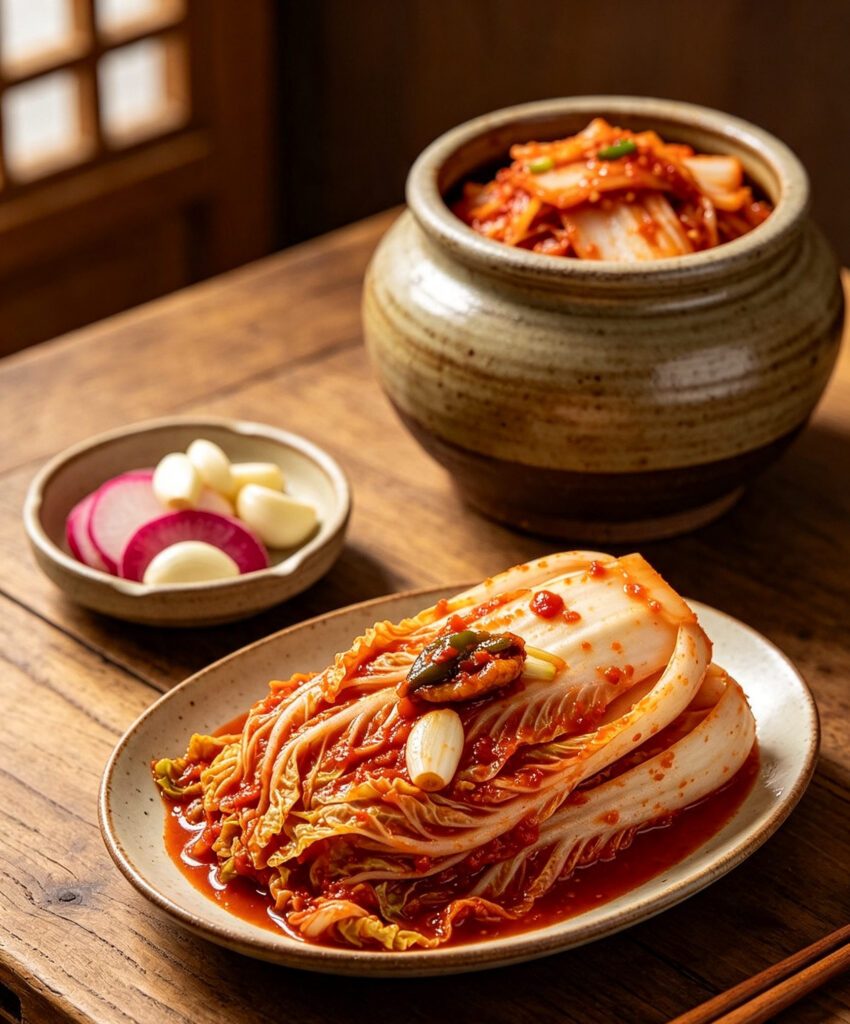
Baechu Kimchi (Napa Cabbage Kimchi)
The Quirky Foodster Team
Ingredients
- Large napa cabbage (about 2 kg / 4.4 lb), quartered lengthwise — 1
- Coarse sea salt, for salting — 200 g (7 oz)
- Water, for the salting brine — 2 L (8 cups)
- Glutinous rice flour, mixed with 1 cup water, cooked into a thin porridge and cooled — 1/2 cup (120 g)
- Gochugaru — 1 cup (100 g)
- Fish sauce (myeolchi aekjeot) — 1/2 cup (120 ml)
- Minced garlic — 3 tbsp (45 g)
- Grated ginger — 1 tbsp (15 g)
- Sugar — 1/4 cup (50 g)
- Korean radish (about 300 g), julienned — 1
- Garlic chives (buchu), cut into 4 cm lengths — 1 bunch
- Spring onions, cut into 4 cm lengths — 4
Method
- Dissolve the sea salt in the water to make a brine. Submerge the cabbage quarters in the brine, turning occasionally, and leave to salt for 6–8 hours or overnight, until the cores bend without snapping.
- Rinse the salted cabbage thoroughly under cold running water 2–3 times to remove excess salt, then drain well in a colander for at least an hour, cut-side down.
- Make the cooled glutinous rice porridge, then stir in the gochugaru, fish sauce, garlic, ginger and sugar to form a thick red paste.
- Fold in the julienned radish, garlic chives and spring onion, mixing well.
- Wearing gloves, spread the paste generously between every leaf of each cabbage quarter, working from the base to the tip, until thoroughly and evenly coated.
- Pack the finished kimchi tightly into an airtight container, pressing down to remove air pockets, and leave at room temperature for 1–2 days to begin fermenting before transferring to the fridge, where it will continue to develop flavour over the following weeks.
Introduction: Baechu kimchi, made from salted and seasoned napa cabbage, is Korea's most iconic dish and a UNESCO-recognised cultural tradition through Kimjang, the communal autumn practice of making large batches of kimchi to last through winter.
Cultural Background: Baechu kimchi, made from salted and seasoned napa cabbage, is Korea's most iconic dish and a UNESCO-recognised cultural tradition through Kimjang, the communal autumn practice of making large batches of kimchi to last through winter. Nearly every Korean meal includes kimchi as a fundamental side dish, and family kimchi recipes are often passed down through generations.
Tips: The cabbage is properly salted when the thick white core of a leaf bends without snapping — under-salted cabbage won't ferment properly, while over-salted cabbage will be too salty to enjoy. Taste the paste before applying it and adjust the salt, sugar or gochugaru — the perfect balance varies by household and by the cabbage's natural sweetness.
Variations: Kkakdugi-style variation: dice the radish instead of julienning for a chunkier textural contrast within the same paste. Baek kimchi: omit the gochugaru entirely for a mild, non-spicy white kimchi, adjusting the paste to a lighter, brothy consistency. Replace the fish sauce with an additional 2 tbsp soy sauce plus 1 tbsp salt for a fully vegan kimchi.
Storage: Keeps refrigerated for several weeks to months, continuing to ferment and sour gradually; always use a clean utensil to remove portions.
Reheating: Traditionally eaten cold or at room temperature as a side; well-aged kimchi is also cooked into dishes such as kimchi-jjigae or kimchi bokkeumbap.
Nutrition: Calories: 25 kcal | Protein: 1 g | Carbs: 5 g | Fat: 0 g | Fibre: 2 g | Sodium: 480 mg Per 50 g serving; estimate only, varies with fermentation time.
FAQs:
Q: How do I know when my kimchi is ready to eat?
A: Fresh kimchi can be eaten immediately, but most people prefer it after a few days to a week of fermentation, when it develops a gentle tang; taste along the way to find your preference.
Q: Why did my kimchi turn out watery?
A: This is usually from under-draining the salted cabbage; make sure to drain it thoroughly for at least an hour before adding the paste.
Q: Can I make kimchi without fish sauce?
A: Yes, salted shrimp or fish sauce are traditional for depth of flavour, but a soy-sauce-based vegan version is a well-established and widely made alternative.
- Large napa cabbage (about 2 kg / 4.4 lb), quartered lengthwise — 1
- Coarse sea salt, for salting — 200 g (7 oz)
- Water, for the salting brine — 2 L (8 cups)
- Glutinous rice flour, mixed with 1 cup water, cooked into a thin porridge and cooled — 1/2 cup (120 g)
- Gochugaru — 1 cup (100 g)
- Fish sauce (myeolchi aekjeot) — 1/2 cup (120 ml)
- Minced garlic — 3 tbsp (45 g)
- Grated ginger — 1 tbsp (15 g)
- Sugar — 1/4 cup (50 g)
- Korean radish (about 300 g), julienned — 1
- Garlic chives (buchu), cut into 4 cm lengths — 1 bunch
- Spring onions, cut into 4 cm lengths — 4
Please log in to leave a comment.