
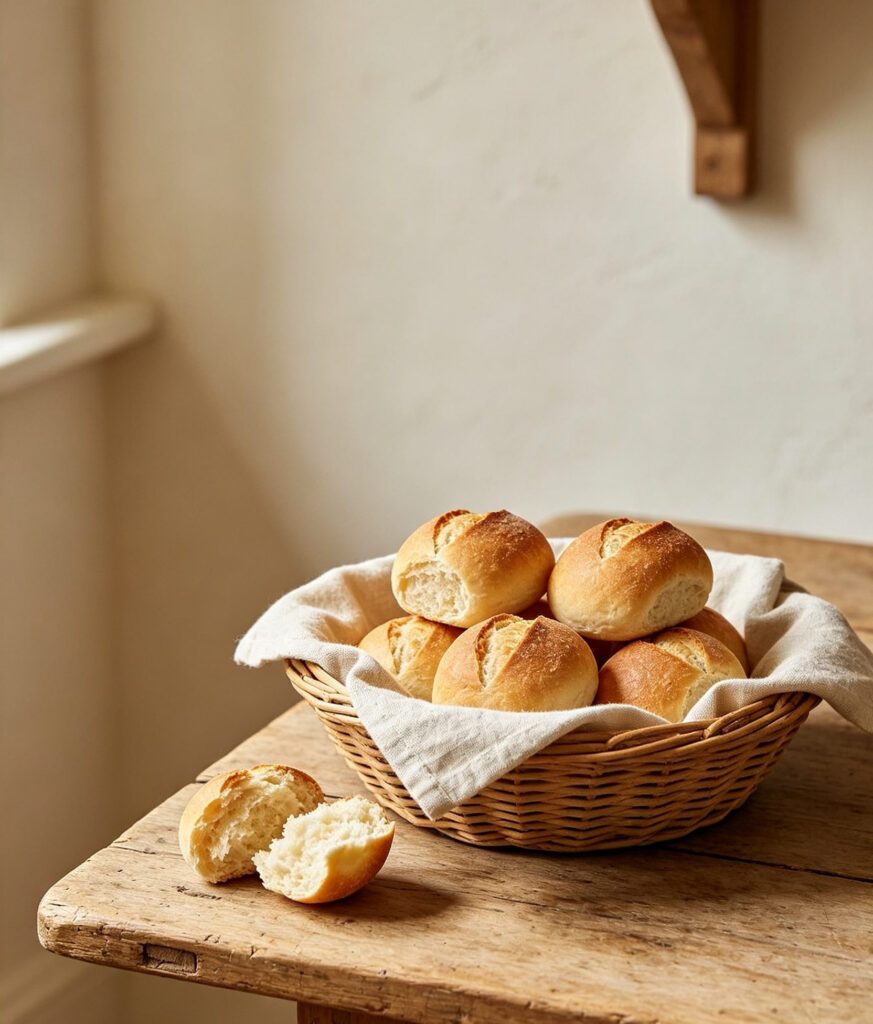
Pão Timorense (Portuguese-Style Bread Rolls)
The Quirky Foodster Team
Ingredients
- Bread flour — 500 g (4 cups)
- Instant yeast — 7 g (2¼ tsp)
- Sugar — 15 g (1 tbsp)
- Salt — 10 g (2 tsp)
- Water, lukewarm — 300 ml (1¼ cups)
- Vegetable oil — 15 ml (1 tbsp)
Method
- In a large bowl, whisk together flour, yeast, sugar, and salt.
- Gradually add warm water and oil, mixing until a shaggy dough forms.
- Turn out onto a floured surface and knead for 10 minutes until smooth and elastic.
- Place the dough in a lightly oiled bowl, cover, and let rise in a warm place for 1–1.5 hours until doubled in size.
- Punch down the dough and divide into 8 equal pieces. Shape each into a small, tight round or oval roll.
- Place the rolls on a baking sheet, spaced apart, cover loosely, and let rise again for 30–40 minutes until puffed.
- Preheat oven to 220°C (425°F). Bake the rolls for 18–20 minutes until golden brown and they sound hollow when tapped on the bottom (internal temperature at least 96°C/205°F). Cool on a wire rack for at least 10 minutes before serving.
Introduction: Pão Timorense are small, crusty bread rolls baked fresh daily in bakeries across Dili and other towns, a direct legacy of Portuguese colonial baking traditions.
Cultural Background: Pão Timorense are small, crusty bread rolls baked fresh daily in bakeries across Dili and other towns, a direct legacy of Portuguese colonial baking traditions. Sold warm each morning, they’re a breakfast staple, typically eaten plain, with butter, or split for a simple sandwich.
Tips: A shallow pan of water placed in the bottom of the oven during baking creates steam that helps develop the characteristic crisp, crackly crust.
Variations: A touch more sugar in the dough gives a slightly sweeter roll, often preferred for breakfast; a plainer version is common for savoury fillings.
Storage: Store at room temperature in a paper bag for up to 2 days for best crust texture; freeze for up to 2 months.
Reheating: Refresh in a 180°C (350°F) oven for 5–8 minutes to restore crustiness.
FAQs:
Q: Why is my bread dense instead of light and airy?
A: Underproofing is the most common cause — ensure the dough fully doubles at both rising stages before baking.
Q: Is pão Timorense the same as a Portuguese papo-seco?
A: It’s inspired by similar Portuguese bread-roll traditions, adapted slightly with local baking conditions and ingredients.
Q: Can I make this bread without a stand mixer?
A: Yes, this recipe is written for hand-kneading and requires no special equipment.
- Bread flour — 500 g (4 cups)
- Instant yeast — 7 g (2¼ tsp)
- Sugar — 15 g (1 tbsp)
- Salt — 10 g (2 tsp)
- Water, lukewarm — 300 ml (1¼ cups)
- Vegetable oil — 15 ml (1 tbsp)
Please log in to leave a comment.