
Miang Kham (Betel Leaf Wraps)
The Quirky Foodster Team
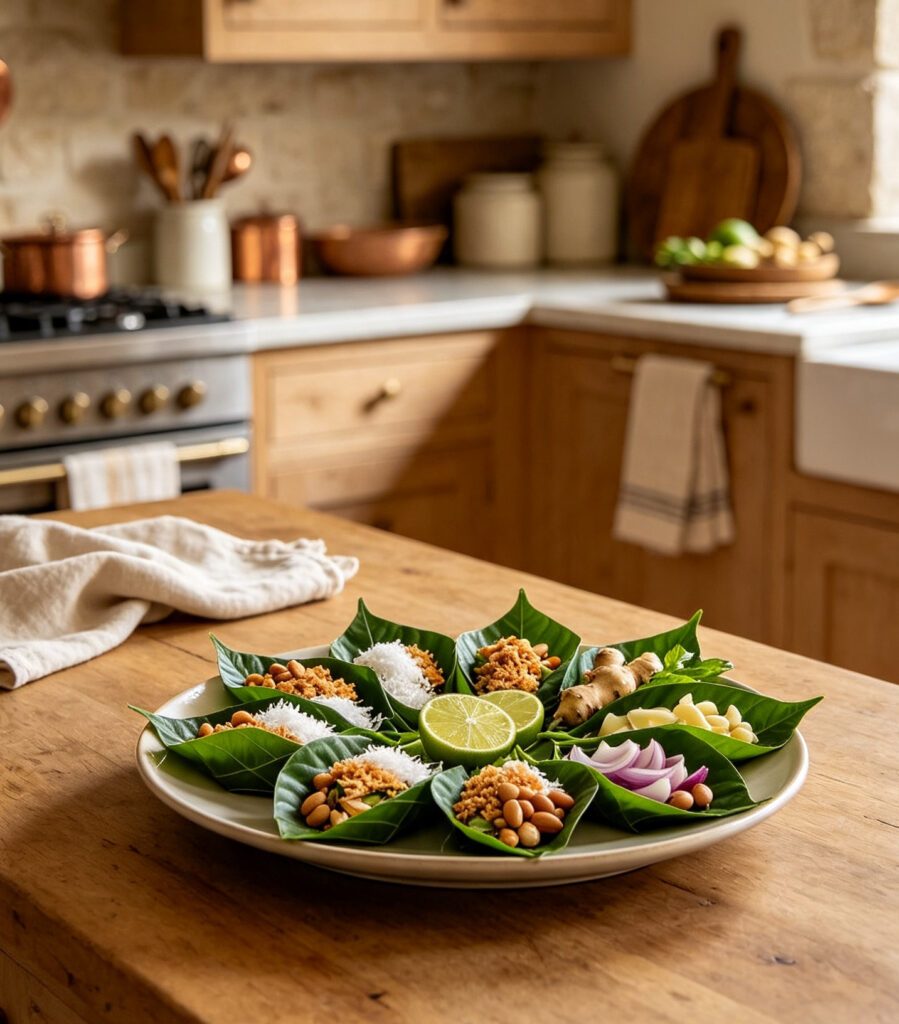
Ingredients
- Fresh betel leaves or wild pepper leaves (cha plu), washed and dried — 20–24
- Dried shrimp — 3 tbsp
- Roasted peanuts, roughly chopped — 3 tbsp
- Lime, peeled and finely diced (including some pith) — 1
- Finely diced ginger — 3 tbsp
- Finely diced shallot — 3 tbsp
- Finely diced fresh coconut or toasted coconut flakes — 2 tbsp
- Small red chillies, finely chopped — 2
- Palm sugar, chopped — 150 g (3/4 cup)
- Fish sauce — 3 tbsp
- Tamarind paste — 2 tbsp
- Water — 100 ml (scant 1/2 cup)
Method
- Make the sauce: combine the palm sugar, fish sauce, tamarind paste and water in a small saucepan and simmer over low heat for 8–10 minutes, stirring, until thickened into a glossy, syrupy sauce. Let cool slightly.
- Arrange the dried shrimp, peanuts, lime, ginger, shallot, coconut and chillies in small individual bowls or piles on a serving platter.
- Arrange the betel leaves on the platter alongside the ingredients and the bowl of sauce.
- To eat, place a leaf in your palm, add a small pinch of several ingredients, spoon over a little sauce, and fold into a small parcel to eat in one bite.
Introduction: Miang kham is a distinctive one-bite snack in which diners wrap a lively mix of small savoury and tangy
ingredients — dried shrimp, peanuts, lime, ginger, shallot and chilli — in a betel or wild pepper leaf, then
coat it in a sweet, thick tamarind-palm sugar sauce.
Cultural Background: Miang kham is a distinctive one-bite snack in which diners wrap a lively mix of small savoury and tangy
ingredients — dried shrimp, peanuts, lime, ginger, shallot and chilli — in a betel or wild pepper leaf, then
coat it in a sweet, thick tamarind-palm sugar sauce. The combination of textures and flavours in a single
bite is considered a hallmark of refined Thai cooking.
Tips: Dice all the filling ingredients very small and uniformly, since each bite should contain a little of everything. The sauce should be quite thick and syrupy by the time it's done — this concentration is what makes it cling to the other ingredients.
Variations: Add small pieces of cooked shrimp for extra protein. Adjust the amount of chilli to suit your preferred spice level. A vegetarian version can be made by omitting the dried shrimp and using soy sauce in place of fish sauce.
Vegetarian Miang Kham: Omit the dried shrimp. Replace the fish sauce in the sauce recipe with an equal
amount of soy sauce. Proceed exactly as directed with the remaining ingredients.
Storage: Store the sauce in the refrigerator for up to a week; keep the fresh ingredients separately and assemble
just before serving.
Reheating: Gently warm the sauce if it has thickened too much after refrigeration; the fresh components are not
reheated.
FAQs:
Q: What are betel leaves?
A: Glossy, heart-shaped leaves (often labelled cha plu or wild pepper leaf) used as an edible wrapper in several Southeast Asian cuisines; available at Asian grocers.
Q: Can I substitute the leaves?
A: Small lettuce leaves can work in a pinch, though they lack the distinctive peppery flavour of true betel or cha plu leaves.
Q: How is this dish meant to be eaten?
A: As a build-your-own one-bite wrap — guests assemble each parcel themselves at the table.
- Fresh betel leaves or wild pepper leaves (cha plu), washed and dried — 20–24
- Dried shrimp — 3 tbsp
- Roasted peanuts, roughly chopped — 3 tbsp
- Lime, peeled and finely diced (including some pith) — 1
- Finely diced ginger — 3 tbsp
- Finely diced shallot — 3 tbsp
- Finely diced fresh coconut or toasted coconut flakes — 2 tbsp
- Small red chillies, finely chopped — 2
- Palm sugar, chopped — 150 g (3/4 cup)
- Fish sauce — 3 tbsp
- Tamarind paste — 2 tbsp
- Water — 100 ml (scant 1/2 cup)
Please log in to leave a comment.