
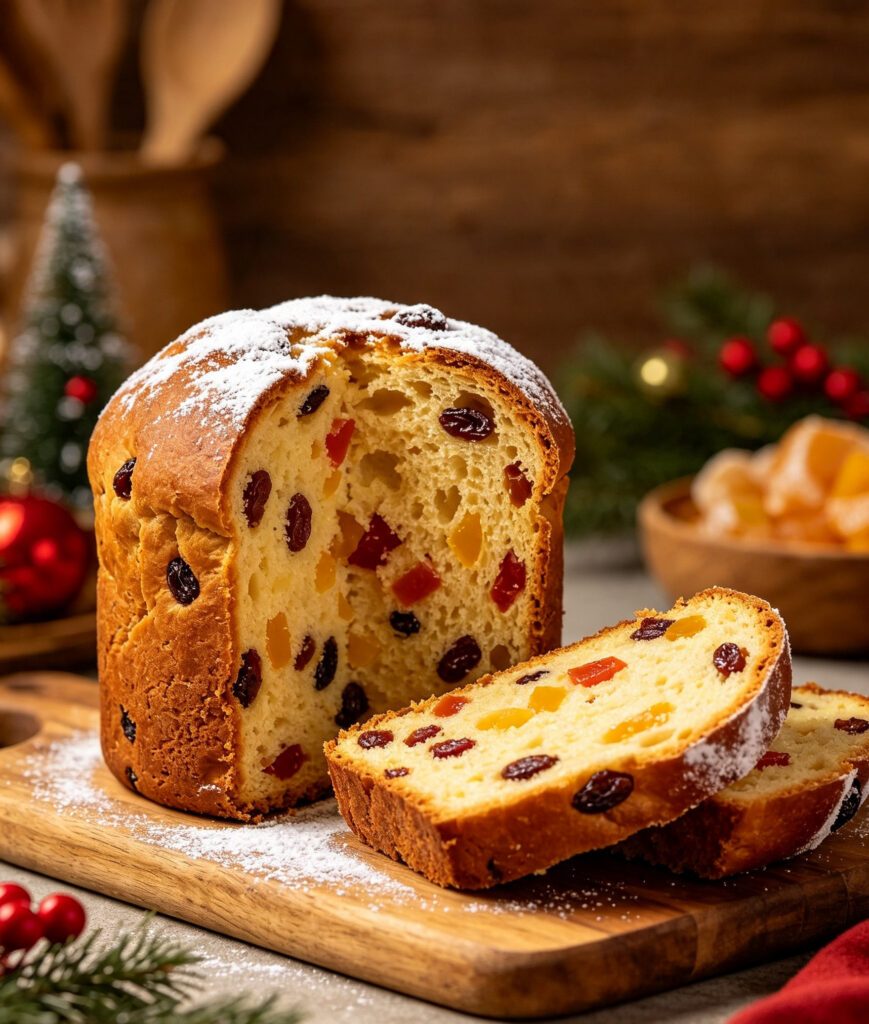
Panetón Peruano Navideño
The Quirky Foodster Team
Ingredients
- Bread flour — 625 g (1 lb 6 oz)
- Active dry yeast — 2.5 tsp
- Sugar — 150 g (5 oz)
- Warm milk — 240 ml (8 fl oz)
- Eggs — 4
- Butter, softened — 115 g (4 oz)
- Vanilla extract — 1 tsp
- Orange zest — 1 tsp
- Mixed candied fruit and raisins — 150 g (5 oz)
- Salt — 1/2 tsp
Method
- Dissolve the yeast and a little sugar in the warm milk and let sit for 10 minutes until foamy.
- Combine the flour, remaining sugar and salt in a large bowl, then add the yeast mixture, eggs, softened butter, vanilla and orange zest, kneading for 12–15 minutes until smooth and elastic.
- Fold in the candied fruit and raisins.
- Cover and let rise in a warm place for 2 hours, or until doubled.
- Punch down and shape into a ball, placing it in a tall paneton paper mould.
- Let rise for a further 1–1.5 hours until it reaches near the top of the mould.
- Preheat the oven to 180°C (350°F) and bake for 40–50 minutes until deeply golden and a skewer comes out clean, tenting with foil if it browns too quickly.
- Let cool completely before slicing, traditionally served with hot chocolate on Christmas Eve.
Introduction: A tall, sweet fruit bread enriched with candied fruit and raisins, the essential centrepiece of Peruvian Christmas celebrations.
Cultural Background: Panetón, adapted from the Italian panettone, has become deeply embedded in Peruvian Christmas tradition, families gathering to share slices alongside hot chocolate on Christmas Eve, with Peru now one of the world's largest panetón consumers.
Tips: Knead thoroughly for the soft, characteristic panetón crumb. Let the panetón cool completely before slicing, as this helps it hold together properly.
Variations: Add a handful of chopped walnuts alongside the candied fruit for extra texture. Serve with a cup of hot chocolate, the essential traditional pairing.
Storage: Store wrapped at room temperature for up to 1 week.
Reheating: Not applicable — served at room temperature, sliced.
FAQs:
Q: Is panetón the same as Italian panettone?
A: It shares its origins with the Italian bread but has become a distinctly beloved Peruvian Christmas tradition in its own right, with Peru among the world's top consumers.
Q: When is panetón traditionally eaten?
A: On Christmas Eve (Nochebuena), shared among family alongside hot chocolate, a cherished part of the celebration.
- Bread flour — 625 g (1 lb 6 oz)
- Active dry yeast — 2.5 tsp
- Sugar — 150 g (5 oz)
- Warm milk — 240 ml (8 fl oz)
- Eggs — 4
- Butter, softened — 115 g (4 oz)
- Vanilla extract — 1 tsp
- Orange zest — 1 tsp
- Mixed candied fruit and raisins — 150 g (5 oz)
- Salt — 1/2 tsp
Please log in to leave a comment.