
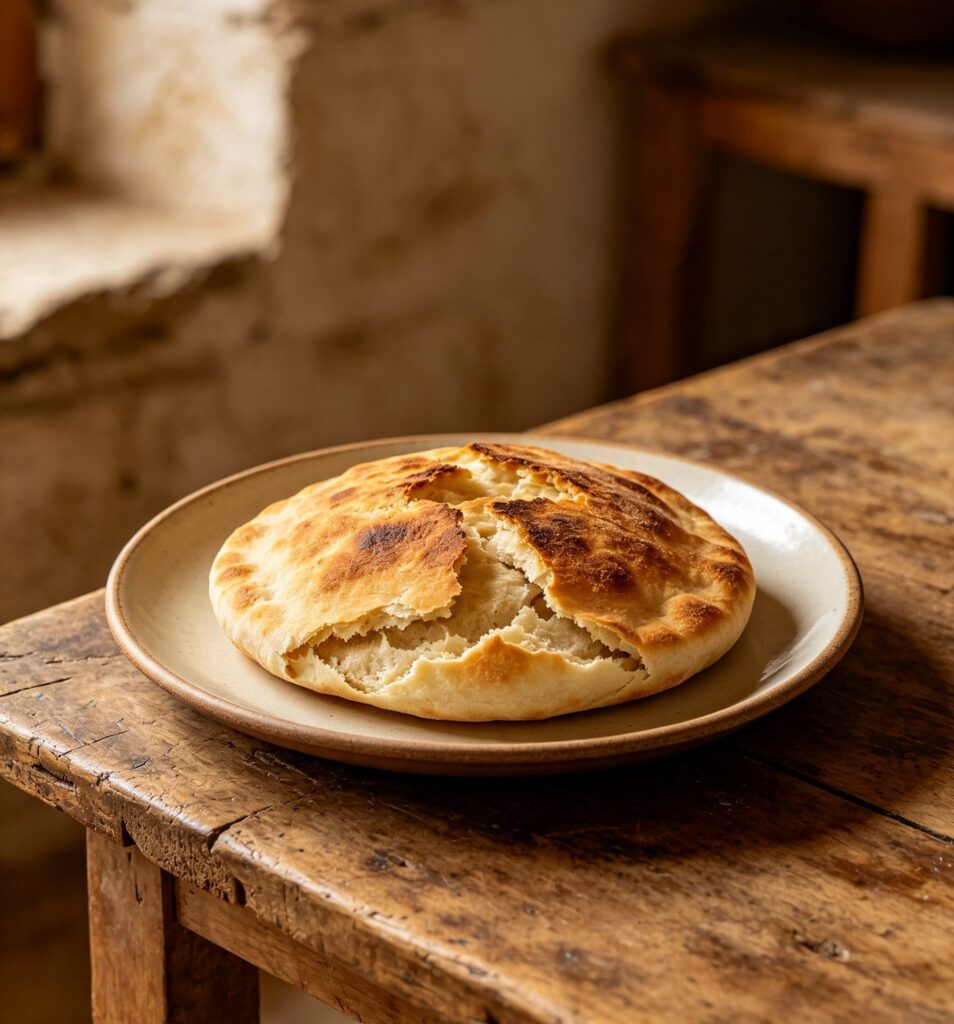
Khobz Sahraoui
The Quirky Foodster Team
Ingredients
- Plain flour — 4 cups (500 g / 1 lb 2 oz)
- Warm water — 1.5 cups (360 ml / 12 fl oz)
- Active dry yeast — 2 tsp
- Salt — 2 tsp
- Oil — 2 tbsp
Method
- Dissolve the yeast in the warm water and let sit for 10 minutes until foamy.
- Combine the flour and salt in a large bowl, then add the yeast mixture and oil.
- Mix and knead for 10 minutes until smooth and elastic.
- Cover and let rise for 1 hour, or until doubled in size.
- Shape into a thick, round loaf.
- For a traditional-style adaptation at home, cook the loaf in a covered heavy skillet over low heat, turning occasionally, for 30–35 minutes until deeply browned and cooked through, or bake at 200°C (400°F) for 30 minutes.
- Let cool slightly before slicing.
Introduction: A rustic, thick flatbread traditionally baked directly in hot sand and ash, a technique developed for life in the open desert.
Cultural Background: Mauritania’s nomadic Saharan communities developed this sand-baking method out of necessity, using the desert’s own heat to bake bread without an oven, and the resulting thick, smoky-crusted loaf remains a point of cultural pride today, though most households now use a conventional oven or stovetop.
Tips: Cooking low and slow, whether in a covered skillet or oven, helps replicate the thick, evenly cooked crumb of the traditional sand-baked loaf. Turn the loaf occasionally if using a skillet, to ensure even cooking on all sides.
Variations: Add a spoonful of semolina to the dough for extra texture. Serve warm with butter and dates.
Storage: Store at room temperature wrapped in a cloth for up to 1 day; freeze for longer storage.
Reheating: Warm in an oven at 180°C (350°F) for 8–10 minutes to refresh.
Nutrition: Per serving (approx., 1 slice): 180 kcal, 5 g protein, 3 g fat, 33 g carbohydrate.
FAQs:
Q: Is this bread really baked in sand?
A: Traditionally yes, among nomadic communities, though most
Q: Why is the crust so thick?
A: The traditional sand-baking method produces a thick, protective crust;
- Plain flour — 4 cups (500 g / 1 lb 2 oz)
- Warm water — 1.5 cups (360 ml / 12 fl oz)
- Active dry yeast — 2 tsp
- Salt — 2 tsp
- Oil — 2 tbsp
Please log in to leave a comment.