
Global
Pestle Family (Cross-Cultural Overview)
Independently developed across nearly every region documented in this series
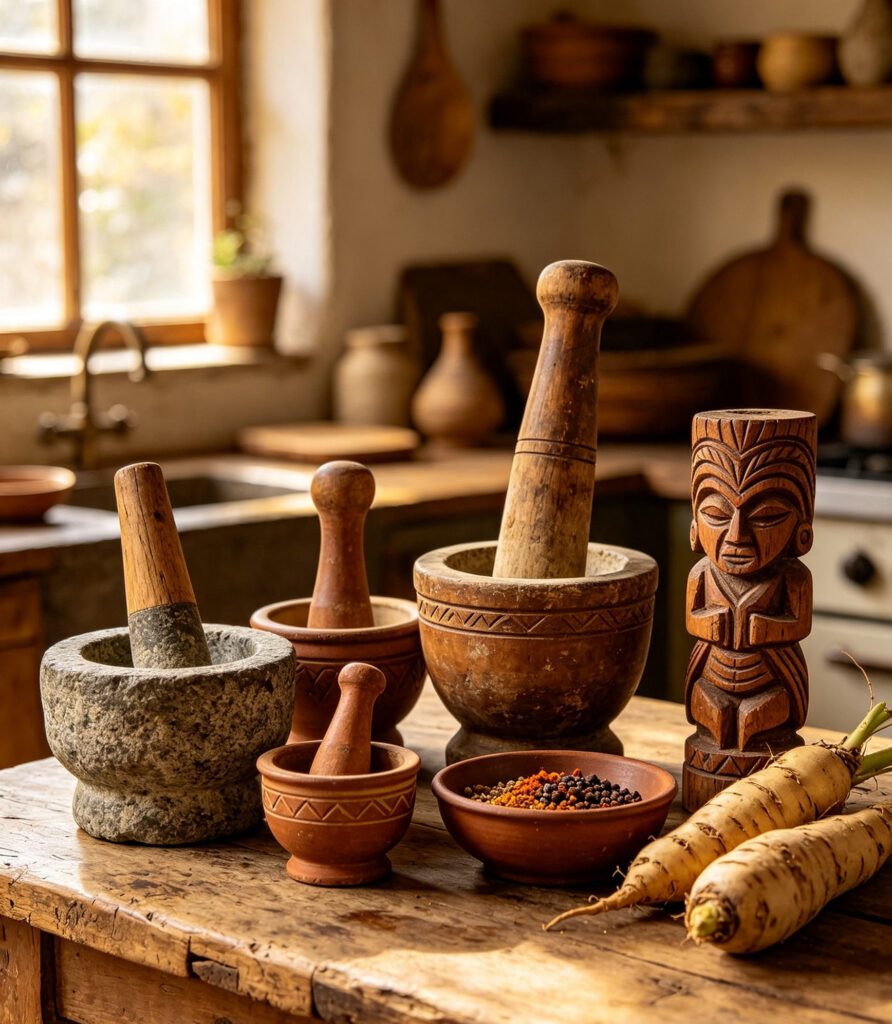
The hand-held pestle — used alongside a stationary mortar or grinding slab — is one of the oldest and most globally convergent food-preparation tools documented across this Atlas, appearing as Africa's muno, the Middle East's mehbash, Mexico's tejolote, the Caribbean's pilón pestle, and Southeast Asia's sak, among others.
Material & Construction
Stone, wood, and occasionally ceramic pestles all recur depending on regional material availability and the specific grinding or pounding task each is suited to.
Traditional Uses
Grinding spices and grains, pounding starches and pastes, and — in the Middle East's mehbash — even communicating a social signal through rhythm; the shared mechanical action underlies a wide range of specific culinary outcomes.
Modern Availability / Equivalents
Electric grinders and food processors have replaced hand-pestle grinding for most volume production worldwide, though hand-pestle technique persists deliberately across nearly every region for dishes where texture is considered essential.
Care & Maintenance
Care varies with the material.
The pestle plays a recurring cross-cultural role — the muno, mehbash, tejolote, pilón pestle, sak and sil batta hand stone are all examples.
Please log in to leave a comment.