
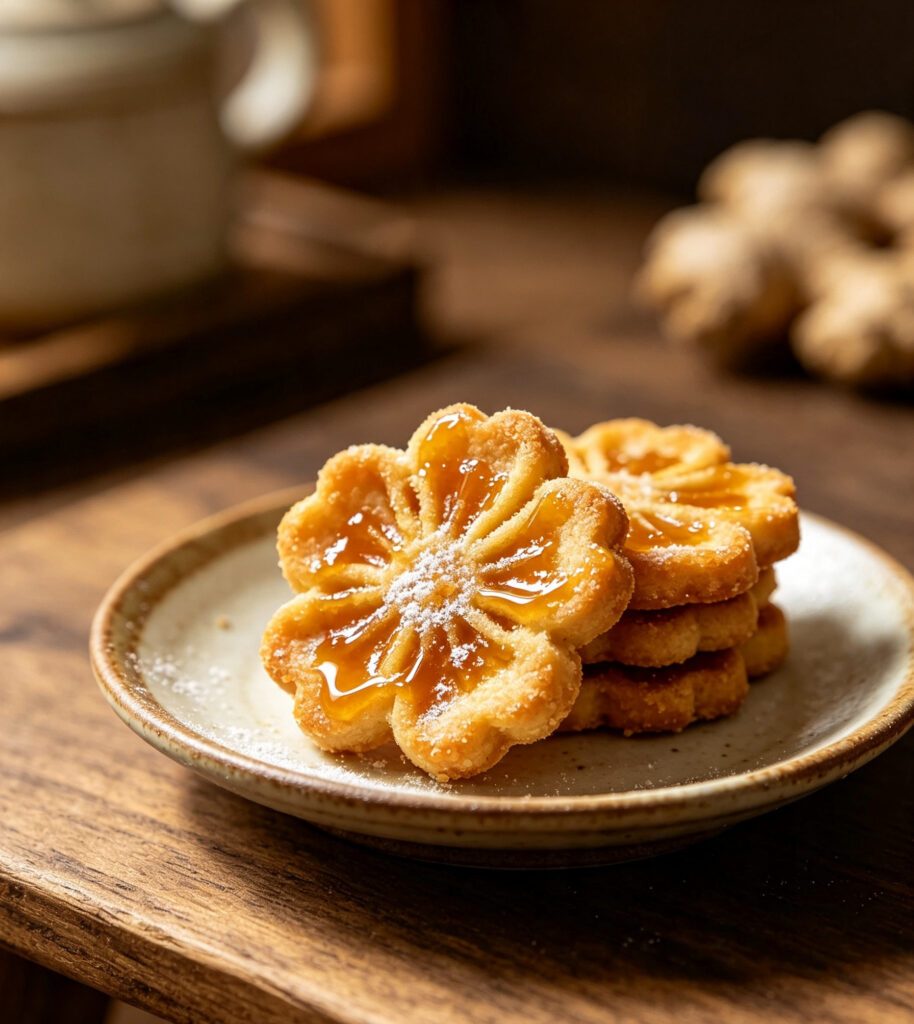
Yakgwa (Honey Ginger Cookies)
The Quirky Foodster Team
Ingredients
- Plain flour — 250 g (2 cups)
- Sesame oil — 3 tbsp (45 ml)
- Rice wine (cheongju or mirin) — 3 tbsp (45 ml)
- Fresh ginger juice (grated ginger, squeezed) — 2 tbsp (30 ml)
- Sugar — 2 tbsp (30 g)
- Salt — 1/2 tsp (3 g)
- Vegetable oil, for deep-frying
- For the syrup:
- Honey — 200 g (7 oz)
- Water — 100 ml (1/2 cup)
- Rice wine — 2 tbsp (30 ml)
- Cinnamon stick — 1
- Pine nuts, crushed, for garnish
Method
- Rub the sesame oil into the flour with your fingertips until the mixture resembles coarse crumbs.
- Combine the rice wine, ginger juice, sugar and salt, then work this liquid into the flour mixture to form a soft, slightly crumbly dough — mix gently and avoid overworking it, which can make the finished yakgwa tough.
- Cover and rest the dough for 30 minutes.
- While the dough rests, make the syrup: combine the honey, water, rice wine and cinnamon stick in a small saucepan and simmer for 5 minutes, then set aside to cool.
- Roll the dough out to about 1 cm (1/2 inch) thickness and cut into small rounds or traditional flower shapes, pricking each a few times with a fork.
- Heat vegetable oil in a deep pot to about 140°C (285°F) — a lower-than-usual frying temperature is key. Fry the pieces in batches for 8–10 minutes, until they puff slightly and turn a deep golden-brown, turning occasionally for even colour.
- Drain briefly on a rack, then submerge the warm pieces in the cooled syrup for at least 20 minutes so they absorb it fully. Garnish with crushed pine nuts before serving.
Introduction: Yakgwa, literally 'medicinal confection', is one of Korea's oldest sweets, historically believed to have health-giving properties thanks to its honey and ginger content.
Cultural Background: Yakgwa, literally 'medicinal confection', is one of Korea's oldest sweets, historically believed to have health-giving properties thanks to its honey and ginger content. Delicately patterned and soaked in a fragrant honey syrup, it has long been reserved for special occasions such as ancestral memorial rites, weddings and major holidays, and remains one of the most recognisable traditional Korean sweets.
Tips: Fry at a genuinely low, steady temperature — yakgwa needs a long, gentle fry to cook through without burning the outside before the inside is done. Let the syrup cool before soaking the fried yakgwa; soaking in hot syrup can make the coating soggy rather than glossy.
Variations: Substitute a portion of the honey syrup with jocheong (Korean rice syrup) for a slightly different sweetness and shine. Shape into small individual rounds instead of the traditional flower press for a simpler home version. Already vegetarian as written.
Storage: Store in an airtight container at room temperature for up to 2 weeks, or refrigerate for up to a month — yakgwa keeps unusually well thanks to the syrup.
Reheating: Traditionally eaten at room temperature; no reheating required.
Nutrition: Calories: 150 kcal | Protein: 2 g | Carbs: 22 g | Fat: 6 g | Fibre: 1 g | Sodium: 45 mg Per piece; estimate only.
FAQs:
Q: Why fry at such a low temperature?
A: A gentle, low-temperature fry allows the dough to cook through and slightly puff without the outside browning too quickly, which is essential for yakgwa's characteristic tender crumb.
Q: Can I skip the syrup soak?
A: The syrup soak is essential to yakgwa's identity — without it, the pastry is simply a plain fried dough rather than the glossy, sweet confection it's known as.
Q: How long does yakgwa traditionally keep?
A: Thanks to the honey syrup, which acts as a natural preservative, well-made yakgwa can keep for one to two weeks at room temperature, making it practical for holiday gifting.
- Plain flour — 250 g (2 cups)
- Sesame oil — 3 tbsp (45 ml)
- Rice wine (cheongju or mirin) — 3 tbsp (45 ml)
- Fresh ginger juice (grated ginger, squeezed) — 2 tbsp (30 ml)
- Sugar — 2 tbsp (30 g)
- Salt — 1/2 tsp (3 g)
- Vegetable oil, for deep-frying
- For the syrup:
- Honey — 200 g (7 oz)
- Water — 100 ml (1/2 cup)
- Rice wine — 2 tbsp (30 ml)
- Cinnamon stick — 1
- Pine nuts, crushed, for garnish
Please log in to leave a comment.