
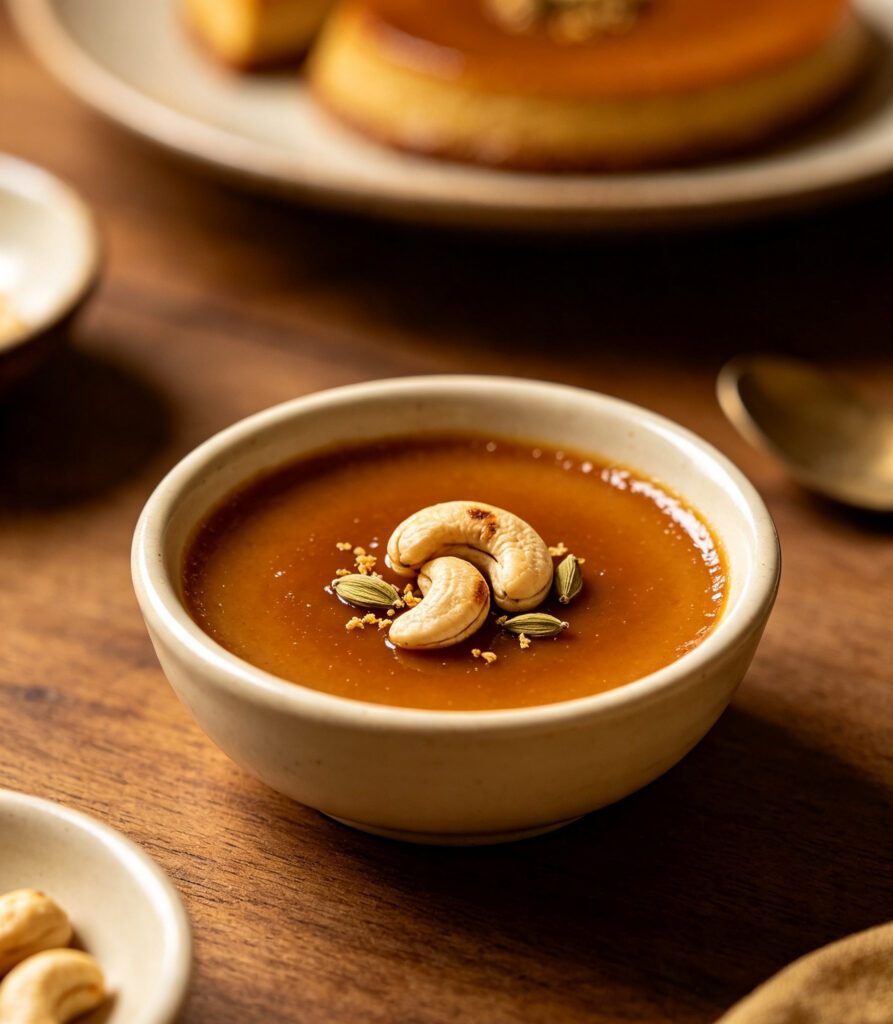
Watalappan (Coconut Jaggery Custard)
The Quirky Foodster Team
Ingredients
- Kithul jaggery or dark palm sugar, grated (7 oz) — 200 g (7.1 oz)
- Water (1/4 cup) — 60 ml (1/4 cup)
- Eggs — 4
- Thick coconut milk (2 cups) — 480 ml (2 cups)
- Ground cardamom (1/2 teaspoon) — 1 g
- Grated nutmeg (1/4 teaspoon) — 0.5 g
- Salt — 1 pinch
- Cashew nuts, halved, for garnish — 8
Method
- Melt the jaggery with the water in a small saucepan over low heat, stirring until fully dissolved. Strain to remove any impurities, then cool slightly.
- In a mixing bowl, whisk the eggs lightly (do not overbeat, as too much air causes a bubbly rather than smooth set). Add the coconut milk, cardamom, nutmeg and salt, and whisk to combine.
- Whisk in the cooled jaggery syrup until fully incorporated.
- Pour the mixture through a fine sieve into a heatproof pudding dish or individual ramekins to remove any lumps or egg strands.
- Arrange cashew halves on top for decoration.
- Set up a steamer with water at a gentle simmer. Cover the dish loosely with foil (to stop condensation dripping in) and steam over low-medium heat for 35-45 minutes, until just set with a slight wobble in the centre.
- Cool completely, then refrigerate for at least 2 hours before serving chilled or at room temperature.
Introduction: Watalappan traces its roots to Sri Lanka's Malay community, brought to the island under Dutch colonial rule, and has since become a beloved dessert across all communities, especially prominent at Eid celebrations.
Cultural Background: Watalappan traces its roots to Sri Lanka's Malay community, brought to the island under Dutch colonial rule, and has since become a beloved dessert across all communities, especially prominent at Eid celebrations. A steamed custard of coconut milk, eggs and kithul (palm) jaggery, spiced with cardamom and nutmeg, its deep caramel-brown colour and dense, silky set distinguish it from lighter Western-style custards – the jaggery is what gives it a rich, almost smoky sweetness unlike refined sugar.
Tips: Whisk the eggs gently, not vigorously – too many air bubbles will make the custard porous instead of silky smooth. Steam at a gentle simmer, not a hard boil; too much heat will curdle the custard. Straining the mixture before steaming is essential for the classic smooth, glossy finish.
Variations: A vegan version replaces eggs with cornstarch or agar as a setting agent, though the texture differs from the traditional custard. Some versions add a few sultanas or a splash of rosewater for extra fragrance. Vegetarian as written; not vegan due to eggs, though egg-free versions using agar-agar exist as a modern adaptation.
Storage: Refrigerate, covered, for up to 3 days.
Reheating: Served chilled or at room temperature; not reheated.
Nutrition: Approx. 290 kcal, 6 g protein, 18 g fat, 27 g carbohydrates, 1 g fibre per serving
FAQs:
Q: What is kithul jaggery and can I substitute it?
A: Kithul jaggery is made from the sap of the kithul (fishtail) palm and has a distinctive deep, slightly smoky sweetness; dark palm sugar or a mix of brown sugar and molasses can substitute if unavailable.
Q: Why did my watalappan turn out grainy or watery?
A: This usually means it was steamed at too high a heat, which curdles the egg custard; keep the steaming water at a gentle simmer, not a rolling boil.
Q: Can watalappan be made without a steamer?
A: Yes, a water bath (bain-marie) in the oven at 160C/325F for about 45-50 minutes works as an alternative to stovetop steaming.
- Kithul jaggery or dark palm sugar, grated (7 oz) — 200 g (7.1 oz)
- Water (1/4 cup) — 60 ml (1/4 cup)
- Eggs — 4
- Thick coconut milk (2 cups) — 480 ml (2 cups)
- Ground cardamom (1/2 teaspoon) — 1 g
- Grated nutmeg (1/4 teaspoon) — 0.5 g
- Salt — 1 pinch
- Cashew nuts, halved, for garnish — 8
Please log in to leave a comment.