
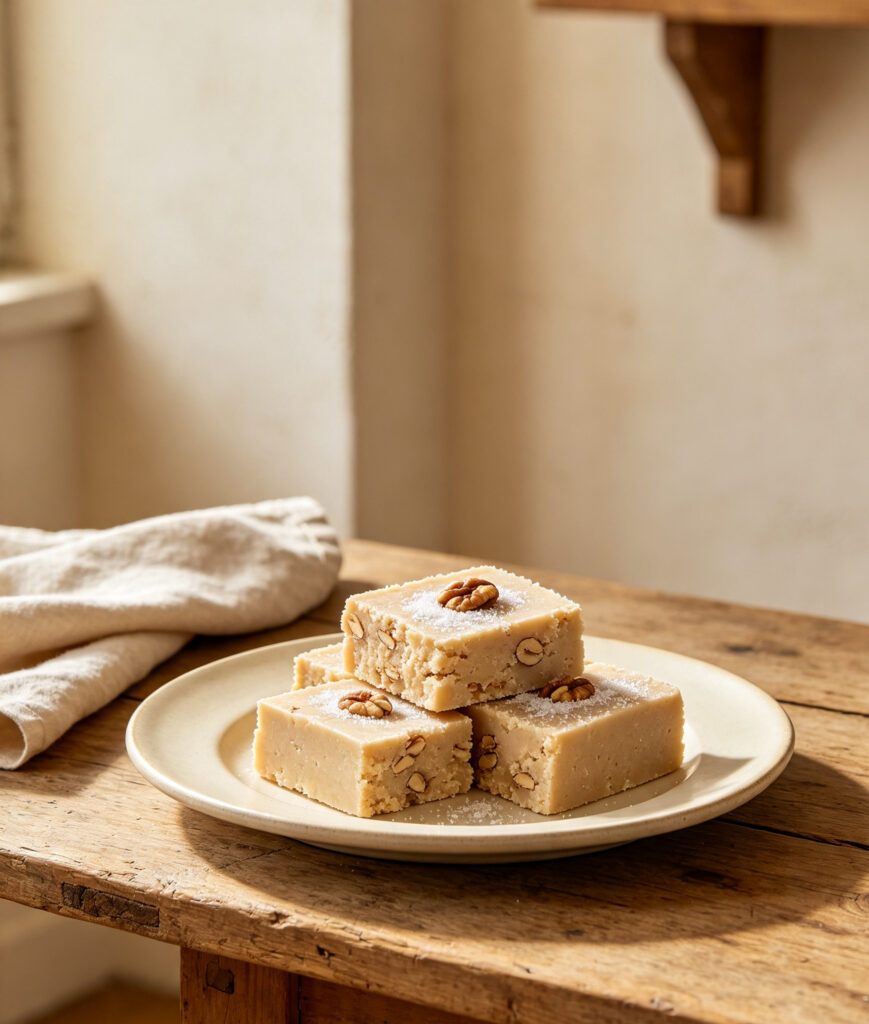
Turkmen Halva (Halwa)
The Quirky Foodster Team
Ingredients
- Unsalted butter — 200 g (1 3/4 sticks)
- Plain flour or semolina — 250 g (1 1/2 cups)
- Sugar — 250 g (1 1/4 cups)
- Water — 300 ml (1 1/4 cups)
- Ground cardamom — 1/2 tsp
- Chopped walnuts or almonds, to serve — 50 g (1/3 cup)
Method
- In a small saucepan, dissolve the sugar in the water over medium heat, then simmer for 5 minutes to make a light syrup; stir in the cardamom and set aside.
- Melt the butter in a heavy saucepan over medium-low heat.
- Add the flour and cook, stirring constantly, for 15–20 minutes until it turns a deep golden brown and smells toasted and nutty; take care not to let it burn.
- Reduce the heat to low and carefully pour in the hot syrup, stirring constantly — it will bubble and thicken quickly.
- Continue stirring for 3–4 minutes until the mixture comes together into a thick, glossy paste.
- Spread into a shallow dish, smooth the top, and scatter with chopped nuts.
- Let cool to room temperature before cutting into diamonds or squares.
Introduction: Halva holds a place of honour on the Turkmen dessert table, traditionally made by slowly cooking flour or
semolina in butter until deeply toasted and nutty, then sweetening it with a hot sugar syrup.
Cultural Background: Halva holds a place of honour on the Turkmen dessert table, traditionally made by slowly cooking flour or
semolina in butter until deeply toasted and nutty, then sweetening it with a hot sugar syrup. It's a dish
closely tied to celebrations and hospitality, often served with tea to welcome guests.
Tips: Stir constantly while toasting the flour — it can go from golden to burnt very quickly. Add the syrup carefully, as it will bubble vigorously when it hits the hot butter and flour.
Variations: Use semolina instead of flour for a slightly grainier, more traditional texture. Add a few strands of saffron to the syrup for extra fragrance. Naturally vegetarian; can be made vegan with plant-based butter.
Storage: Store in an airtight container at room temperature for up to a week.
Reheating: Best served at room temperature; not typically reheated.
FAQs:
Q: Why does the flour need to be toasted so long?
A: The long toasting develops the nutty, caramel flavour that defines halva.
Q: Can I use oil instead of butter?
A: Butter gives the best flavour, though a neutral oil can be used for a dairy-free version.
Q: How do I store leftover halva?
A: Keep it in an airtight container at room temperature; it keeps well for several days.
- Unsalted butter — 200 g (1 3/4 sticks)
- Plain flour or semolina — 250 g (1 1/2 cups)
- Sugar — 250 g (1 1/4 cups)
- Water — 300 ml (1 1/4 cups)
- Ground cardamom — 1/2 tsp
- Chopped walnuts or almonds, to serve — 50 g (1/3 cup)
Please log in to leave a comment.