
Tudor Gingerbread
The Quirky Foodster Team
Ingredients
- Honey — 200 g (1 cup)
- Fine dry white breadcrumbs — 200 g (4 cups)
- Ground ginger — 1 tbsp
- Ground cinnamon — 1 tsp
- Ground black pepper — 1/2 tsp
- Ground cloves — 1/4 tsp
- Red wine (optional, for binding and colour) — 1 tbsp
Method
- Gently warm the honey in a small saucepan over low heat until runny, taking care not to let it boil.
- In a mixing bowl, combine the breadcrumbs, ginger, cinnamon, pepper and cloves.
- Pour the warm honey over the breadcrumb mixture and stir thoroughly until well combined and the mixture holds together.
- Add the red wine, if using, a little at a time, to help bind the mixture and deepen the colour, stopping once a firm, mouldable paste forms.
- Press the mixture firmly into a decorative mould, or shape by hand into a flat block on a piece of parchment, smoothing the surface.
- Leave to firm up at room temperature for at least 4 hours, or overnight, until set firm enough to slice or turn out of the mould.
- Turn out of the mould if used, and cut into small pieces to serve.
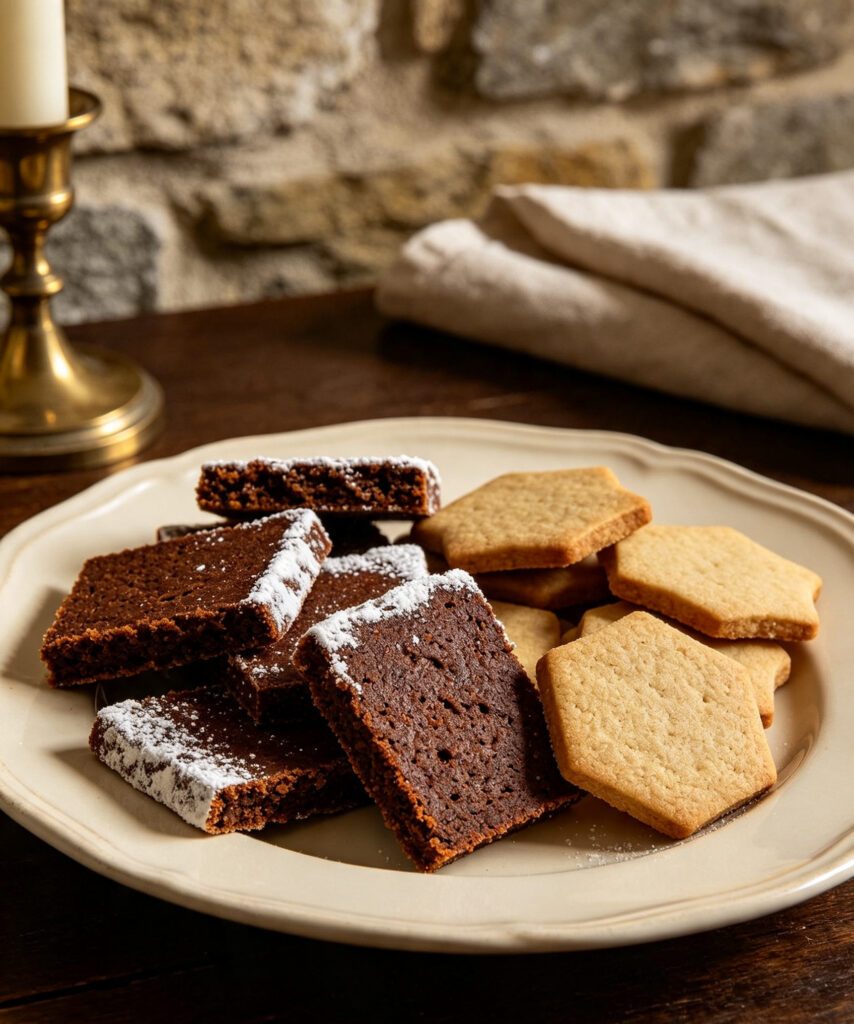
Introduction: A dense, richly spiced confection bound with honey and breadcrumbs, Tudor gingerbread was sold by street vendors and fairground stalls as a sweet, portable treat.
Cultural Background: Gingerbread had evolved considerably by the Tudor period from its earlier medieval form, which was closer to a spiced, honey-bound paste than the baked biscuit familiar today. It was commonly sold at fairs and markets, sometimes pressed into decorative wooden moulds shaped like animals, coats of arms or figures, and gilded for a festive appearance.
Tips: (cid:127) Use very fine, dry breadcrumbs for the smoothest texture; stale bread blitzed in a food processor and lightly toasted works well. (cid:127) This gingerbread firms up considerably as it cools and rests, so be patient and allow the full setting time before cutting.
Variations: (cid:127) Press whole cloves into the surface in a decorative pattern before it sets, a traditional finishing touch recorded in period sources. (cid:127) A little liquorice root powder can be added for a deeper, more complex flavour, as recorded in some Tudor recipe collections.
Storage: Store in an airtight container at room temperature for up to 3 weeks; it keeps very well due to its honey content.
Reheating: No reheating required; this gingerbread is served at room temperature.
Nutrition: Per serving (approx., 1 piece): 110 kcal, 2 g protein, 24 g carbohydrate, 0.5 g fat, 1 g fibre, 60 mg sodium.
FAQs:
Q: Is this the same as modern baked gingerbread?
A: No, this Tudor version is unbaked and set simply by resting, giving a dense, chewy texture quite different from a modern baked gingerbread biscuit or cake. (cid:127) Q: Can I speed up the setting time? A: Refrigerating the mixture will help it firm up more quickly, in about 2 hours, though resting at room temperature overnight gives the best texture and flavour development.
- Honey — 200 g (1 cup)
- Fine dry white breadcrumbs — 200 g (4 cups)
- Ground ginger — 1 tbsp
- Ground cinnamon — 1 tsp
- Ground black pepper — 1/2 tsp
- Ground cloves — 1/4 tsp
- Red wine (optional, for binding and colour) — 1 tbsp
Please log in to leave a comment.