
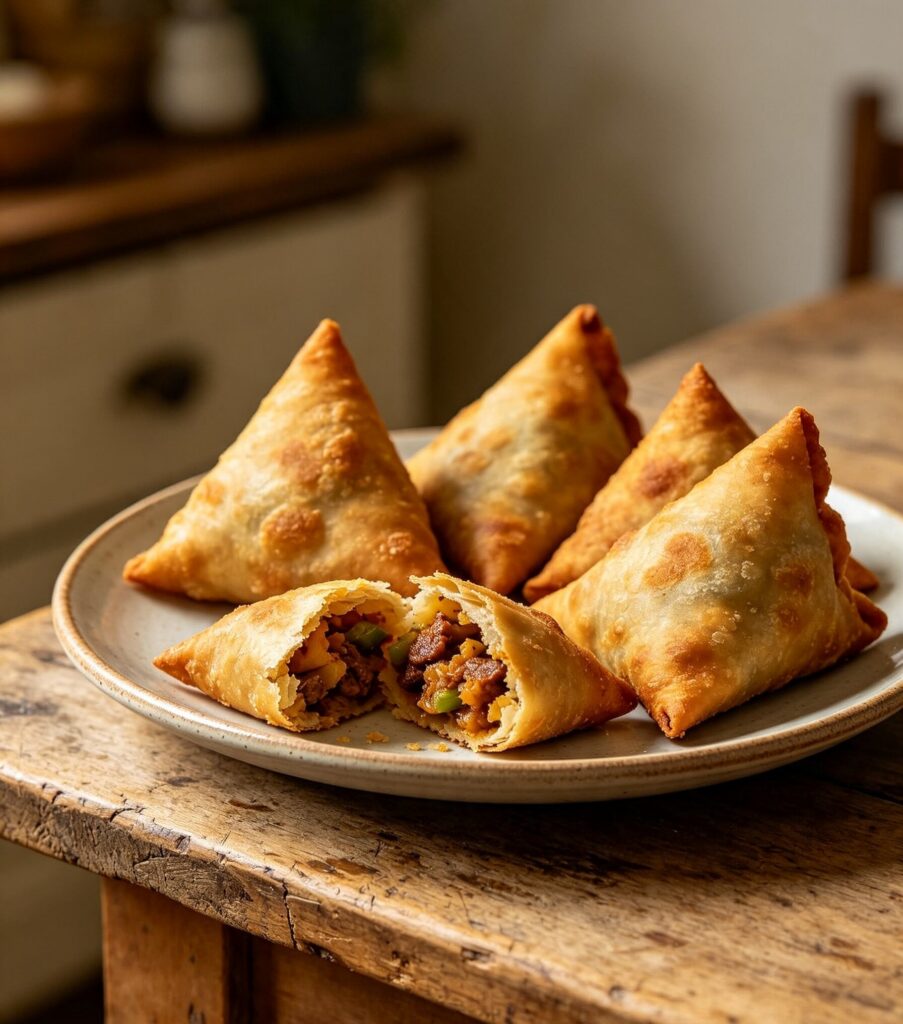
Samosa (Sambusa)
The Quirky Foodster Team
Ingredients
- Plain flour — 250 g (2 cups)
- Salt — 1/2 tsp (3 g)
- Vegetable oil, plus extra for frying — 2 tbsp (30 ml)
- Water, plus more as needed — 120 ml (1/2 cup)
- Minced beef or lamb (or 250 g mixed vegetables for a vegetarian filling) — 250 g (9 oz)
- Small onion, finely diced — 1
- Garlic, minced — 2 cloves
- Grated ginger — 1 tsp (5 g)
- Curry powder — 1 tsp (2 g)
- Ground cumin — 1/2 tsp (1 g)
- Green chili, finely chopped (optional) — 1
- Chopped coriander — 2 tbsp (8 g)
- Salt and pepper, — to taste
- Flour mixed with 2 tbsp (30 ml) water, for sealing — 1 tbsp (8 g)
Method
- Make the dough: combine flour, salt and oil, then gradually add water, kneading to a firm, smooth dough. Cover and rest for 30 minutes.
- Make the filling: heat a little oil in a pan and saute the onion, garlic and ginger until soft.
- Add the minced meat (or vegetables), curry powder, cumin and chili. Cook until the meat is browned and cooked through, or vegetables are tender.
- Stir in coriander, season with salt and pepper, and set aside to cool completely.
- Divide the dough into balls, roll each thinly, and cut into strips. Fold each strip into a cone, fill with 1-2 tablespoons of filling, and seal the edges with the flour paste to form a triangle.
- Heat oil in a deep pot to 170 C (340 F) and fry the samosas in batches for 3-4 minutes until golden and crisp.
- Drain on paper towels and serve hot.
Introduction: Samosas, known locally as sambusa, arrived in East Africa through Indian and Arab trade along the Swahili coast and have since become a beloved Kenyan snack and appetizer.
Cultural Background: Samosas, known locally as sambusa, arrived in East Africa through Indian and Arab trade along the Swahili coast and have since become a beloved Kenyan snack and appetizer. Filled with spiced minced meat or vegetables and folded into crisp triangles, they are a fixture at parties, Ramadan iftars, and street food stalls throughout Nairobi and Mombasa.
Tips: Let the filling cool fully before assembling, or the pastry will become soggy. Seal edges firmly to prevent the filling from leaking during frying. Ready-made spring roll or samosa pastry sheets can be used to save time.
Variations: A vegetarian version uses spiced potatoes, peas and carrots; a baked version can be made by brushing with oil and baking at 200 C (400 F) for 20-25 minutes. A vegetarian filling of spiced potatoes, peas and carrots is a widely enjoyed and authentic substitute for the meat filling.
Storage: Refrigerate cooked samosas in an airtight container for up to 3 days; uncooked, assembled samosas freeze well for up to 2 months.
Reheating: Reheat in an oven or air fryer at 180 C (350 F) for 8-10 minutes to restore crispness; avoid microwaving, which softens the pastry.
FAQs:
Q: Can Samosas be made ahead of time?
A: Yes, they can be assembled and frozen uncooked, then fried directly from frozen, adding a couple of extra minutes to the frying time.
Q: What is the difference between Kenyan and Indian samosas?
A: Kenyan sambusa are typically smaller and thinner-skinned, with fillings shaped by both Swahili and South Asian spicing.
- Plain flour — 250 g (2 cups)
- Salt — 1/2 tsp (3 g)
- Vegetable oil, plus extra for frying — 2 tbsp (30 ml)
- Water, plus more as needed — 120 ml (1/2 cup)
- Minced beef or lamb (or 250 g mixed vegetables for a vegetarian filling) — 250 g (9 oz)
- Small onion, finely diced — 1
- Garlic, minced — 2 cloves
- Grated ginger — 1 tsp (5 g)
- Curry powder — 1 tsp (2 g)
- Ground cumin — 1/2 tsp (1 g)
- Green chili, finely chopped (optional) — 1
- Chopped coriander — 2 tbsp (8 g)
- Salt and pepper, — to taste
- Flour mixed with 2 tbsp (30 ml) water, for sealing — 1 tbsp (8 g)
Please log in to leave a comment.