
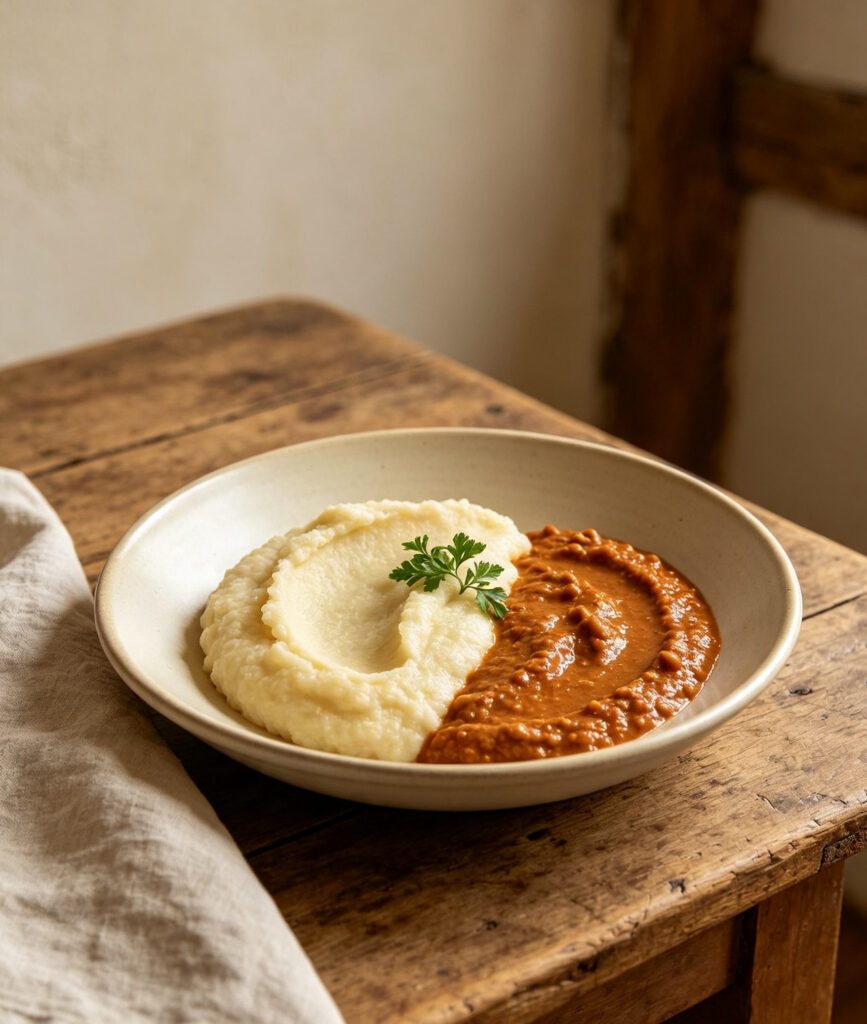
Pâte et Sauce d’Arachide (Corn Dough with Peanut Sauce)
The Quirky Foodster Team
Ingredients
- White corn flour — 500 g (4 cups)
- Water, divided — 1.5 L (6 cups)
- Chicken or beef, cut into pieces — 600 g (1.3 lb)
- Smooth natural peanut butter — 250 g (1 cup)
- Onion, chopped — 1
- Garlic, minced — 3 cloves
- Tomatoes, chopped — 2
- Tomato paste — 15 g (1 tbsp)
- Scotch bonnet pepper, whole — 1
- Vegetable oil — 30 ml (2 tbsp)
- Salt, — to taste
Method
- Make the peanut sauce first: brown the meat in oil in a saucepan over medium heat, about 8 minutes. Add onion and garlic, cooking 4 minutes, then add tomatoes and tomato paste, cooking 5 minutes more.
- Whisk peanut butter with 250 ml (1 cup) warm water until smooth, then stir into the pot with 500 ml (2 cups) water and the whole scotch bonnet pepper. Simmer 40–45 minutes, stirring occasionally, until the meat is tender and the sauce has thickened (internal temperature at least 74°C/165°F for chicken).
- While the sauce simmers, make the pâte: bring 750 ml (3 cups) water to a boil in a large heavy pot.
- In a separate bowl, mix the corn flour with 250 ml (1 cup) cold water to form a smooth paste.
- Gradually stir the corn flour paste into the boiling water, whisking constantly to avoid lumps.
- Reduce heat to low and cook, stirring vigorously and constantly with a wooden paddle, for 12–15 minutes until the mixture becomes very thick, smooth, stretchy, and pulls away cleanly from the sides of the pot (internal temperature at least 90°C/195°F).
- Remove the scotch bonnet from the sauce and season with salt to taste. Shape warm pâte into smooth balls or mounds using a wet spoon, and serve immediately alongside the peanut sauce.
Introduction: Pâte is Togo’s everyday staple starch — a smooth, stretchy dough made from corn flour, similar to Ghanaian banku or Beninese pâte.
Cultural Background: Pâte is Togo’s everyday staple starch — a smooth, stretchy dough made from corn flour, similar to Ghanaian banku or Beninese pâte. Served alongside a rich peanut sauce with meat or fish, it forms the backbone of daily meals across the country and is traditionally eaten by hand, using small portions to scoop up the sauce.
Tips: Stirring the pâte vigorously and continuously is essential — stopping partway can result in a lumpy, uneven texture rather than the desired smooth, stretchy consistency.
Variations: Cassava flour or a cassava-corn flour blend can be used instead of pure corn flour for a slightly different, equally traditional texture.
Storage: Pâte is best eaten fresh, as it firms up considerably once cooled; the peanut sauce keeps refrigerated for up to 4 days and freezes well for up to 3 months.
Reheating: Reheat pâte by steaming briefly or microwaving with a damp cloth over it to restore softness; reheat sauce gently on the stovetop with a splash of water.
FAQs:
Q: Why is my pâte lumpy?
A: Adding the flour paste too quickly or not stirring continuously during cooking are the most common causes — stir constantly and vigorously throughout.
Q: Can I make pâte in a stand mixer with a dough hook?
A: Some cooks do use a stand mixer for the vigorous stirring stage, though a traditional wooden paddle gives the most authentic texture and control.
Q: Is this dish naturally glutenfree?
A: Yes, both the corn-based pâte and the peanut sauce are naturally gluten-free.
- White corn flour — 500 g (4 cups)
- Water, divided — 1.5 L (6 cups)
- Chicken or beef, cut into pieces — 600 g (1.3 lb)
- Smooth natural peanut butter — 250 g (1 cup)
- Onion, chopped — 1
- Garlic, minced — 3 cloves
- Tomatoes, chopped — 2
- Tomato paste — 15 g (1 tbsp)
- Scotch bonnet pepper, whole — 1
- Vegetable oil — 30 ml (2 tbsp)
- Salt, — to taste
Please log in to leave a comment.