
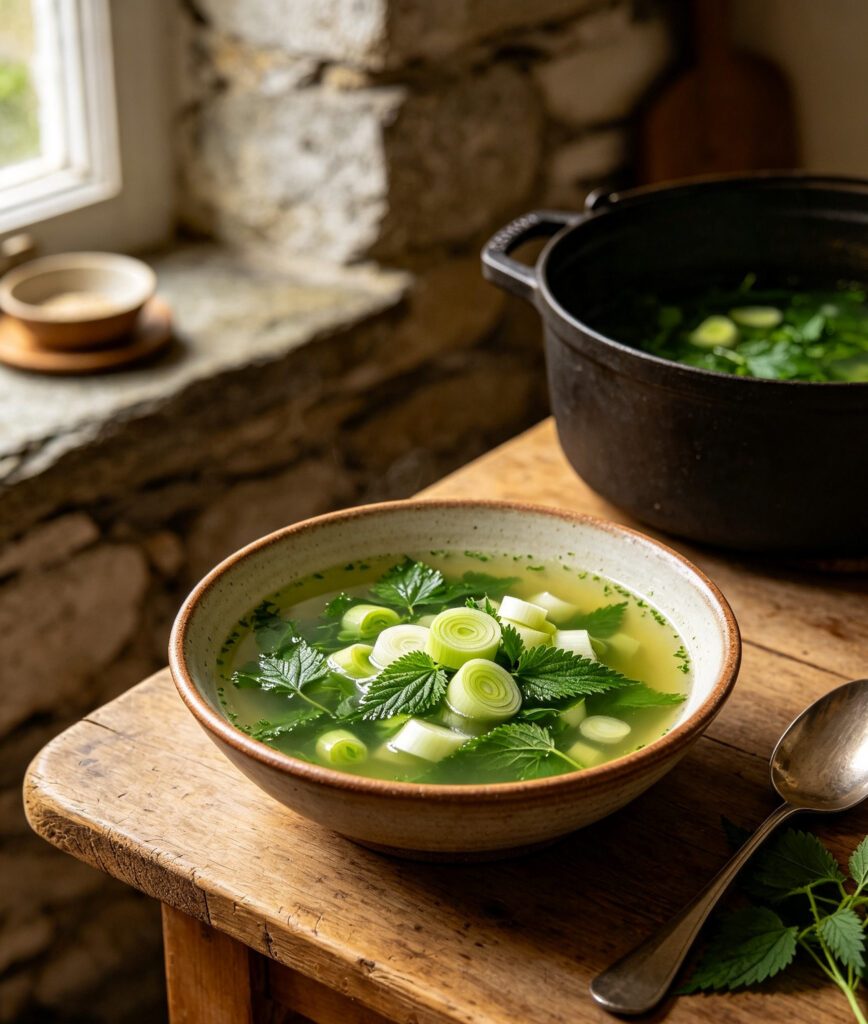
Nettle and Leek Broth
The Quirky Foodster Team
Ingredients
- Young nettle tops (wear gloves when handling raw) — 200 g (7 oz)
- Leeks, sliced — 2
- Water or light broth — 1 L (4 cups)
- Salt — 1 pinch
Method
- Wearing gloves, rinse the nettle tops thoroughly in cold water.
- Bring the water or broth to a simmer in the pot and add the sliced leeks.
- Simmer for 8 minutes, until the leeks begin to soften.
- Add the nettle tops (the leaves lose their sting once cooked) and simmer a further 8-10 minutes, until wilted and tender.
- Season with salt and serve hot.
Introduction: A bright, mineral-rich broth of young nettle tops simmered with leeks, one of the earliest fresh greens available after winter in early Ireland.
Cultural Background: Nettles are among the most consistently referenced wild plants in early Irish sources and folklore, valued as one of the first fresh greens of spring, and their use as a cooked pot-herb continues in Irish tradition into the present day; leeks and onions are separately well attested in early Irish garden cultivation.
Tips: Always wear gloves when handling raw nettles; the sting disappears completely once cooked. Use only young, tender nettle tops from the top few inches of the plant; older leaves are tougher and more bitter.
Variations: Naturally vegan as written when made with water. A richer version can be made with a little butter stirred in at the end, reflecting dairy’s wide everyday use.
Storage: Refrigerate covered for up to 2 days.
Reheating: Reheat gently in a pot over low heat for 5 minutes; avoid prolonged reheating, which dulls the bright colour and flavour.
Nutrition: Per serving (approx.): 70 kcal, 4 g protein, 9 g carbohydrate, 1 g fat, 3 g fibre.
FAQs:
Q: Is it safe to eat nettles?
A: Yes, once cooked the sting is completely neutralised; only handle raw nettles with gloves before cooking.
Q: When is the best time to gather nettles?
A: Young, tender spring growth is best; older, taller nettle plants become tougher and more bitter and are best avoided for this dish.
- Young nettle tops (wear gloves when handling raw) — 200 g (7 oz)
- Leeks, sliced — 2
- Water or light broth — 1 L (4 cups)
- Salt — 1 pinch
Please log in to leave a comment.