
Breakfast
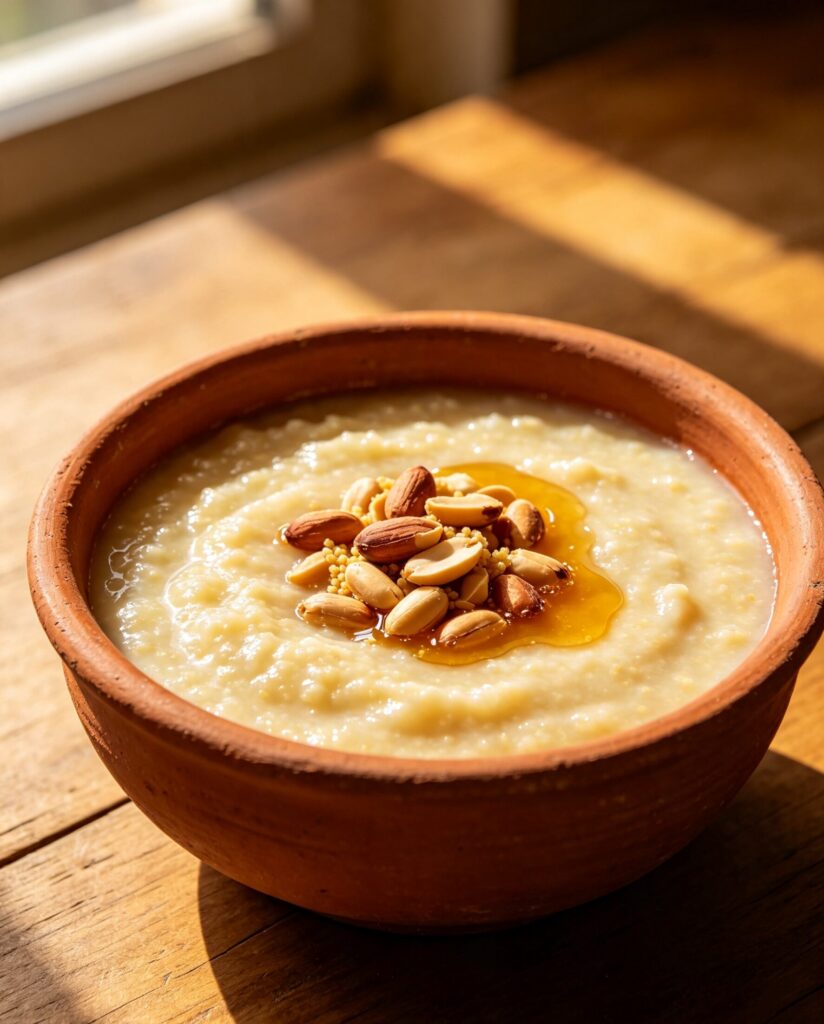
Ndogu (Fermented Millet Porridge)
The Quirky Foodster Team
Ingredients
- 250 g (1 1/3 cups) coarse millet flour
- 1 litre (4 cups) water, divided
- 120 ml (1/2 cup) fresh milk or coconut milk
- 3 tbsp sugar, or to taste
- 1/4 tsp salt
Method
- The night before, mix the millet flour with 250ml (1 cup) of the water into a thin paste, cover and leave at room temperature to ferment lightly for 8-12 hours.
- The next morning, bring the remaining 750ml (3 cups) water to a boil in a saucepan.
- Whisk the fermented millet paste into the boiling water, stirring constantly to avoid lumps.
- Simmer for 8-10 minutes, stirring frequently, until thickened to a smooth pourable porridge.
- Stir in the milk, sugar and salt, and warm through for 1-2 minutes before serving.
Introduction: Ndogu is a lightly fermented millet porridge eaten across Gambian villages and towns, often prepared the night before so the grain ferments slightly overnight, giving the porridge a gentle tang.
Cultural Background: Ndogu is a lightly fermented millet porridge eaten across Gambian villages and towns, often prepared the night before so the grain ferments slightly overnight, giving the porridge a gentle tang. It is a staple start to the day for schoolchildren and farmers alike.
Tips: A shorter ferment (a few hours) gives a milder porridge for those new to the tang. Keep whisking as it thickens to prevent sticking to the pan base.
Variations: Swap cow's milk for coconut milk for a dairy-free, slightly sweet version. Some families add a pinch of ground cloves for warmth.
Storage: Best eaten fresh; leftover porridge keeps in the fridge for 1 day and thickens further on cooling.
Reheating: Reheat gently on the stovetop with a splash of water or milk to loosen, stirring constantly.
Nutrition: Approx. 190 kcal, 4g protein, 3g fat, 36g carbohydrate per serving.
FAQs:
Q: Why ferment the millet first?
A: Fermentation softens the grain, deepens flavour, and is believed traditionally to aid digestion.
Q: Can I skip fermentation entirely?
A: Yes, though the porridge will taste flatter and lack the characteristic gentle sourness.
Please log in to leave a comment.