
Modaka (Steamed Rice Flour Dumplings with Jaggery and Sesame)
The Quirky Foodster Team
Ingredients
- Rice flour — 200 g (1.3 cups)
- Water — 250 ml (1 cup)
- Ghee, plus extra for greasing — 1/4 tsp
- Rock salt — 1/4 tsp
- Sesame seeds, toasted and coarsely ground — 100 g (0.75 cup)
- Jaggery, grated — 100 g (0.5 cup)
- Ground cardamom — 1/4 tsp
Method
- For the filling, combine the ground toasted sesame seeds and grated jaggery in a small saucepan over low heat, stirring until the jaggery melts and coats the sesame evenly, about 3-4 minutes.
- Stir in the ground cardamom, then remove from the heat and set aside to cool completely.
- For the dough, bring the water, ghee and salt to the boil in a separate saucepan.
- Remove from the heat and stir in the rice flour all at once, mixing quickly until a rough dough forms.
- Once cool enough to handle, knead the dough briefly until smooth, keeping it covered with a damp cloth to prevent it from drying out.
- Divide the dough into small balls, then flatten each into a small disc in your palm.
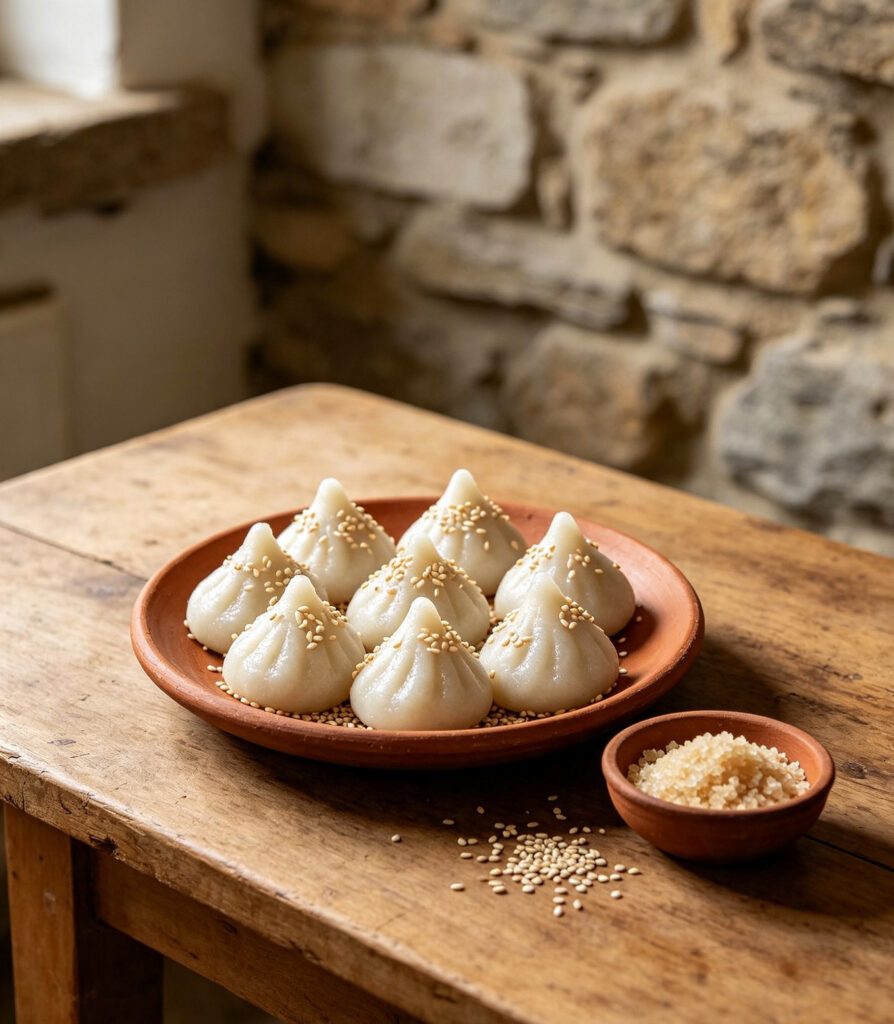
- Place a spoonful of the cooled sesame and jaggery filling in the centre of each disc, then gather the edges up and around the filling, pinching to seal into a small dumpling.
- Lightly grease a steamer basket, arrange the dumplings inside without touching, and steam over simmering water for 12-15 minutes, until the dough looks slightly translucent and is cooked through.
- Serve warm.
Introduction: Small dumplings of rice flour dough filled with sweetened sesame and jaggery, then steamed until soft, modaka is a sweet with deep roots in ancient Indian textual tradition, its name appearing across early Sanskrit sources.
Cultural Background: The term modaka appears in ancient Sanskrit lexicons and literature describing sweet, ball-shaped confections, indicating the dish’s long history within the Indian subcontinent’s culinary tradition. This recipe presents the filling and steaming technique attested for this period, using sesame seeds and jaggery, a pairing well documented among the Mauryan Empire’s staple sweeteners and oil-seed crops, ahead of the coconut-based fillings that became more common in some regions in later centuries.
Tips: (cid:127) Keep the dough covered with a damp cloth while shaping the dumplings, as rice flour dough dries out and cracks quickly if left exposed to air. (cid:127) Do not overfill the dumplings, as this can cause them to split open during steaming.
Variations: (cid:127) A little grated fresh coconut can be added to the sesame and jaggery filling for a variation that became especially popular in later centuries. (cid:127) The dumplings can be lightly pan-fried in ghee after steaming for a version with a crisp exterior.
Storage: Store in an airtight container in the refrigerator for up to 2 days.
Reheating: Reheat by steaming for 4-5 minutes until warmed through, as this keeps the dough soft; a microwave can also be used briefly, covered with a damp cloth.
Nutrition: Per serving (approx., 2 dumplings): 210 kcal, 4 g protein, 34 g carbohydrate, 7 g fat, 2 g fibre, 100 mg sodium.
FAQs:
Q: Can I make the dough ahead of time?
A: The dough is best shaped while still warm and pliable; if it cools and stiffens, knead in a few drops of warm water to restore its workability. (cid:127) Q: Why do my dumplings crack while steaming? A: Cracking usually indicates the dough was too dry when shaped, or the filling parcel was overfilled; ensure the dough is adequately moist and pinch the seals firmly closed.
- Rice flour — 200 g (1.3 cups)
- Water — 250 ml (1 cup)
- Ghee, plus extra for greasing — 1/4 tsp
- Rock salt — 1/4 tsp
- Sesame seeds, toasted and coarsely ground — 100 g (0.75 cup)
- Jaggery, grated — 100 g (0.5 cup)
- Ground cardamom — 1/4 tsp
Please log in to leave a comment.